 Back
BackOrganic Chemistry Midterm Practice Guidance
Study Guide - Smart Notes
 Tailored notes based on your materials, expanded with key definitions, examples, and context.
Q1. What will be the major product/products of the following reactions? (Mechanism not required; consider stereochemistry.)
Background
Topic: Reaction Products & Stereochemistry
This question tests your ability to predict the major organic product(s) of a reaction, including consideration of stereochemistry. You should be familiar with reaction types (addition, elimination, substitution), regioselectivity, and stereoselectivity.
Key Terms:
Major product: The most abundant product formed under given conditions.
Stereochemistry: The spatial arrangement of atoms in molecules and its effect on the outcome of reactions.
Regioselectivity: Preference for one direction of chemical bond making or breaking over all other possible directions.
Markovnikov/anti-Markovnikov: Rules for predicting the outcome of addition reactions.
Step-by-Step Guidance
Identify the type of reaction (e.g., addition, elimination, substitution) based on the reactants and reagents.
Determine the regioselectivity (Markovnikov or anti-Markovnikov) and predict which atom/group will add to which carbon.
Consider the stereochemistry: Will the product be syn or anti addition? Will there be chiral centers or E/Z isomers?
Draw the possible products, indicating stereochemistry where relevant.
Try solving on your own before revealing the answer!
Q2. List the following molecules in order of increasing stability (1 – most stable; 4 – least stable). Explain.
Background
Topic: Alkene Stability
This question tests your understanding of factors affecting alkene stability, such as substitution, conjugation, and cis/trans (E/Z) isomerism.
Key Terms:
Alkene: Hydrocarbon with a carbon-carbon double bond.
Substitution: Number of alkyl groups attached to the double bond.
Conjugation: Alternating double and single bonds, which increases stability.
E/Z isomerism: Geometric isomerism in alkenes.
Step-by-Step Guidance
Count the number of alkyl substituents on each alkene; more substitution generally means greater stability.
Check for conjugation or resonance effects, which can further stabilize the molecule.
Compare E/Z isomers; E (trans) is usually more stable than Z (cis) due to less steric hindrance.
Rank the molecules from most to least stable based on these factors.
Try solving on your own before revealing the answer!
Q3. Which of the following reactions:
A) Is the most kinetically stable? Explain.
B) Is thermodynamically and kinetically unstable? Explain.
C) Is thermodynamically stable and kinetically unstable? Explain.
D) Is thermodynamically and kinetically stable? Explain.
E) Is spontaneous? Explain.
F) Is not spontaneous? Explain.
G) Can occur at low temperatures? Explain.
H) Can only occur at high temperatures? Explain.
Background
Topic: Reaction Thermodynamics and Kinetics
This question tests your understanding of the difference between kinetic and thermodynamic stability, spontaneity, and temperature dependence of reactions.
Key Terms and Formulas:
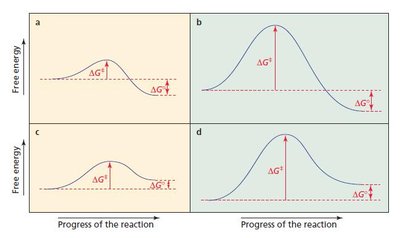
Kinetic stability: Related to activation energy ().
Thermodynamic stability: Related to free energy change ().
Spontaneity: Determined by the sign of (negative is spontaneous).
Activation energy: The energy barrier for a reaction.
Step-by-Step Guidance
Examine the free energy diagrams for each reaction. Identify (thermodynamic) and (kinetic) for each.
Determine which reactions have low activation energy (kinetically stable) and which have high activation energy (kinetically unstable).
Assess the overall free energy change () to determine thermodynamic stability and spontaneity.
Consider temperature effects: Reactions with high activation energy may require higher temperatures to proceed.
Try solving on your own before revealing the answer!
Q4. List the following carbocations in order of increasing stability (1 – most stable; 4 – least stable). Explain.
Background
Topic: Carbocation Stability
This question tests your understanding of carbocation stability, which depends on substitution, resonance, and inductive effects.
Key Terms:
Carbocation: Positively charged carbon atom.
Substitution: Tertiary > secondary > primary > methyl.
Resonance stabilization: Delocalization of charge increases stability.
Inductive effects: Electron-donating groups stabilize carbocations.
Step-by-Step Guidance
Identify the degree of substitution for each carbocation (tertiary, secondary, primary).
Check for resonance stabilization (can the positive charge be delocalized?).
Consider inductive effects from nearby groups.
Rank the carbocations from most to least stable based on these factors.
Try solving on your own before revealing the answer!
Q5. Propose a plausible mechanism for the following transformations.
Background
Topic: Reaction Mechanisms
This question tests your ability to propose stepwise mechanisms for organic transformations, including electron flow (arrow-pushing).
Key Terms:
Mechanism: Stepwise description of how reactants convert to products.
Arrow-pushing: Shows movement of electrons.
Intermediates: Species formed during the reaction.
Step-by-Step Guidance
Identify the starting material and product.
Determine the type of reaction (addition, elimination, substitution, rearrangement).
Draw each step of the mechanism, using curved arrows to show electron movement.
Label intermediates and transition states where relevant.
Try solving on your own before revealing the answer!
Q6. Mechanisms and products for reactions of (E)-3-methyl-2-pentene and trans-2-butene with various reagents.
Background
Topic: Alkene Reaction Mechanisms
This question tests your ability to draw arrow-pushing mechanisms and predict products for alkene reactions with HBr, Cl2 in water, H2SO4, Br2, borane/THF, and peroxy-acid.
Key Terms:
Arrow-pushing: Curved arrows showing electron movement.
Markovnikov/anti-Markovnikov addition: Regioselectivity of addition reactions.
Syn/anti addition: Stereochemistry of addition reactions.
Reaction intermediates: Carbocations, bromonium ions, etc.
Step-by-Step Guidance
For each reaction, identify the reagent and predict the type of addition (Markovnikov, anti-Markovnikov, syn, anti).
Draw the starting alkene and use curved arrows to show electron movement for each step.
Identify intermediates (e.g., carbocation, bromonium ion) and show how the product(s) are formed.
Consider stereochemistry and draw all possible products, indicating their relationship (e.g., enantiomers, diastereomers).
Try solving on your own before revealing the answer!
