 Back
BackOrganic Chemistry Practice Exam 3 – Step-by-Step Study Guidance
Study Guide - Smart Notes
 Tailored notes based on your materials, expanded with key definitions, examples, and context.
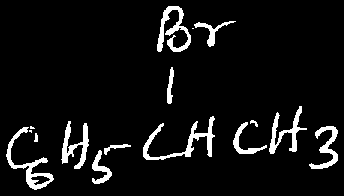
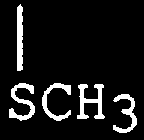
Q1. When (S)-1-bromo-1-phenylethane undergoes an SN1 reaction with CH3SH, the product is the compound shown below. What is the configuration of the product?
Background
Topic: Stereochemistry of SN1 Reactions
This question tests your understanding of how SN1 reactions affect the stereochemistry at a chiral center, specifically whether the product retains, inverts, or forms a mixture of configurations.
Key Terms and Concepts:
SN1 Reaction: A two-step nucleophilic substitution mechanism involving carbocation formation.
Chiral Center: A carbon atom bonded to four different groups, leading to stereoisomers (R/S).
Inversion/Retention: Refers to whether the configuration at the chiral center changes (inverts) or stays the same (retains).
R/S Configuration: Absolute configuration assigned by Cahn-Ingold-Prelog rules.
Step-by-Step Guidance
Identify the starting material: (S)-1-bromo-1-phenylethane. Assign priorities to the groups attached to the chiral center using the Cahn-Ingold-Prelog rules.
Understand the SN1 mechanism: The reaction proceeds via formation of a carbocation intermediate after the bromide leaves.
Recognize that the carbocation intermediate is planar, allowing the nucleophile (CH3SH) to attack from either side, potentially leading to both R and S configurations in the product.
Recall that SN1 reactions typically produce a mixture of stereoisomers, but due to ion-pair effects, there is often slightly more inversion than retention at the chiral center.
Examine the product structure (see image below) and determine which configuration(s) are possible based on the mechanism.
Try solving on your own before revealing the answer!
Final Answer: C) a mixture of R and S with slightly more S than R
SN1 reactions at a chiral center produce both R and S configurations, but due to ion-pair effects, there is slightly more inversion (S) than retention (R).
Q2. Which of the following carbocations is likely to rearrange?
Background
Topic: Carbocation Stability and Rearrangement
This question tests your ability to identify carbocations that are prone to rearrangement (hydride or alkyl shifts) to form more stable carbocations.
Key Terms and Concepts:
Carbocation: A positively charged carbon atom with only three bonds.
Rearrangement: Movement of hydride or alkyl groups to stabilize the carbocation.
Stability Order: Tertiary > Secondary > Primary > Methyl.
Step-by-Step Guidance
Examine each carbocation structure (see image below) and determine the degree of substitution (primary, secondary, tertiary).
Identify carbocations that are not already tertiary or resonance-stabilized, as these are most likely to rearrange.
Look for carbocations adjacent to more substituted carbons or those that could become stabilized by resonance after rearrangement.
Consider possible hydride or alkyl shifts for each carbocation to see if a more stable carbocation can be formed.

Try solving on your own before revealing the answer!
Final Answer: II
Carbocation II is likely to rearrange because it can form a more stable tertiary carbocation via a hydride shift.
Q3. Which of the following correctly describes intermediates and/or transition states?
Background
Topic: Reaction Coordinate Diagrams
This question tests your understanding of the difference between intermediates and transition states in reaction mechanisms.
Key Terms and Concepts:
Transition State: The highest energy point along the reaction pathway; bonds are partially formed/broken.
Intermediate: A species formed during the reaction that is lower in energy than the transition state and exists for a measurable time.
Reaction Coordinate Diagram: A plot of energy vs. reaction progress.
Step-by-Step Guidance
Recall that transition states are not isolable and occur at energy maxima on the reaction coordinate diagram.
Intermediates are local minima between transition states and can sometimes be isolated.
Transition states have partially formed bonds, while intermediates have fully formed bonds.
Review the answer choices and match them to these definitions.
Try solving on your own before revealing the answer!
Final Answer: D) Transition states have partially formed bonds whereas intermediates have fully formed bonds
This is the key distinction between transition states and intermediates.
Q4. Which of the following is an isolated diene?
Background
Topic: Types of Dienes
This question tests your ability to distinguish between isolated, conjugated, and cumulated dienes based on their structures.
Key Terms and Concepts:
Diene: A compound with two double bonds.
Isolated Diene: Double bonds separated by more than one single bond.
Conjugated Diene: Double bonds separated by one single bond.
Cumulated Diene: Double bonds sharing a carbon atom.
Step-by-Step Guidance
Examine the structures of the dienes provided (see image below).
Identify which structure has double bonds separated by more than one single bond (isolated diene).
Compare with conjugated and cumulated dienes to ensure correct identification.

Try solving on your own before revealing the answer!
Final Answer: The first structure is an isolated diene
It has two double bonds separated by more than one single bond.
