Back
BackOrganic Chemistry Practice: Naming Cycloalkanes and Arenes
Study Guide - Smart Notes
 Tailored notes based on your materials, expanded with key definitions, examples, and context.
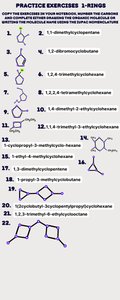
Q1. Name the cycloalkane structures shown in the worksheet (e.g., 1,2-dimethylcyclopentane).
Background
Topic: Nomenclature of Cycloalkanes
This question tests your ability to apply IUPAC rules for naming cycloalkanes, including identifying substituents, numbering the ring, and assigning locants.
Key Terms and Formulas
Cycloalkane: A saturated hydrocarbon ring (e.g., cyclopentane, cyclohexane).
Substituent: An atom or group attached to the ring (e.g., methyl, ethyl).
Locant: The number assigned to a carbon in the ring to indicate the position of a substituent.
IUPAC Naming Steps:
Identify the parent ring (e.g., cyclopentane).
Identify and name substituents.
Number the ring to give substituents the lowest possible locants.
Combine substituent names and locants with the parent ring name.
Step-by-Step Guidance
Examine the structure and identify the parent cycloalkane (e.g., cyclopentane, cyclohexane).
Identify all substituents attached to the ring (e.g., methyl, ethyl groups).
Number the ring carbons so that the substituents receive the lowest possible numbers. Start numbering at the carbon with the highest priority substituent.
Assign locants to each substituent and list them in alphabetical order if there are multiple types.
Combine the substituent names and locants with the parent ring name to form the complete IUPAC name.
Try solving on your own before revealing the answer!
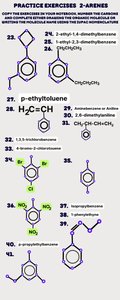
Q2. Name the aromatic (arene) structures shown in the worksheet (e.g., 2-ethyl-1,4-dimethylbenzene).
Background
Topic: Nomenclature of Arenes (Aromatic Compounds)
This question tests your ability to name aromatic compounds using IUPAC rules, including identifying substituents, their positions, and using common names for some arenes.
Key Terms and Formulas
Arene: Aromatic hydrocarbon (e.g., benzene, toluene).
Substituent: Atom or group attached to the aromatic ring (e.g., methyl, ethyl, halogens).
Locant: Number assigned to a ring carbon to indicate substituent position.
IUPAC Naming Steps:
Identify the parent aromatic ring (e.g., benzene).
Identify and name substituents.
Assign locants to substituents, starting from the highest priority group.
Use common names for some arenes (e.g., toluene, aniline) when appropriate.
Combine substituent names and locants with the parent ring name.
Step-by-Step Guidance
Examine the aromatic structure and identify the parent ring (e.g., benzene, toluene).
Identify all substituents attached to the ring (e.g., methyl, ethyl, halogens).
Assign locants to each substituent, starting from the highest priority group and following IUPAC rules for numbering.
List substituents in alphabetical order if there are multiple types, and use common names when appropriate.
Combine the substituent names and locants with the parent ring name to form the complete IUPAC name.
Try solving on your own before revealing the answer!