 Back
BackOrganic Chemistry Practice Problems: Step-by-Step Guidance
Study Guide - Smart Notes
 Tailored notes based on your materials, expanded with key definitions, examples, and context.
Q1. Condensed Formula to Bond-Line Thinking
Background
Topic: Structural Representation and Nomenclature
This question tests your ability to interpret condensed structural formulas, identify the longest carbon chain, recognize alkyl substituents, convert to bond-line notation, and determine the molecular formula.
Key Terms and Formulas:
Condensed structural formula: A compact way to represent organic molecules.
Bond-line formula: Simplified drawing where lines represent bonds and vertices represent carbon atoms.
Alkyl substituent: A branch off the main carbon chain.
Step-by-Step Guidance
Break down the condensed formula: CH3CH2CH(CH3)CH2CH3. Identify each group and how they connect.
Find the longest continuous carbon chain by counting the main backbone carbons.
Locate the alkyl substituent (the group in parentheses) and determine its position on the chain.
Set up the bond-line formula by drawing the main chain and adding the substituent at the correct carbon.
Try solving on your own before revealing the answer!
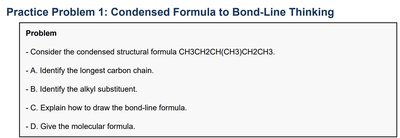
Final Answer:
The longest chain is five carbons (pentane), with a methyl group on the third carbon. The bond-line formula shows a zig-zag with a branch at the third vertex. The molecular formula is C6H14.
Q2. Alkyl Halide Degree and Physical Properties
Background
Topic: Functional Groups and Physical Properties
This question tests your understanding of alkyl halides, their classification, polarity, and intermolecular forces.
Key Terms and Formulas:
Alkyl halide: An organic compound containing a halogen atom bonded to an alkyl group.
Primary, secondary, tertiary: Classification based on the carbon to which the halogen is attached.
Polarity: Determined by electronegativity differences and molecular structure.
Intermolecular forces: Includes dipole-dipole, London dispersion, and hydrogen bonding.
Step-by-Step Guidance
Identify the functional group in (CH3)3CCl: Look for the halogen (Cl) attached to a carbon.
Classify the alkyl halide: Determine if the carbon bonded to Cl is primary, secondary, or tertiary.
Compare polarity: Consider the structure and electronegativity to predict if (CH3)3CCl is more polar than pentane.
Predict intermolecular forces: Analyze which molecule has stronger forces based on structure and functional groups.
Try solving on your own before revealing the answer!
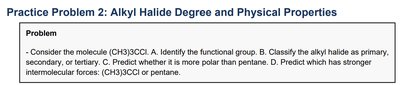
Final Answer:
(CH3)3CCl is a tertiary alkyl halide. It is more polar than pentane and has stronger intermolecular forces due to the presence of the halogen.
Q3. Protic vs. Aprotic and Reaction Understanding
Background
Topic: Solvent Classification and Hydrogen Bonding
This question tests your ability to classify solvents as protic or aprotic and understand their hydrogen bonding capabilities.
Key Terms and Formulas:
Protic solvent: Can donate a hydrogen bond (has O-H or N-H).
Aprotic solvent: Cannot donate a hydrogen bond but may accept one.
Hydrogen bond donor/acceptor: Donor has a hydrogen attached to electronegative atom; acceptor has lone pairs.
Step-by-Step Guidance
Examine each molecule: Methanol (CH3OH), acetone (CH3COCH3), DMSO ((CH3)2SO).
Identify if each can donate or accept hydrogen bonds based on their structure.
Classify as protic or aprotic: Look for O-H or N-H bonds for protic.
Explain which can donate and which can accept hydrogen bonds.
Try solving on your own before revealing the answer!
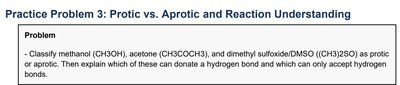
Final Answer:
Methanol is protic and can donate hydrogen bonds. Acetone and DMSO are aprotic and can accept hydrogen bonds but cannot donate.
Q4. Isomers Containing a sec-Butyl Group
Background
Topic: Isomerism and Alkyl Groups
This question tests your understanding of constitutional isomers and the sec-butyl group in C6H14.
Key Terms and Formulas:
Constitutional isomers: Compounds with same formula but different connectivity.
sec-Butyl group: A four-carbon group attached at the second carbon.
Step-by-Step Guidance
Draw the sec-butyl group and attach it to different positions in C6H14.
Check for unique connectivity to ensure each isomer is distinct.
Count the number of possible constitutional isomers with a sec-butyl group.
Try solving on your own before revealing the answer!

Final Answer:
There are two constitutional isomers of C6H14 that possess a sec-butyl group.
Q5. Sigma Bonds in CH3-C(=O)-CH2-C≡CH
Background
Topic: Bond Counting and Structural Analysis
This question tests your ability to count sigma bonds in a molecule with single, double, and triple bonds.
Key Terms and Formulas:
Sigma bond (σ): The first bond formed between two atoms.
Double bond: One sigma and one pi bond.
Triple bond: One sigma and two pi bonds.
Step-by-Step Guidance
Draw the structure for CH3-C(=O)-CH2-C≡CH.
Identify all single, double, and triple bonds in the molecule.
Count the sigma bonds: Each single bond is a sigma bond; double and triple bonds contain one sigma bond each.
Add up the total number of sigma bonds from all connections.
Try solving on your own before revealing the answer!
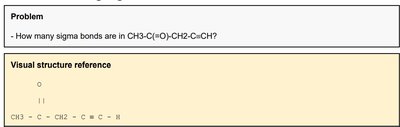
Final Answer:
There are 10 sigma bonds in CH3-C(=O)-CH2-C≡CH.
Q6. Constitutional Isomers with C=C and Methyl Branch (C5H10)
Background
Topic: Isomerism and Bond-Line Structures
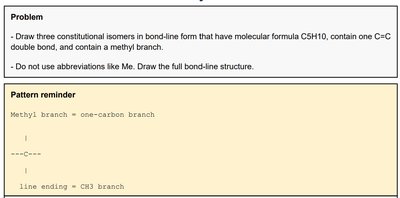
This question tests your ability to draw constitutional isomers with a double bond and a methyl branch for C5H10.
Key Terms and Formulas:
Constitutional isomers: Same formula, different connectivity.
Bond-line structure: Simplified drawing of carbon skeleton.
Methyl branch: One-carbon branch (CH3).
Step-by-Step Guidance
Draw the main carbon chain for C5H10 and introduce one C=C double bond.
Add a methyl branch at different positions to create unique isomers.
Ensure each structure is a constitutional isomer (different connectivity).
Check that you have three distinct isomers.
Try solving on your own before revealing the answer!
Final Answer:
Three constitutional isomers can be drawn, each with a double bond and a methyl branch.
Q7. Resonance Structure for Nitrate Ion (NO3-)
Background
Topic: Resonance Structures
This question tests your ability to draw resonance structures for polyatomic ions.
Key Terms and Formulas:
Resonance structure: Different ways to draw the same molecule showing delocalized electrons.
Nitrate ion: NO3-, with three oxygens and one nitrogen.
Step-by-Step Guidance
Draw the nitrate ion with one nitrogen and three oxygens.
Place double bonds between nitrogen and one oxygen, single bonds to the other two.
Move the double bond to each oxygen to show resonance.
Try solving on your own before revealing the answer!

Final Answer:
There are three resonance structures for NO3-, each with a double bond to a different oxygen.
Q8. Resonance Hybrid Contribution for Pyrrole Species
Background
Topic: Resonance Hybrid and Structure Contribution
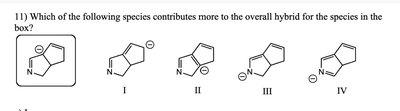
This question tests your understanding of resonance structures and their contribution to the resonance hybrid.
Key Terms and Formulas:
Resonance hybrid: The true structure is a blend of all resonance forms.
Major contributor: The resonance structure that is most stable and resembles the actual molecule.
Step-by-Step Guidance
Examine each resonance structure for charge placement and octet completion.
Identify which structure has the least formal charge and most stable arrangement.
Compare the resonance forms to determine which contributes most to the hybrid.
Try solving on your own before revealing the answer!
Final Answer:
Structure I contributes most to the resonance hybrid because it has the least formal charge and full octets.
Q9. Resonance Structures for Acetate Ion
Background
Topic: Resonance and Structure Stability
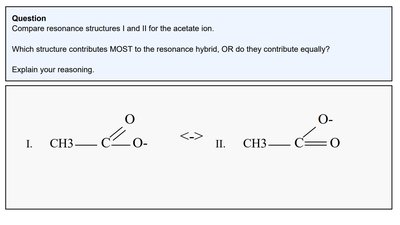
This question tests your ability to compare resonance structures and determine their contribution to the resonance hybrid.
Key Terms and Formulas:
Resonance structure: Different ways to represent delocalized electrons.
Acetate ion: CH3COO-, with two resonance forms.
Step-by-Step Guidance
Draw both resonance structures for acetate ion.
Analyze formal charges and octet completion in each structure.
Determine if one structure is more stable or if they contribute equally.
Try solving on your own before revealing the answer!
Final Answer:
Both resonance structures contribute equally to the resonance hybrid because the negative charge is delocalized over both oxygens.
Q10. Naming a Molecule with Double Bond and -OH Group
Background
Topic: IUPAC Nomenclature
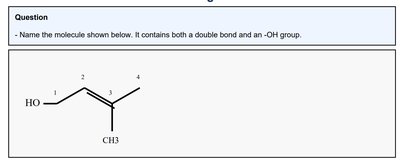
This question tests your ability to name a molecule with both a double bond and a hydroxyl group.
Key Terms and Formulas:
Double bond: C=C, affects numbering and suffix.
Hydroxyl group (-OH): Alcohol functional group.
IUPAC rules: Number the chain to give the lowest numbers to functional groups.
Step-by-Step Guidance
Identify the longest carbon chain and number it to give the -OH group the lowest possible number.
Locate the double bond and assign its position.
Combine the names using IUPAC rules for alcohols and alkenes.
Try solving on your own before revealing the answer!
Final Answer:
The molecule is named 3-methyl-2-buten-1-ol.
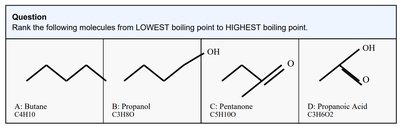
Q11. Ranking Boiling Points of Organic Molecules
Background
Topic: Physical Properties and Intermolecular Forces
This question tests your understanding of boiling points based on molecular structure and functional groups.
Key Terms and Formulas:
Boiling point: Temperature at which a substance changes from liquid to gas.
Intermolecular forces: Includes hydrogen bonding, dipole-dipole, and London dispersion.
Functional groups: Alcohol, ketone, carboxylic acid, alkane.
Step-by-Step Guidance
Identify the functional group in each molecule: Butane (alkane), propanol (alcohol), pentanone (ketone), propanoic acid (carboxylic acid).
Rank the strength of intermolecular forces: Carboxylic acid > alcohol > ketone > alkane.
Arrange the molecules from lowest to highest boiling point based on their functional groups.
Try solving on your own before revealing the answer!
Final Answer:
Boiling point order: Butane < Pentanone < Propanol < Propanoic Acid.
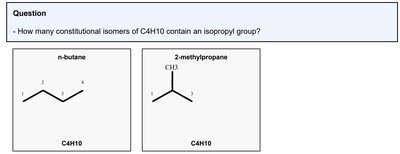
Q12. Isomers of C4H10 with Isopropyl Group
Background
Topic: Isomerism and Alkyl Groups
This question tests your ability to identify constitutional isomers of C4H10 containing an isopropyl group.
Key Terms and Formulas:
Isopropyl group: A three-carbon branch (CH(CH3)2).
Constitutional isomers: Same formula, different connectivity.
Step-by-Step Guidance
Draw all possible isomers of C4H10.
Identify which isomers contain an isopropyl group.
Count the number of isomers with this group.
Try solving on your own before revealing the answer!
Final Answer:
Only 2-methylpropane contains an isopropyl group; n-butane does not.
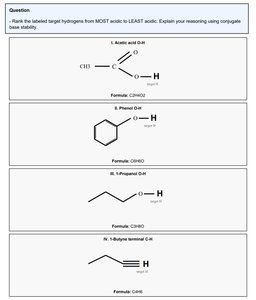
Q13. Ranking Acidity Using Conjugate Base Stability
Background
Topic: Acidity and Conjugate Base Stability
This question tests your ability to rank acidity based on the stability of the conjugate base.
Key Terms and Formulas:
Acidity: Tendency to donate a proton (H+).
Conjugate base: The species formed after losing a proton.
Stability factors: Resonance, electronegativity, hybridization.
Step-by-Step Guidance
Identify the target hydrogen in each molecule.
Analyze the stability of the conjugate base formed after deprotonation.
Rank the molecules from most to least acidic based on conjugate base stability.
Try solving on your own before revealing the answer!
Final Answer:
Acetic acid > 1-propanol > cyclohexanol > alkyne terminal C-H.
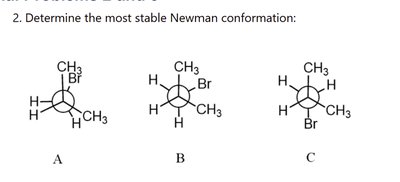
Q14. Most Stable Newman Conformation
Background
Topic: Conformational Analysis
This question tests your ability to determine the most stable Newman projection based on steric interactions.
Key Terms and Formulas:
Newman projection: Visualizes the spatial arrangement of atoms around a bond.
Staggered vs. eclipsed: Staggered is more stable due to minimized repulsion.
Steric hindrance: Repulsion between bulky groups.
Step-by-Step Guidance
Examine each Newman projection for staggered or eclipsed arrangement.
Identify which projection minimizes repulsion between large groups (CH3, Br).
Choose the most stable conformation based on these criteria.
Try solving on your own before revealing the answer!
Final Answer:
Conformation B is the most stable because it is staggered and separates bulky groups.
Q15. Relationship Between Structures 1 and 2
Background
Topic: Stereochemistry and Isomerism
This question tests your ability to identify the relationship between two structures: enantiomers, diastereomers, constitutional isomers, or the same compound.
Key Terms and Formulas:
Enantiomers: Non-superimposable mirror images.
Diastereomers: Stereoisomers that are not mirror images.
Constitutional isomers: Different connectivity.
Same compound: Identical in every way.
Step-by-Step Guidance
Compare the connectivity of atoms in both structures.
Analyze the stereochemistry (spatial arrangement) of the groups.
Determine if they are mirror images, diastereomers, constitutional isomers, or the same compound.
Try solving on your own before revealing the answer!
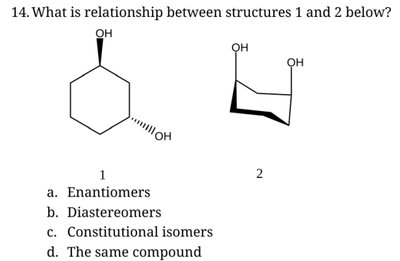
Final Answer:
Structures 1 and 2 are constitutional isomers because they have different connectivity.
