 Back
BackOrganic Chemistry Reaction Mechanisms: Bromination and Epoxidation
Study Guide - Smart Notes
 Tailored notes based on your materials, expanded with key definitions, examples, and context.
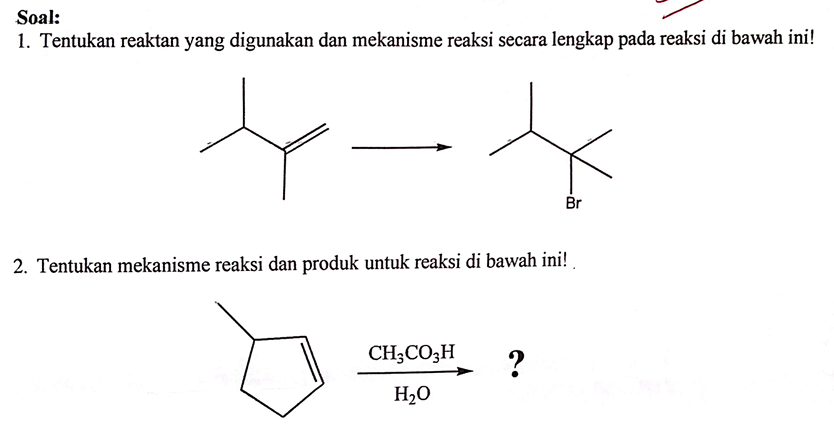
Q1. Tentukan reaktan yang digunakan dan mekanisme reaksi secara lengkap pada reaksi di bawah ini!
Background
Topic: Electrophilic Addition to Alkenes (Bromination)
This question tests your understanding of how alkenes react with halogens (such as Br2) to form alkyl halides, specifically the mechanism of bromine addition to an alkene.
Key Terms and Formulas
Alkene: A hydrocarbon with a carbon-carbon double bond.
Bromination: Addition of bromine (Br2) across a double bond.
Electrophilic addition: A reaction where an electrophile reacts with a nucleophile (the alkene).
Step-by-Step Guidance
Identify the starting material: The compound on the left is an alkene (specifically, 2-methyl-2-butene).
Determine the reagent: Bromine (Br2) is typically used for bromination of alkenes.
Describe the mechanism: The alkene acts as a nucleophile and attacks Br2, forming a bromonium ion intermediate.
Explain the next step: The bromide ion (Br-) attacks the more substituted carbon of the bromonium ion, leading to the final product.
Try solving on your own before revealing the answer!
Final Answer:
The reactant is Br2, and the mechanism involves electrophilic addition forming a bromonium ion, followed by nucleophilic attack by Br- to yield the alkyl bromide.
The product is 2-bromo-2-methylbutane.
Q2. Tentukan mekanisme reaksi dan produk untuk reaksi di bawah ini!
Background
Topic: Epoxidation and Hydrolysis of Alkenes
This question tests your understanding of the epoxidation of alkenes using peroxy acids (such as mCPBA or CH3CO3H) and subsequent hydrolysis to form diols.
Key Terms and Formulas
Epoxidation: Formation of an epoxide (three-membered cyclic ether) from an alkene.
Peroxy acid: A reagent like CH3CO3H (peracetic acid) used for epoxidation.
Hydrolysis: Reaction with water to open the epoxide ring, forming a diol.
Step-by-Step Guidance
Identify the starting material: The compound is methylcyclopentene.
Determine the reagent: CH3CO3H (peracetic acid) is used for epoxidation.
Describe the mechanism: The alkene reacts with the peroxy acid to form an epoxide intermediate.
Explain the next step: The epoxide is then hydrolyzed by water (H2O), opening the ring to form a trans-1,2-diol.
Try solving on your own before revealing the answer!
Final Answer:
The mechanism involves epoxidation followed by hydrolysis, resulting in a trans-1,2-diol product.
The product is trans-2-methylcyclopentane-1,2-diol.
