 Back
BackOrganic Chemistry Study Guidance: Bases, Acidity, Aldol Condensation, and Compound Identification
Study Guide - Smart Notes
 Tailored notes based on your materials, expanded with key definitions, examples, and context.
Q1. In the following pair of compounds, select the stronger base, and explain your choice: ClCH2CH2NH2 or CH3CH2NH2?
Background
Topic: Basicity of Amines
This question tests your understanding of how substituents (like chlorine or methyl groups) affect the basicity of amines through inductive effects.
Key Terms and Concepts:
Basicity: The tendency of a compound to accept a proton (H+).
Inductive Effect: Electron-withdrawing or electron-donating effects of substituents that influence electron density on the nitrogen atom.
Step-by-Step Guidance
Identify the functional group responsible for basicity in both compounds (the amine group, NH2).
Consider the effect of the substituent attached to the ethyl group: chlorine (Cl) is electron-withdrawing, while methyl (CH3) is electron-donating.
Analyze how these effects influence the electron density on the nitrogen atom, which affects its ability to accept a proton.
Predict which compound will have a higher electron density on nitrogen and thus be a stronger base.
Try solving on your own before revealing the answer!
Q2. Rank the following compounds in order of increasing acidity:
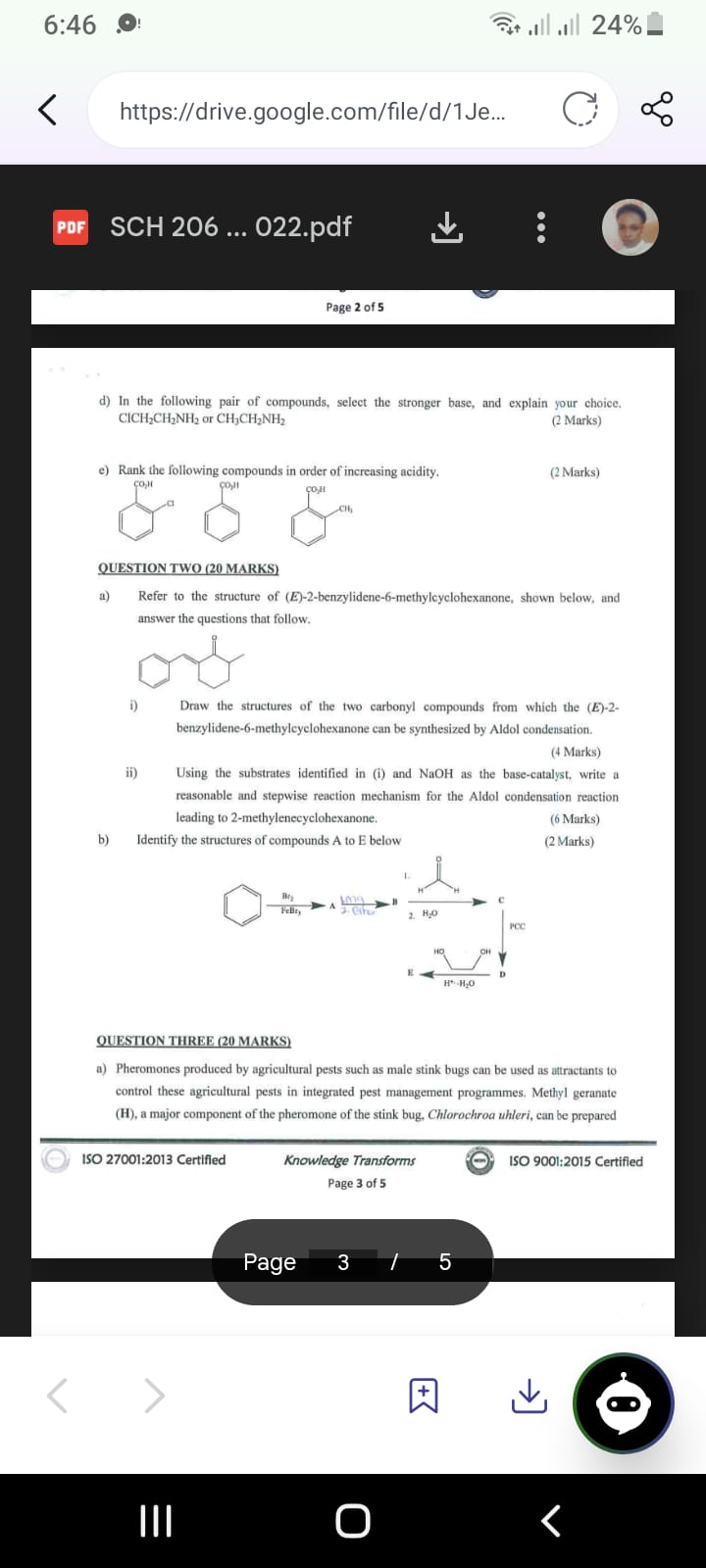
Background
Topic: Acidity of Aromatic Carboxylic Acids
This question tests your ability to compare the acidity of carboxylic acids based on the nature and position of substituents on the aromatic ring.
Key Terms and Concepts:
Acidity: The tendency of a compound to donate a proton (H+).
Substituent Effects: Electron-withdrawing groups (like Cl) increase acidity, while electron-donating groups (like CH3) decrease acidity.
Step-by-Step Guidance
Identify the functional group responsible for acidity (the carboxylic acid group, COOH).
Examine the substituents on each aromatic ring: Cl, H, and CH3.
Recall that electron-withdrawing groups stabilize the conjugate base, increasing acidity, while electron-donating groups destabilize it, decreasing acidity.
Arrange the compounds based on the expected acidity from lowest to highest.
Try solving on your own before revealing the answer!
Q3. Draw the structures of the two carbonyl compounds from which (E)-2-benzylidene-6-methylcyclohexanone can be synthesized by Aldol condensation.
Background
Topic: Aldol Condensation
This question tests your understanding of retrosynthetic analysis and the identification of starting materials for an Aldol condensation reaction.
Key Terms and Concepts:
Aldol Condensation: A reaction between an aldehyde or ketone with another carbonyl compound in the presence of a base to form a β-hydroxy carbonyl, followed by dehydration to yield an α,β-unsaturated carbonyl compound.
Retrosynthesis: Breaking down a target molecule into simpler starting materials.
Step-by-Step Guidance
Examine the structure of (E)-2-benzylidene-6-methylcyclohexanone and identify the α,β-unsaturated carbonyl system.
Determine which fragments could have combined via Aldol condensation (typically an enolate and an aldehyde).
Draw the two carbonyl compounds that would react to form the product.
Check that the combination of these compounds would yield the target molecule after condensation and dehydration.
Try solving on your own before revealing the answer!
Q4. Using the substrates identified in (i) and NaOH as the base-catalyst, write a reasonable and stepwise reaction mechanism for the Aldol condensation reaction leading to 2-methylenecyclohexanone.
Background
Topic: Aldol Condensation Mechanism
This question tests your ability to write a detailed mechanism for a base-catalyzed Aldol condensation, including enolate formation, nucleophilic addition, and dehydration steps.
Key Terms and Concepts:
Enolate Formation: The base abstracts a proton from the α-carbon of a ketone or aldehyde.
Nucleophilic Addition: The enolate attacks the carbonyl carbon of the other substrate.
Dehydration: Removal of water to form the α,β-unsaturated carbonyl compound.
Step-by-Step Guidance
Show the formation of the enolate ion from the ketone using NaOH.
Illustrate the nucleophilic attack of the enolate on the aldehyde carbonyl carbon.
Depict the formation of the β-hydroxy carbonyl intermediate.
Explain the dehydration step to yield the α,β-unsaturated carbonyl product.
Try solving on your own before revealing the answer!
Q5. Identify the structures of compounds A to E in the reaction sequence below.
Background
Topic: Organic Reaction Mechanisms and Product Identification
This question tests your ability to follow a multi-step reaction sequence and identify the products at each stage, including bromination, Grignard formation, hydrolysis, oxidation, and hydration.
Key Terms and Concepts:
Bromination: Introduction of a bromine atom to the aromatic ring.
Grignard Reagent Formation: Reaction of bromobenzene with Mg in ether.
Hydrolysis: Reaction with water to form alcohols.
Oxidation: Use of PCC to convert alcohols to aldehydes or ketones.
Step-by-Step Guidance
Identify the starting compound and the reagent used in the first step (bromination).
Follow the sequence to the Grignard reagent formation and subsequent reactions.
Predict the structure after each transformation, considering the reagents and conditions.
Draw or describe the structure for each compound (A to E) based on the reaction steps.
Try solving on your own before revealing the answer!
