Back
BackOrganic Chemistry Study Guide: Alkyne Reactions, Synthesis, and Lindlar Reductions
Study Guide - Smart Notes
 Tailored notes based on your materials, expanded with key definitions, examples, and context.
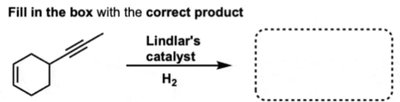
Q1. Fill in the box with the correct product: Benzene ring with alkyne, Lindlar's catalyst, H2
Background
Topic: Partial hydrogenation of alkynes
This question tests your understanding of selective reduction of alkynes to alkenes using Lindlar's catalyst, which produces a cis-alkene.
Key Terms and Formulas
Lindlar's catalyst: A poisoned palladium catalyst used for partial hydrogenation.
Alkyne: A molecule containing a carbon-carbon triple bond.
Cis-alkene: An alkene with both substituents on the same side of the double bond.
Step-by-Step Guidance
Recognize that Lindlar's catalyst selectively reduces alkynes to cis-alkenes, not to alkanes.
Identify the starting material: a benzene ring with an alkyne side chain.
Predict the product: the triple bond will be reduced to a double bond, forming a cis-alkene.
Draw the product with the two hydrogens added to the same side of the double bond (cis configuration).
Try solving on your own before revealing the answer!
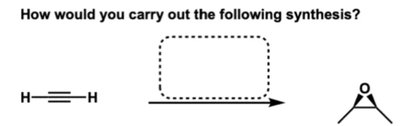
Q2. How would you carry out the following synthesis? Acetylene to epoxide
Background
Topic: Organic synthesis, functional group transformations
This question tests your ability to plan a synthetic route from acetylene (ethyne) to an epoxide (oxirane).
Key Terms and Formulas
Acetylene:
Epoxide: A three-membered cyclic ether.
Functional group interconversion: Changing one functional group to another through a series of reactions.
Step-by-Step Guidance
Consider how to convert acetylene into an alkene or alcohol, which can then be transformed into an epoxide.
Think about possible addition reactions to acetylene, such as halogenation or hydration.
Plan a route to obtain a suitable precursor (e.g., a vicinal dihalide or an alcohol) for epoxidation.
Identify reagents that can convert the precursor to an epoxide (e.g., peracid for alkene epoxidation).
Try solving on your own before revealing the answer!
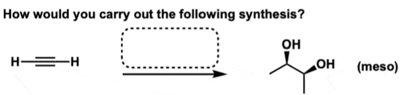
Q3. How would you carry out the following synthesis? Acetylene to meso-2,3-butanediol
Background
Topic: Organic synthesis, diol formation
This question tests your ability to synthesize a meso diol from acetylene, requiring knowledge of addition reactions and stereochemistry.
Key Terms and Formulas
Meso compound: A molecule with multiple stereocenters that is superimposable on its mirror image.
Diol: A compound with two hydroxyl groups.
Syn addition: Addition of two groups to the same side of a double bond.
Step-by-Step Guidance
Consider how to build a four-carbon chain from acetylene.
Think about the addition of alkyl halides to acetylene to extend the carbon chain.
Plan for the formation of an alkene, which can be converted to a diol via syn addition (e.g., OsO4 or KMnO4).
Ensure the stereochemistry leads to a meso compound.
Try solving on your own before revealing the answer!
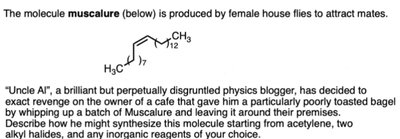
Q4. Synthesis of Muscalure from acetylene, two alkyl halides, and inorganic reagents
Background
Topic: Multi-step organic synthesis, carbon chain extension
This question tests your ability to design a synthetic route for a complex molecule (muscalure) using acetylene as a starting material and chain extension via alkylation.
Key Terms and Formulas
Acetylene:
Alkylation: Addition of alkyl groups to a molecule.
Inorganic reagents: Bases (e.g., NaNH2) used to deprotonate acetylene.
Step-by-Step Guidance
Identify the number of carbons needed to build muscalure from acetylene.
Plan the sequence of alkylations using two different alkyl halides to extend the carbon chain.
Choose an appropriate base (e.g., NaNH2) to deprotonate acetylene for nucleophilic substitution.
Consider the order of alkylations to achieve the correct chain length and branching.
Try solving on your own before revealing the answer!
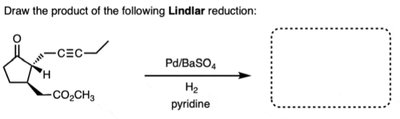
Q5. Draw the product of the following Lindlar reduction: Cyclopentanone with alkyne, Pd/BaSO4, H2, pyridine
Background
Topic: Selective reduction of alkynes in complex molecules
This question tests your ability to predict the product of a Lindlar reduction in a molecule with multiple functional groups.
Key Terms and Formulas
Lindlar's catalyst: Pd/BaSO4 used for partial hydrogenation.
Alkyne reduction: Conversion of a triple bond to a cis double bond.
Functional group compatibility: Ensuring other groups (e.g., ketones, esters) are not affected by the reduction.
Step-by-Step Guidance
Identify the alkyne group in the molecule and note its position relative to other functional groups.
Recall that Lindlar's catalyst will reduce the alkyne to a cis-alkene without affecting the ketone or ester groups.
Draw the product with the triple bond replaced by a cis double bond, maintaining the stereochemistry.
Check that the other functional groups remain unchanged in the product.
Try solving on your own before revealing the answer!