 Back
BackOrganic Chemistry Study Guide: Nomenclature, Acidity, Basicity, Chirality, and Reaction Mechanisms
Study Guide - Smart Notes
 Tailored notes based on your materials, expanded with key definitions, examples, and context.
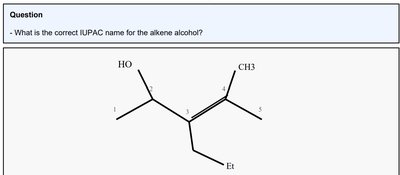
Q1. What is the correct IUPAC name for the alkene alcohol?
Background
Topic: IUPAC Nomenclature of Organic Compounds
This question tests your ability to apply IUPAC rules to name a molecule containing both an alkene and an alcohol functional group, as well as substituents.
Key Terms and Formulas:
Longest carbon chain containing the double bond
Numbering the chain to give the lowest possible locants to the double bond and alcohol
Alcohol suffix: -ol
Alkene suffix: -ene
Substituent names: methyl (CH3), ethyl (Et)
Step-by-Step Guidance
Identify the longest carbon chain that contains both the alkene and alcohol functional groups.
Number the chain so that the alcohol group gets the lowest possible number, followed by the alkene.
Assign locants to the substituents (methyl, ethyl) and the double bond.
Combine the names, listing substituents alphabetically, and use the correct suffixes for alcohol and alkene.
Try solving on your own before revealing the answer!
Final Answer: 4-methyl-3-ethylpent-2-en-1-ol
The longest chain is five carbons, numbered from the alcohol. The double bond is at position 2, methyl at 4, ethyl at 3.
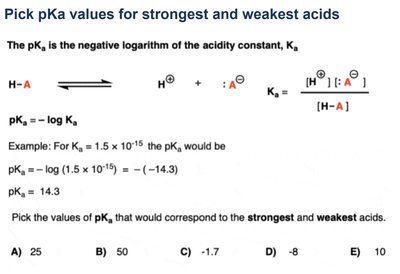
Q2. Pick pKa values for strongest and weakest acids
Background
Topic: Acidity and pKa Values
This question tests your understanding of how pKa values relate to acid strength. Lower pKa means stronger acid.
Key Terms and Formulas:
Strong acids have low pKa values
Weak acids have high pKa values
Step-by-Step Guidance
Recall that the lower the pKa, the stronger the acid.
Compare the given pKa values: 25, 50, -1.7, -8, 10.
Identify the lowest and highest pKa values from the list.
Try solving on your own before revealing the answer!
Final Answer: Strongest acid: D (-8), Weakest acid: B (50)
Acids with the lowest pKa are strongest; highest pKa are weakest.
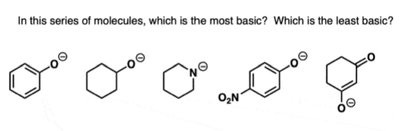
Q3. In this series of molecules, which is the most basic? Which is the least basic?
Background
Topic: Basicity of Organic Molecules
This question tests your ability to compare basicity based on structure and resonance effects.
Key Terms and Formulas:
Basicity: Ability to accept a proton
Resonance and electron-withdrawing groups decrease basicity
Step-by-Step Guidance
Examine each molecule for resonance stabilization and electron-withdrawing groups.
Identify which molecule has the least resonance or electron-withdrawing effects (most basic).
Identify which molecule has the most resonance or electron-withdrawing effects (least basic).
Try solving on your own before revealing the answer!
Final Answer: Most basic: cyclohexyl anion; Least basic: nitro-substituted anion
Resonance and electron-withdrawing groups decrease basicity.
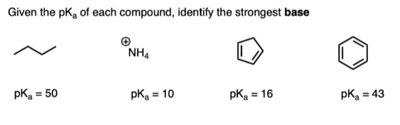
Q4. Given the pKa of each compound, identify the strongest base
Background
Topic: Relationship between pKa and Basicity
This question tests your understanding of how the pKa of a conjugate acid relates to the strength of its conjugate base.
Key Terms and Formulas:
Strongest base has the conjugate acid with the highest pKa
pKa values: ethane (50), ammonium (10), cyclopentadiene (16), benzene (43)
Step-by-Step Guidance
Recall that the higher the pKa of the conjugate acid, the stronger the base.
Compare the pKa values given for each compound.
Identify which compound has the highest pKa value.
Try solving on your own before revealing the answer!
Final Answer: Ethane (pKa = 50) is the strongest base
The conjugate acid with the highest pKa corresponds to the strongest base.
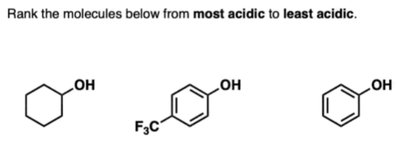
Q5. Rank the molecules below from most acidic to least acidic
Background
Topic: Acidity of Phenols and Cyclohexanols
This question tests your ability to rank acidity based on structure and substituents.
Key Terms and Formulas:
Electron-withdrawing groups increase acidity
Phenol vs. cyclohexanol
Step-by-Step Guidance
Identify which molecule has electron-withdrawing groups (e.g., CF3).
Recall that phenol is more acidic than cyclohexanol.
Rank the molecules based on these features.
Try solving on your own before revealing the answer!
Final Answer: CF3-phenol > phenol > cyclohexanol
Electron-withdrawing groups increase acidity; phenol is more acidic than cyclohexanol.
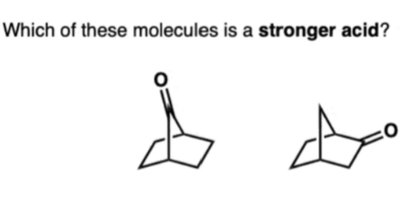
Q6. Which of these molecules is a stronger acid?
Background
Topic: Acidity of Cycloalkanes
This question tests your ability to compare acidity based on ring strain and resonance.
Key Terms and Formulas:
Ring strain can affect acidity
Position of carbonyl group
Step-by-Step Guidance
Compare the two molecules for ring strain and carbonyl position.
Consider how these factors affect the stability of the conjugate base.
Try solving on your own before revealing the answer!
Final Answer: The molecule with the carbonyl at the bridgehead is less acidic; the other is more acidic.
Ring strain and carbonyl position affect acidity.
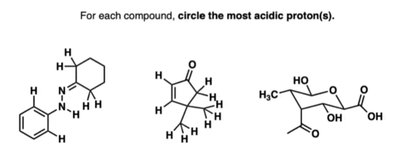
Q7. For each compound, circle the most acidic proton(s)
Background
Topic: Identifying Acidic Protons in Organic Molecules
This question tests your ability to recognize the most acidic hydrogen atoms in complex molecules.
Key Terms and Formulas:
Acidic protons are often attached to electronegative atoms or near electron-withdrawing groups
Carboxylic acids, imides, and enols
Step-by-Step Guidance
Identify functional groups in each molecule (e.g., carboxylic acid, imide).
Locate protons attached to electronegative atoms or near electron-withdrawing groups.
Circle the most acidic protons based on these features.
Try solving on your own before revealing the answer!
Final Answer: Most acidic protons are on carboxylic acids and imides.
Acidic protons are typically found on carboxylic acids and imides.
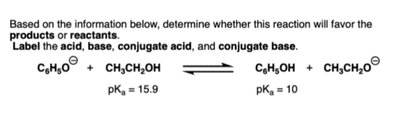
Q8. Based on the information below, determine whether this reaction will favor the products or reactants. Label the acid, base, conjugate acid, and conjugate base.
Background
Topic: Acid-Base Equilibria and pKa Comparison
This question tests your ability to predict the direction of an acid-base equilibrium using pKa values.
Key Terms and Formulas:
Equilibrium favors the side with the weaker acid (higher pKa)
Labeling acid, base, conjugate acid, conjugate base
Step-by-Step Guidance
Identify the acids and bases on both sides of the equation.
Compare the pKa values to determine which side is favored.
Label each species as acid, base, conjugate acid, or conjugate base.
Try solving on your own before revealing the answer!
Final Answer: Reaction favors the side with the higher pKa (weaker acid).
Equilibrium favors the formation of the weaker acid and base.
Q9. Determine if this molecule is chiral or achiral
Background
Topic: Chirality in Organic Molecules
This question tests your ability to identify chirality based on symmetry and the presence of stereocenters.
Key Terms and Formulas:
Chiral: No plane of symmetry, at least one stereocenter
Achiral: Has a plane of symmetry or no stereocenter
Step-by-Step Guidance
Identify any stereocenters in the molecule.
Check for a plane of symmetry.
Determine if the molecule is chiral or achiral based on these features.
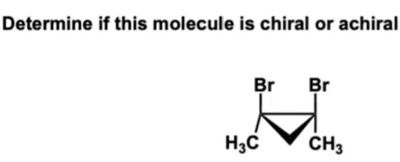
Try solving on your own before revealing the answer!
Final Answer: The molecule is achiral due to a plane of symmetry.
Presence of symmetry means the molecule is achiral.
Q10. Are these molecules enantiomers, diastereomers, or the same?
Background
Topic: Stereochemistry – Enantiomers vs. Diastereomers
This question tests your ability to distinguish between enantiomers, diastereomers, and identical molecules.
Key Terms and Formulas:
Enantiomers: Non-superimposable mirror images
Diastereomers: Stereoisomers that are not mirror images
Same: Identical molecules
Step-by-Step Guidance
Compare the configuration of each stereocenter in both molecules.
Determine if the molecules are mirror images or not.
Decide if they are enantiomers, diastereomers, or the same.
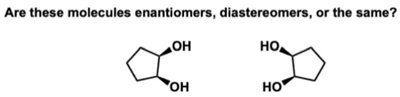
Try solving on your own before revealing the answer!
Final Answer: The molecules are enantiomers.
They are non-superimposable mirror images.
Q11. The molecules below each have a reasonable leaving group, but only one will undergo SN1 / SN2 / E1 / E2 reactions. Which one?
Background
Topic: Nucleophilic Substitution and Elimination Reactions
This question tests your ability to identify which molecule is most likely to undergo substitution or elimination reactions based on structure.
Key Terms and Formulas:
Leaving group: Atom or group that can depart with a pair of electrons
SN1/SN2/E1/E2: Types of substitution and elimination mechanisms
Step-by-Step Guidance
Examine the structure of each molecule for stability of carbocation or accessibility for nucleophile.
Determine which molecule is most likely to undergo SN1/SN2/E1/E2 reactions.
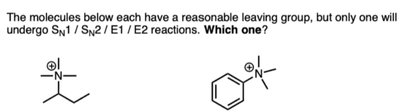
Try solving on your own before revealing the answer!
Final Answer: The benzyl group is most likely to undergo SN1/SN2/E1/E2 reactions.
Benzyl groups stabilize carbocations and are accessible for nucleophilic attack.
Q12. Predict the product for each acid-catalyzed hydration of the alkene reaction. Draw the curved arrow mechanism to support your answer and keep in mind the possibility of rearrangements that occur during the addition of water to alkenes.
Background
Topic: Alkene Hydration Mechanism
This question tests your ability to predict the product of acid-catalyzed hydration and to draw the mechanism, including possible carbocation rearrangements.
Key Terms and Formulas:
Markovnikov's rule: Addition of water to the more substituted carbon
Curved arrow mechanism: Shows movement of electrons
Carbocation rearrangement: Hydride or alkyl shift
Step-by-Step Guidance
Identify the alkene and predict where the carbocation will form after protonation.
Consider possible rearrangements to form a more stable carbocation.
Show the addition of water and deprotonation to yield the alcohol product.
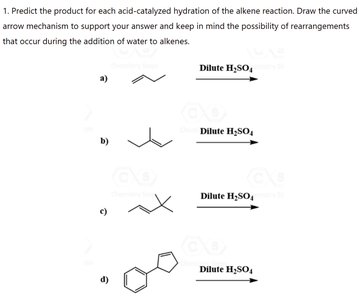
Try solving on your own before revealing the answer!
Final Answer: Alcohols formed at the more substituted carbon, with possible rearrangements.
Markovnikov addition and carbocation rearrangement determine the product.
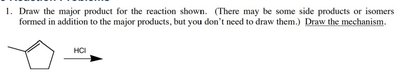
Q13. Draw the major product for the reaction shown. Draw the mechanism.
Background
Topic: Electrophilic Addition to Alkenes
This question tests your ability to predict the major product and draw the mechanism for the addition of HCl to an alkene.
Key Terms and Formulas:
Electrophilic addition: Alkene reacts with HCl
Markovnikov's rule: H adds to less substituted carbon, Cl to more substituted
Carbocation intermediate
Step-by-Step Guidance
Identify the alkene and predict where the carbocation will form after protonation.
Show the addition of Cl- to the carbocation.
Draw the mechanism with curved arrows.
Try solving on your own before revealing the answer!
Final Answer: Major product is the Markovnikov addition of HCl to the alkene.
Cl adds to the more substituted carbon; mechanism involves carbocation intermediate.
