Back
BackOrganic Chemistry Study Notes: Resonance, Diels-Alder, Substitution & Elimination, and Reactions of Alcohols, Ethers, and Epoxides
Study Guide - Smart Notes
 Tailored notes based on your materials, expanded with key definitions, examples, and context.
Resonance in Organic Molecules
Resonance Contributions and Resonance Hybrid
Resonance is a key concept in organic chemistry, describing the delocalization of electrons within molecules that cannot be represented by a single Lewis structure. The actual structure is a resonance hybrid of all possible resonance contributors.
Rules for Writing Resonance Structures:
Only electrons move – atoms do not move.
Only π bonds and lone pairs can move; do not change σ bonds.
The total number of electrons and the net charge of the molecule do not change between resonance structures.
Resonance of Amides: Amides exhibit resonance between the lone pair on nitrogen and the carbonyl group, stabilizing the molecule.
Resonance structures are not always equivalent and may differ in stability.
Stability of Resonance Structures
All atoms have a complete octet (most stable).
Negative charges are placed on the most electronegative atom.
Positive charges are placed on the least electronegative atom.
Minimize charges if possible.
Opposing charges (if present) should be separated across the molecule.
Diels-Alder Reaction and Regioselectivity
Considerations for Diels-Alder: Unsymmetrical Reagents (Regioisomerism)
The Diels-Alder reaction is a [4+2] cycloaddition between a diene and a dienophile. When unsymmetrical reagents react, two regioisomeric products are possible. The reaction is regioselective, and the product distribution depends on the resonance contributions of the diene and dienophile.
Electron-Withdrawing Groups (EWG): Pull electron density away from the diene, stabilizing the transition state.
Electron-Donating Groups (EDG): Donate electron density to the diene, influencing the regioselectivity of the product.
One of each (EWG and EDG) is ideal for a fast, productive Diels-Alder reaction.
Substitution and Elimination Reactions of Alkyl Halides
Conditions Affecting Substitution Reactions
Substitution reactions (SN1 and SN2) are influenced by several factors, including the structure of the alkyl halide and the strength of the nucleophile.
Type of Alkyl Halide (and Carbocation): Alkyl halides that can form stable carbocations favor SN1 reactions. Those with steric bulk favor SN2 reactions less.
Nucleophilic Strength
Strong nucleophiles favor SN2 reactions.
Weak nucleophiles are used for SN1 reactions.
Determining Nucleophilicity:
Charge: Negatively charged atoms are generally more nucleophilic.
Basicity: Stronger bases are usually stronger nucleophiles.
Steric Hindrance: Bulky nucleophiles are less nucleophilic.
Solvent Effects: Polar aprotic solvents increase nucleophilicity.
Reactions of Alcohols, Ethers, and Epoxides
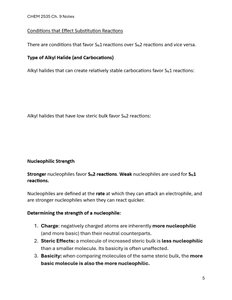
Successive Reaction Steps in Synthesis
Organic synthesis often involves multiple steps to convert starting materials into desired products. For example, converting an alkene to an alcohol, then to an ether, and so on. Understanding the reactivity of alcohols, ethers, and epoxides is essential for designing synthetic pathways.
Nucleophilic Substitution of Epoxides
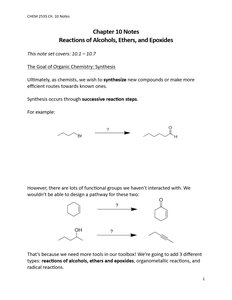
Epoxides are three-membered cyclic ethers that are highly reactive due to their bond angle strain. They can undergo nucleophilic substitution under either acidic or basic conditions, with the nucleophile attacking the more substituted carbon in acid and the less substituted carbon in base.
Bond Angle Strain: The three-membered ring makes epoxides more reactive than other ethers.
Opening the Ring: Epoxides can be opened by a variety of nucleophiles, making them useful intermediates in synthesis.
Acid-Catalyzed Nucleophilic Substitution: The nucleophile attacks the more substituted carbon atom.
Mechanistic Notes:
HBr or ROH with acid can be used.
Nucleophile adds to the more substituted side.
Summary Table: Substitution and Elimination Reactions
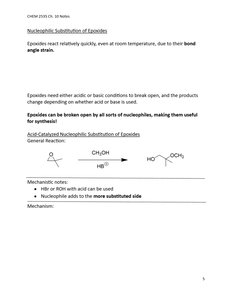
The following table summarizes the outcomes of substitution (SN1, SN2) and elimination (E1, E2) reactions for various alkyl halides under different conditions. It is a useful reference for predicting reaction pathways.
Substrate | Strong Nuc/Strong Base | Strong Nuc/Weak Base | Weak Nuc/Strong Base | Weak Nuc/Weak Base |
|---|---|---|---|---|
Primary Alkyl Halide | SN2 & E2 | SN2 | E2 | No Reaction |
Secondary Alkyl Halide | E2 & SN2 | SN2 | E2 | SN1 & E1 |
Tertiary Alkyl Halide | E2 | No Reaction | E2 | SN1 & E1 |
Benzyl/Allyl Halide | SN2 & E2 | SN2 | E2 | SN1 & E1 |