 Back
BackOrganic Reaction Mechanisms and Chemical Structure Representation
Study Guide - Smart Notes
 Tailored notes based on your materials, expanded with key definitions, examples, and context.
Reaction Mechanisms and Structure in Organic Chemistry
Introduction to Reaction Mechanisms
Organic chemistry involves understanding how chemical reactions occur at the molecular level. Reaction mechanisms describe the stepwise process by which reactants are transformed into products, detailing the breaking and formation of chemical bonds and the movement of electrons.
Chemical Change: A chemical reaction results in new compounds with different physical and chemical properties from the starting materials.
Reaction Mechanism: Provides a detailed account of each stage in a chemical transformation, including which bonds are broken and formed.
Predictive Value: Mechanisms help predict the reactivity of organic molecules in laboratory and biological contexts.
Example: Sodium metal reacting with water forms sodium hydroxide and hydrogen gas, with electron transfer and bond rearrangement.
Electron Movement in Organic Reactions
Bond breaking and formation in organic reactions involve the movement of valence electrons. This movement is depicted using curly arrows in reaction mechanisms.
Curly Double-Headed Arrow: Represents the movement of an electron pair (two electrons).
Curly Fish Hook Arrow: Represents the movement of a single electron, typical in radical reactions.
Bond Breaking: Can be heterolytic (unsymmetrical, forming ions) or homolytic (symmetrical, forming radicals).
Homolytic and Heterolytic Cleavage
Bond cleavage is a fundamental step in reaction mechanisms, and it can occur in two distinct ways:
Heterolytic Cleavage: Both bonding electrons go to one atom, forming ions. This is common in polar reactions.
Homolytic Cleavage: Each atom retains one electron, forming radicals. Radicals are highly reactive due to their unpaired electron.
Equation for Homolytic Cleavage:
Equation for Heterolytic Cleavage:
Bond Formation: Symmetrical vs. Unsymmetrical
Bond formation can also be symmetrical (each reactant donates one electron) or unsymmetrical (one reactant donates both electrons).
Symmetrical Bond Formation: Typical in radical reactions.
Unsymmetrical Bond Formation: Typical in polar reactions.
Types of Organic Reactions
Organic reactions are classified into four main types based on the changes occurring in the molecules:
Addition Reactions: Two reactants combine to form a single product. Example:
Elimination Reactions: A single reactant splits into two products, often forming a small molecule like water. Example: Dehydration of alcohol to form alkene.
Substitution Reactions: Two reactants exchange parts to form two new products. Example: Hydrolysis of esters.
Rearrangement Reactions: A single reactant reorganizes its bonds and atoms to yield an isomeric product. Example: Conversion of dihydroacetone phosphate to glyceraldehyde 3-phosphate in glycolysis.
Key Terms: Nucleophiles, Electrophiles, and Radicals
Organic molecules interact with three main classes of chemical species:
Nucleophile: Electron-rich, negatively polarized species that donate a pair of electrons to form a bond with an electron-poor atom.
Electrophile: Electron-poor, positively polarized species that accept a pair of electrons from a nucleophile.
Radical: Neutral species with a single unpaired electron, highly reactive.
Representation of Chemical Structures
Organic molecules are often represented using various shorthand notations to simplify complex structures:
Kekule Structure: Shows all bonds explicitly.
Condensed Structure: Groups like CH3 and CH2 are written without showing bonds.
Skeletal Structure: Uses zigzag lines for C–C bonds; intersections represent carbon atoms, and hydrogen atoms are omitted.
Functional Groups: Shown explicitly in skeletal structures.
R Notation: R, R1, R2, etc., denote general alkyl groups; Ar denotes aromatic groups.
Summary Table: Types of Organic Reactions
Reaction Type | Description | Example |
|---|---|---|
Addition | Two reactants combine to form one product | |
Elimination | One reactant splits into two products | Dehydration of alcohol |
Substitution | Exchange of parts between two reactants | Ester hydrolysis |
Rearrangement | Reorganization of bonds within a molecule | Isomerization in glycolysis |
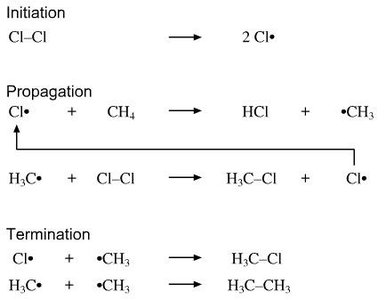
Example: Radical Mechanism of Chlorination of Methane
The radical mechanism for the chlorination of methane involves three stages: initiation, propagation, and termination. This illustrates homolytic cleavage and radical reactions.
Initiation: Homolytic cleavage of Cl2 forms two Cl radicals.
Propagation: Cl radical reacts with CH4 to form HCl and CH3 radical; CH3 radical reacts with Cl2 to form CH3Cl and another Cl radical.
Termination: Radicals combine to form stable products.
Summary of Key Learning Objectives
Use curly arrow notation to show electron movement in bond making and breaking.
Define nucleophiles, electrophiles, and free radicals.
Understand homolytic and heterolytic reactions.
Represent chemical structures using condensed and skeletal notations.
