 Back
BackOxymercuration-Demercuration and Acid-Catalyzed Hydration: Step-by-Step Organic Chemistry Guidance
Study Guide - Smart Notes
 Tailored notes based on your materials, expanded with key definitions, examples, and context.
Q1. Predict the product for each oxymercuration-demercuration reaction with the correct stereochemistry where needed.
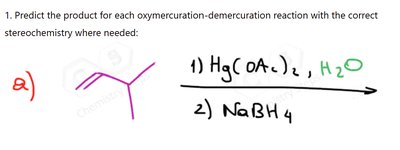
Background
Topic: Oxymercuration-Demercuration of Alkenes
This question tests your understanding of the oxymercuration-demercuration reaction, which is used to hydrate alkenes (add H and OH across a double bond) in a Markovnikov fashion without carbocation rearrangement. Stereochemistry may be relevant depending on the substrate.
Key Terms and Formulas
Oxymercuration-Demercuration: A two-step reaction sequence: (1) Addition of Hg(OAc)2 and H2O (or alcohol), (2) Reduction with NaBH4.
Markovnikov Addition: The nucleophile (OH or OR) adds to the more substituted carbon of the alkene.
No Rearrangement: Unlike acid-catalyzed hydration, this method avoids carbocation rearrangement.
Step-by-Step Guidance
Identify the double bond in the starting alkene and determine the more substituted carbon (Markovnikov position).
Recognize that H2O is the nucleophile, so an OH group will be added to the more substituted carbon, and H to the less substituted carbon.
Draw the product with the new OH group at the correct position. Consider if any stereochemistry is relevant (e.g., if a new chiral center is formed).
Check for possible formation of stereoisomers if the addition creates a new stereocenter.
Try solving on your own before revealing the answer!
Q2. Predict the product for the following oxymercuration-demercuration reaction (cyclopentene derivative with wedge substituent).
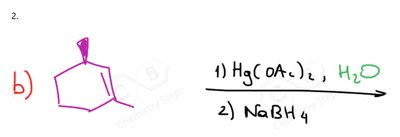
Background
Topic: Stereochemistry in Oxymercuration-Demercuration
This question focuses on the regioselectivity and stereochemistry of oxymercuration-demercuration, especially when the alkene is part of a ring and has existing stereochemistry.
Key Terms and Formulas
Syn/Anti Addition: Oxymercuration is typically anti addition, but reduction with NaBH4 can scramble stereochemistry at the site of addition.
Retention of Configuration: Pre-existing stereochemistry (e.g., wedges/dashes) must be preserved unless the reaction affects that center.
Step-by-Step Guidance
Locate the double bond and the existing stereocenter (wedge substituent).
Determine which carbon will receive the OH group (Markovnikov position) and which will receive H.
Draw the product, ensuring the new OH and H are added across the double bond. Consider if the addition creates a new stereocenter and whether both possible stereoisomers are formed.
Preserve the original stereochemistry of the wedge substituent in your product.
Try solving on your own before revealing the answer!
Q3. Predict the product for the oxymercuration-demercuration reaction using EtOH as the nucleophile.
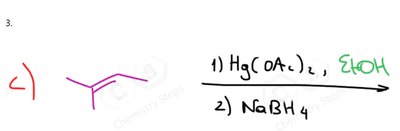
Background
Topic: Oxymercuration-Demercuration with Alcohol as Nucleophile
This question tests your ability to predict the product when an alcohol (EtOH) is used instead of water, resulting in an ether (alkoxy group) rather than an alcohol.
Key Terms and Formulas
Alkoxymercuration: When an alcohol is used, the OR group (from the alcohol) adds to the more substituted carbon.
Markovnikov Addition: The ethoxy group (OEt) adds to the more substituted carbon.
Step-by-Step Guidance
Identify the double bond and determine the more substituted carbon.
Recognize that EtOH will add as an OEt group to the more substituted carbon, and H to the less substituted carbon.
Draw the product with the ethoxy group at the correct position.
Check for any new stereocenters and consider if stereochemistry needs to be shown.
Try solving on your own before revealing the answer!
Q4. Predict the product for the oxymercuration-demercuration reaction using EtNH2 as the nucleophile.
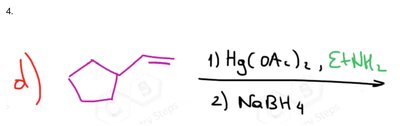
Background
Topic: Oxymercuration-Demercuration with Amine as Nucleophile
This question tests your understanding of oxymercuration-demercuration when an amine (EtNH2) is used as the nucleophile, leading to the formation of an amine derivative.
Key Terms and Formulas
Aminomercuration: The amine adds to the more substituted carbon of the alkene.
Markovnikov Addition: The EtNH group adds to the more substituted carbon.
Step-by-Step Guidance
Identify the double bond and the more substituted carbon.
Recognize that EtNH2 will add as an EtNH group to the more substituted carbon, and H to the less substituted carbon.
Draw the product with the EtNH group at the correct position.
Consider if any new stereocenters are formed and if stereochemistry should be indicated.
Try solving on your own before revealing the answer!
Q5. Predict the product for reactions (a)-(c) if an acid-catalyzed hydration had been performed rather than an oxymercuration-demercuration.
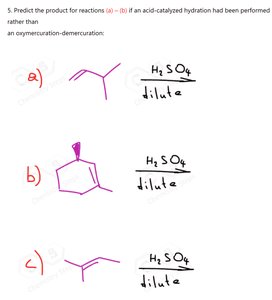
Background
Topic: Acid-Catalyzed Hydration of Alkenes
This question compares acid-catalyzed hydration (using H2SO4, dilute) to oxymercuration-demercuration. Acid-catalyzed hydration also gives Markovnikov addition of water but proceeds via a carbocation intermediate, which can rearrange.
Key Terms and Formulas
Carbocation Rearrangement: Hydride or alkyl shifts may occur if a more stable carbocation can form.
Markovnikov Addition: OH adds to the more substituted carbon, but rearrangement may alter the product.
Step-by-Step Guidance
Identify the double bond and consider the possible carbocation intermediates after protonation.
Check if a hydride or alkyl shift would lead to a more stable carbocation (secondary to tertiary, etc.).
Draw the product after water adds to the most stable carbocation, followed by deprotonation.
Compare the product to what would be formed by oxymercuration-demercuration (no rearrangement).
Try solving on your own before revealing the answer!
Q6. Determine the major product of the following oxymercuration-demercuration reaction (cyclohexene with t-BuOH and a side chain containing OH).
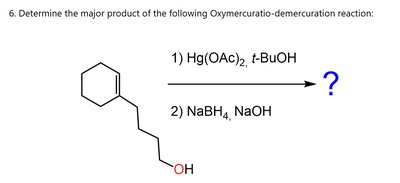
Background
Topic: Oxymercuration-Demercuration with Bulky Alcohol
This question tests your ability to predict the product when a bulky alcohol (t-BuOH) is used as the nucleophile, resulting in a tert-butoxy ether at the Markovnikov position.
Key Terms and Formulas
Markovnikov Addition: The tert-butoxy group (O-t-Bu) adds to the more substituted carbon of the alkene.
No Rearrangement: The reaction avoids carbocation rearrangement.
Step-by-Step Guidance
Identify the double bond and the more substituted carbon in the cyclohexene ring.
Recognize that t-BuOH will add as an O-t-Bu group to the more substituted carbon, and H to the less substituted carbon.
Draw the product, ensuring the tert-butoxy group is at the correct position and the side chain remains unchanged.
Check for any new stereocenters and indicate stereochemistry if necessary.
Try solving on your own before revealing the answer!
Q7. Draw a plausible mechanism for the following synthesis (involving PhNH2, Hg(OAc)2, NaBH4).
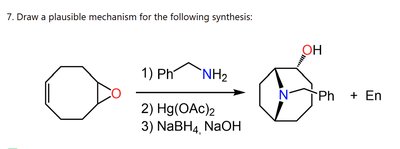
Background
Topic: Multi-Step Mechanism Involving Amine Addition and Oxymercuration-Demercuration
This question asks you to propose a mechanism for a sequence involving nucleophilic addition of an amine, followed by oxymercuration-demercuration, leading to a bicyclic amine alcohol product.
Key Terms and Formulas
Nucleophilic Addition: The amine attacks the carbonyl or imine intermediate.
Oxymercuration-Demercuration: Addition of Hg(OAc)2 and reduction with NaBH4.
Ring Formation: Intramolecular reactions may occur, forming bicyclic structures.
Step-by-Step Guidance
Identify the nucleophilic site (PhNH2) and the electrophilic site (the carbonyl or imine in the starting material).
Show the nucleophilic attack and formation of the intermediate (iminium or aminal).
Indicate the oxymercuration step, where Hg(OAc)2 activates the alkene for nucleophilic attack by water or another nucleophile.
Show the reduction step (NaBH4, NaOH) leading to the final product, and indicate the formation of the bicyclic structure.
Try solving on your own before revealing the answer!
