 Back
BackPredicting Products of Organic Reactions (E2 Elimination and Substitution)
Study Guide - Smart Notes
 Tailored notes based on your materials, expanded with key definitions, examples, and context.
Q1. Predict the product for the following reaction:
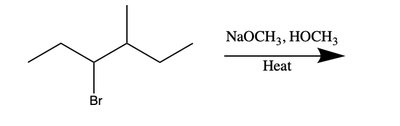
Background
Topic: E2 Elimination Reactions
This question tests your understanding of elimination reactions, specifically the E2 mechanism, which is favored by strong bases (like NaOCH3) and heat. You are asked to predict the organic product formed when a bromoalkane is treated with sodium methoxide in methanol under heated conditions.
Key Terms and Formulas
E2 Elimination: A concerted mechanism where a base removes a proton (H) from a β-carbon, while the leaving group (Br) departs from the α-carbon, forming a double bond (alkene).
β-Hydrogen: The hydrogen atom on the carbon adjacent to the carbon bearing the leaving group.
Zaitsev's Rule: The most substituted alkene is usually the major product in E2 eliminations.
Step-by-Step Guidance
Identify the leaving group (Br) and the β-hydrogens available for elimination. The base (NaOCH3) will abstract a β-hydrogen.
Determine which β-hydrogen abstraction will lead to the most substituted (Zaitsev) alkene. Look for hydrogens on carbons adjacent to the carbon with Br.
Draw the possible alkenes formed by elimination of each β-hydrogen. Consider both the more substituted and less substituted alkene products.
Apply Zaitsev's rule to predict which alkene will be the major product (the one with more alkyl substituents on the double bond).
Try solving on your own before revealing the answer!
Final Answer:
The major product is the most substituted alkene formed by E2 elimination, following Zaitsev's rule. The double bond will be placed between the carbon bearing the Br and the more substituted adjacent carbon.
This results in 3,3-dimethyl-2-pentene as the major product.
