 Back
BackRadical Reactions in Organic Chemistry: Mechanisms, Stability, and Selectivity
Study Guide - Smart Notes
 Tailored notes based on your materials, expanded with key definitions, examples, and context.
Radical Reactions
Types of Cleavage
Bond cleavage in organic chemistry can occur via two main mechanisms: heterolytic and homolytic cleavage. Understanding these processes is essential for predicting the products and mechanisms of radical reactions.
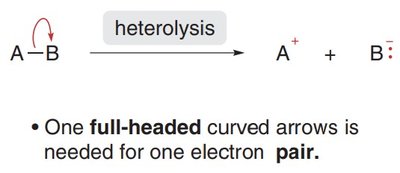
Heterolytic cleavage: Both electrons from the covalent bond are transferred to one atom, generating two charged species (one cation and one anion). This process is depicted with a full-headed curved arrow to show the movement of an electron pair.
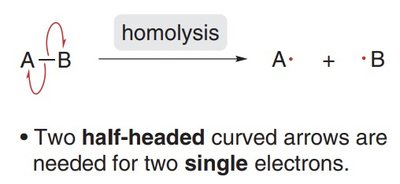
Homolytic cleavage: Each atom receives one electron from the bond, resulting in two uncharged radicals. This is shown with half-headed curved arrows ("fishhooks") for single electron movement.
Key distinction: Heterolytic cleavage produces ions, while homolytic cleavage produces radicals.
Radical Structure and Stability
Carbon Radical Structure
Carbon radicals are important intermediates in many organic reactions. Their structure and hybridization influence their reactivity and stability.
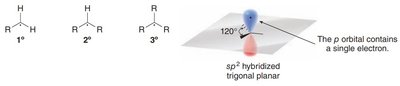
Hybridization: Carbon radicals are sp2-hybridized and have a trigonal planar geometry.
Unpaired electron: The unpaired electron resides in an unhybridized p orbital, perpendicular to the plane of the molecule.
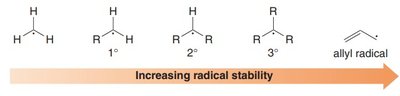
Classification: Radicals are classified as primary (1°), secondary (2°), or tertiary (3°) based on the number of alkyl groups attached to the radical center.
Radical Stability
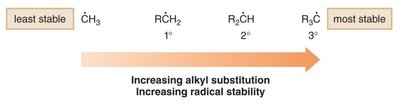
The stability of carbon radicals increases with greater alkyl substitution due to hyperconjugation and inductive effects.
Order of stability: 3° > 2° > 1° > methyl (Me)
Rearrangement: 2° and 1° radicals do not undergo rearrangement.
Reason: Alkyl groups donate electron density, stabilizing the radical center.
Radical Reactions and Mechanisms
General Properties of Radical Reactions
Radicals are highly reactive species that seek to achieve an octet. They participate in several types of reactions:
React with σ-bonds (e.g., halogenation of alkanes, allylic halogenation)
Add to π-bonds (e.g., radical addition of HBr, polymerization)
React with other radicals (termination steps)
Radical Halogenation of Alkanes
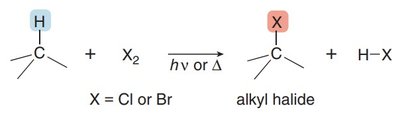
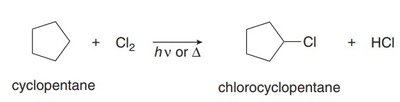
Radical halogenation is a key method for converting alkanes to alkyl halides, typically using chlorine (Cl2) or bromine (Br2) in the presence of light or heat.
Mechanism: Radical substitution, where halogen replaces a hydrogen atom via a radical pathway.
Conditions: Requires light (hv) or heat (Δ) to initiate homolysis.
Products: Alkyl halide and hydrogen halide (H–X).
Mechanism Steps of Radical Halogenation
The radical halogenation mechanism consists of three distinct steps:
Initiation: Homolysis of the weakest bond (usually X–X) by light or heat forms two radicals.
Propagation: The halogen radical abstracts a hydrogen atom, forming a new carbon radical and H–X. The carbon radical then abstracts a halogen atom from X2, forming the alkyl halide and regenerating the halogen radical. This "chain mechanism" repeats.
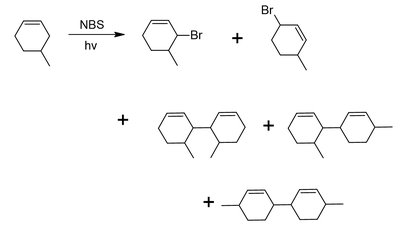
Termination: Two radicals combine to form a stable bond, often leading to unwanted side-products.
Bond Strength and Reactivity
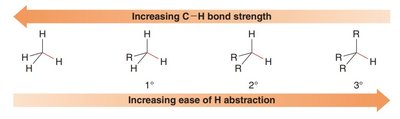
The ease of radical halogenation depends on the strength of the C–H bond being broken. Weaker C–H bonds are more readily abstracted.
Order of bond strength: 1° > 2° > 3°
Ease of abstraction: 3° > 2° > 1°
Product Distribution and Selectivity
Radical Chlorination
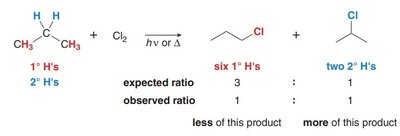
Product distribution in radical chlorination depends on the type of C–H bond broken, not the number of each type of hydrogen.
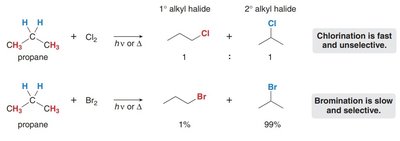
Chlorination is fast and unselective.
Major product results from cleavage of the weakest C–H bond.
Chlorination vs. Bromination
Chlorination and bromination differ in their selectivity and speed:
Chlorination: Fast, unselective, produces a mixture of products.
Bromination: Slow, highly selective, usually yields one major product.
Reason: Bromination favors abstraction of hydrogen from the weakest C–H bond, forming the most stable radical.
Energetics and Transition States
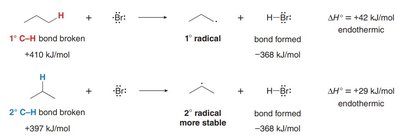
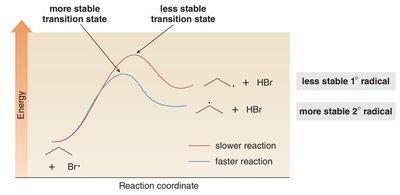
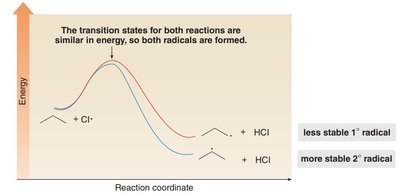
The rate-determining step (RDS) in bromination is endothermic and forms the more stable radical faster. In chlorination, the RDS is exothermic and transition states resemble starting materials, so both radicals are formed.
Bromination: Endothermic RDS, transition state resembles products.
Chlorination: Exothermic RDS, transition state resembles reactants.
Synthetic Applications
Transforming C–H Bonds
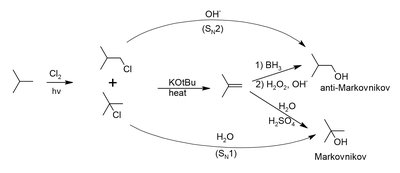
Radical halogenation is a valuable synthetic tool for converting unreactive C–H bonds into alkyl halides, which can undergo further reactions such as nucleophilic substitution or elimination.
Alkanes: Generally unreactive, but can be functionalized via radical halogenation.
Alkyl halides: More reactive, suitable for various synthetic transformations.
Stereochemistry of Radical Halogenation
Effects on Stereochemistry
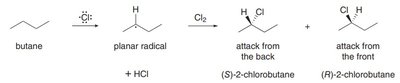
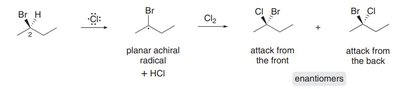
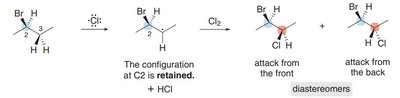
The stereochemical outcome of radical halogenation depends on the nature of the starting material and the site of reaction.
Achiral starting material: Yields achiral or racemic products due to the planar nature of the radical intermediate.
Chiral starting material: If the reaction does not occur at the stereocenter, configuration is retained. If a new stereocenter is formed, racemization occurs.
Allylic Radicals and Selective Bromination
Allylic Radicals
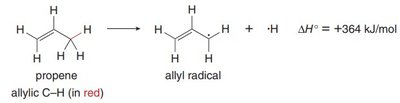
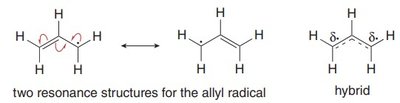
An allylic carbon is adjacent to a double bond, and the corresponding allyl radical is stabilized by resonance.
Allylic C–H bond: Weaker than tertiary C–H bond, making it more susceptible to abstraction.
Stability: Allyl radical is more stable than tertiary radicals due to resonance delocalization.
Selective Bromination at Allylic Carbon
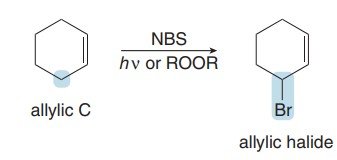
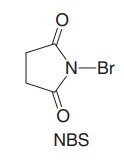
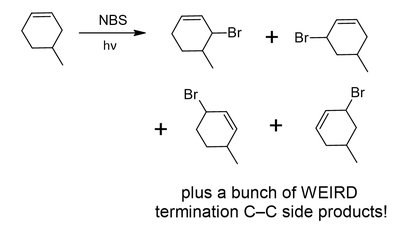
Selective bromination at the allylic position is achieved using N-bromosuccinimide (NBS), which generates Br• radicals and Br2 in situ. The reaction requires light or a radical initiator (ROOR).
Initiation: Homolysis of the N–Br bond in NBS forms Br• radicals.
Propagation: Br• abstracts an allylic hydrogen, forming an allylic radical. The allylic radical reacts with Br2 to form the allylic halide and regenerate Br•.
Termination: Two radicals combine to form a stable bond.
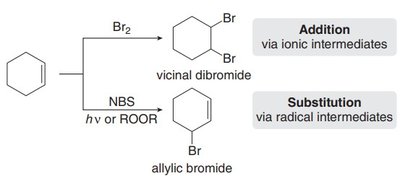
Comparison of Bromination Methods
Bromination of alkenes can proceed via ionic or radical intermediates. NBS favors radical substitution at the allylic position, while Br2 addition forms vicinal dibromides via ionic intermediates.
Addition: Ionic intermediates (bromonium ion).
Substitution: Radical intermediates (favored by NBS).
Product Distribution and Regiochemistry
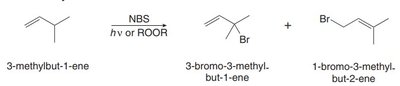
Halogenation at the allylic carbon often generates a mixture of products due to resonance stabilization of the allylic radical. The major product is typically the more substituted alkene, following Zaitsev's rule.
Regiochemistry: Zaitsev's rule applies; more substituted alkene is the major product.
Stereochemistry: Same principles as other radical reactions.
Summary Table: Radical Halogenation Comparison
Halogen | Speed | Selectivity | Major Product |
|---|---|---|---|
Cl2 | Fast | Unselective | Mixture |
Br2 | Slow | Highly selective | Most stable radical |
Key Equations
Homolytic cleavage:
Radical halogenation:
Allylic bromination:
