 Back
BackRadical Reactions in Organic Chemistry: Mechanisms, Types, and Applications
Study Guide - Smart Notes
 Tailored notes based on your materials, expanded with key definitions, examples, and context.
Radical Reactions
Introduction to Radical Reactions
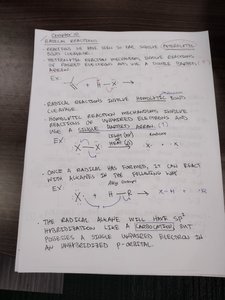
Radical reactions are a fundamental class of organic reactions involving species with unpaired electrons, known as radicals. These reactions are distinct from ionic mechanisms and play a crucial role in synthetic and biological chemistry.
Radicals: Atoms or molecules with an unpaired electron, typically formed by homolytic bond cleavage.
Homolytic Cleavage: The breaking of a covalent bond so that each fragment retains one electron, forming two radicals.
Example:
Mechanism of Radical Reactions
Radical reactions generally proceed via three main steps: initiation, propagation, and termination.
Initiation: Formation of radicals, often by heat or light.
Propagation: Radicals react with stable molecules to form new radicals, continuing the chain reaction.
Termination: Two radicals combine to form a stable molecule, ending the chain reaction.
Example:
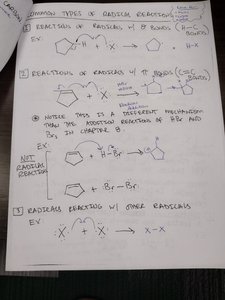
Types of Radical Reactions
Common Types
Reaction with Radicals and H-X Bonds: Radicals abstract hydrogen atoms from molecules, forming new radicals. Example:
Reaction of Radicals with π Bonds: Radicals add to double bonds, forming new carbon-centered radicals. Example:
Radicals Reacting with Other Radicals: Two radicals combine to form a stable molecule. Example:
Radical Inhibitors and Antioxidants
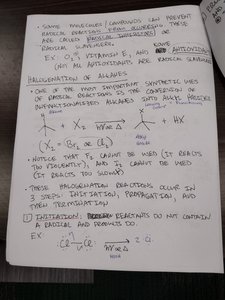
Some molecules can prevent radical chain reactions by reacting with radicals to form stable products. These are known as radical inhibitors or antioxidants.
Antioxidants: Compounds like vitamin E and BHT (butylated hydroxytoluene) act as radical scavengers.
Example:
Halogenation of Alkanes
Radical Halogenation
One of the most important synthetic uses of radical reactions is the halogenation of alkanes, where a halogen atom is introduced into an alkyl group.
General Reaction:
Initiation:
Propagation:
Termination:
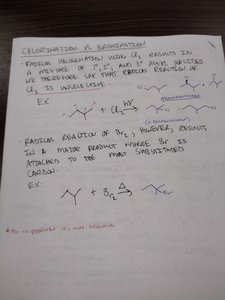
Chlorination vs. Bromination
Chlorination and bromination differ in selectivity and product distribution.
Chlorination: Less selective, often produces a mixture of products.
Bromination: More selective, favors substitution at the most substituted carbon.
Example: Chlorination: Bromination:
Radical Reaction Classifications
Precipitation, Termination, and Initiation
Radical reactions can be classified based on the presence of radicals in reactants and products.
Precipitation: Reactants contain a radical, and products contain a radical.
Termination: Reactants contain a radical, but products do not.
Initiation: Reactants do not contain a radical, but products do.
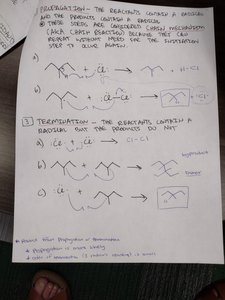
Summary Table: Types of Radical Reactions
Type | Reactants | Products | Example |
|---|---|---|---|
Initiation | No radical | Radical | |
Propagation | Radical | Radical | |
Termination | Radical | No radical |
Key Points and Applications
Radical reactions are essential for alkane halogenation, polymerization, and biological processes.
Understanding selectivity and mechanism is crucial for predicting products.
Antioxidants and radical inhibitors are important in preventing unwanted radical reactions.
Additional info: Academic context was added to clarify mechanisms, selectivity, and the role of antioxidants, as well as to provide a summary table for classification.
