 Back
BackReaction Kinetics in Organic Chemistry: Study Notes
Study Guide - Smart Notes
 Tailored notes based on your materials, expanded with key definitions, examples, and context.
Reaction Kinetics in Organic Chemistry
Introduction to Reaction Kinetics
Reaction kinetics is a fundamental topic in organic chemistry, focusing on the rates at which chemical reactions occur and the factors influencing these rates. Understanding kinetics allows chemists to deduce reaction mechanisms and optimize conditions for desired outcomes.
Definition of Reaction Rate
The reaction rate (r) is defined as the change in concentration of reactants or products per unit time. It can be expressed as:
For concentration: $r = \frac{\Delta [A]}{\Delta t}$
For partial pressure (gases): $r = \frac{\Delta P(A)}{\Delta t}$
Rates can be positive or negative depending on whether the concentration of a reactant decreases or a product increases.
Average and Instantaneous Reaction Rate
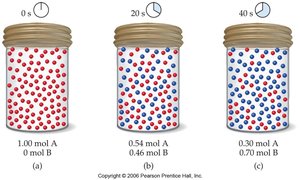
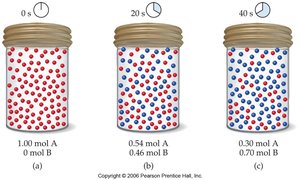
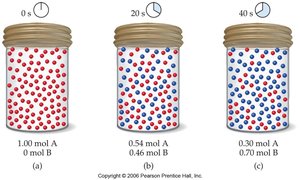
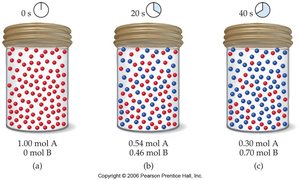
The average reaction rate is calculated over a time interval, while the instantaneous rate is the rate at a specific moment, often determined by the slope of a concentration vs. time graph.
Example: For the reaction A → B, the rate at different intervals can be calculated using concentration data.
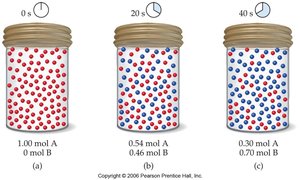
Improved Definition of Reaction Rate
For reactions involving multiple reactants and products, the rate is standardized by dividing the change in concentration by the stoichiometric coefficient:
Example: $1\text{ N}_2 + 3\text{ H}_2 \rightarrow 2\text{ NH}_3$
$r = -\frac{1}{1} \frac{\Delta [\text{N}_2]}{\Delta t} = -\frac{1}{3} \frac{\Delta [\text{H}_2]}{\Delta t} = +\frac{1}{2} \frac{\Delta [\text{NH}_3]}{\Delta t}$
Factors Affecting Reaction Rate
Several factors influence the rate of a chemical reaction:
Concentration: Higher concentration increases collision frequency.
Temperature: Higher temperature increases kinetic energy and collision frequency.
Catalyst: Alters the reaction mechanism, lowering activation energy.
Surface Area: Relevant for reactions involving solids.
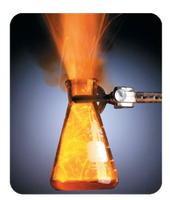
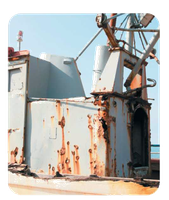
Reaction Rate as a Function of Concentration
The rate of reaction often depends on the concentration of reactants. This relationship is described by the rate law:
Example: $\text{C}_4\text{H}_9\text{Cl}(aq) + \text{H}_2\text{O}(l) \rightarrow \text{C}_4\text{H}_9\text{OH}(aq) + \text{HCl}(aq)$
The slope of the concentration vs. time graph gives the instantaneous rate.
Rate Law and Reaction Order
The rate law expresses the rate as a function of reactant concentrations:
$r = k[\text{C}_2\text{H}_4\text{Br}_2][\text{I}^-]$
Here, k is the rate constant, and the exponents indicate the order of the reaction with respect to each reactant.
Reaction Order
The order of a reaction is determined by the sum of the exponents in the rate law:
First order: $r = k[X]$
Second order: $r = k[X]^2$ or $r = k[X][Y]$
Zero order: $r = k$
The order is not always directly related to the stoichiometry of the reaction equation.
Integrated Rate Laws
Integrated rate laws allow calculation of reactant concentration at any time t:
First order: $[X]_t = [X]_0 e^{-kt}$
Second order: $\frac{1}{[X]_t} = kt + \frac{1}{[X]_0}$
Zero order: $[X]_t = [X]_0 - kt$
Graphical analysis helps determine reaction order by plotting appropriate functions (e.g., ln[X] vs. t for first order).
Determining Reaction Order from Data
Experimental data can be used to determine reaction order by fitting concentration-time data to different integrated rate laws and comparing linearity.
Example: For NO2 decomposition, plotting 1/[NO2] vs. t yields a straight line, indicating second-order kinetics.
Relationship Between Rate and Mechanism: SN1 and SN2
Reaction rate analysis provides insight into the mechanism. For example:
SN2 reactions: Rate depends on both nucleophile and substrate concentrations ($r = k[\text{OH}^-][\text{CH}_3\text{Cl}]$).
SN1 reactions: Rate depends only on substrate concentration ($r = k[(\text{CH}_3)_3\text{Cl}]$).
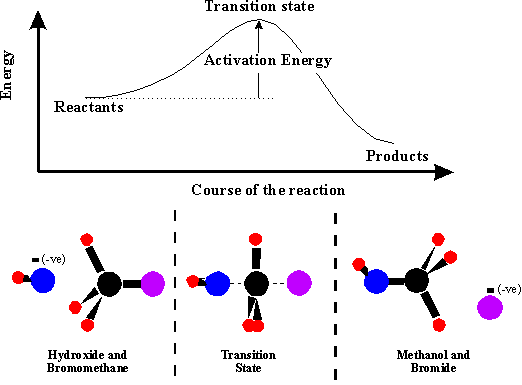
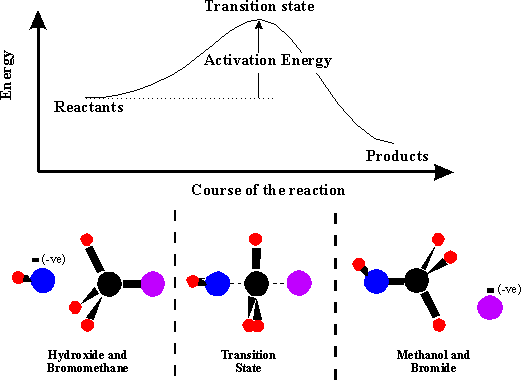
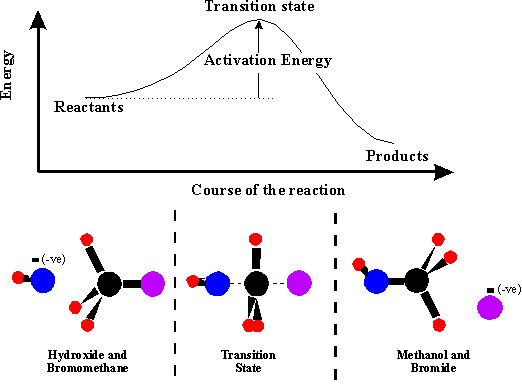
Thus, kinetic analysis can reveal whether a reaction proceeds via SN1 or SN2 mechanism.
Summary Table: Reaction Order and Rate Law
Order | Rate Law | Integrated Rate Law | Unit of k |
|---|---|---|---|
Zero | $r = k$ | $[X]_t = [X]_0 - kt$ | mol L-1 s-1 |
First | $r = k[X]$ | $[X]_t = [X]_0 e^{-kt}$ | s-1 |
Second | $r = k[X]^2$ or $r = k[X][Y]$ | $\frac{1}{[X]_t} = kt + \frac{1}{[X]_0}$ | L mol-1 s-1 |
Conclusion
Reaction kinetics is essential for understanding how organic reactions proceed, how to determine their mechanisms, and how to optimize conditions. Rate laws, reaction order, and kinetic analysis are key tools in the organic chemist's toolkit.
