 Back
BackReactions and Properties of Aldehydes and Ketones: Nucleophilic Addition, Reduction, and Synthetic Applications
Study Guide - Smart Notes
 Tailored notes based on your materials, expanded with key definitions, examples, and context.
Reactivity of Aldehydes and Ketones
Relative Reactivity of Carbonyl Compounds
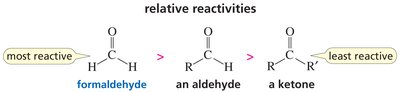
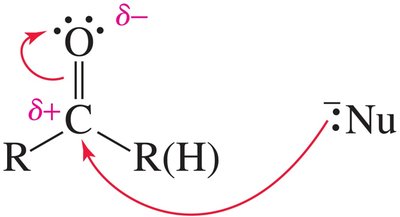
Aldehydes and ketones are important carbonyl compounds in organic chemistry, exhibiting distinct reactivity patterns due to their structural differences. The reactivity of carbonyl compounds toward nucleophilic addition decreases in the following order: formaldehyde > other aldehydes > ketones. This is because aldehydes have a greater partial positive charge on the carbonyl carbon and are less sterically hindered than ketones.
Aldehydes are more reactive than ketones due to the presence of a hydrogen atom (more electron-withdrawing) and less steric hindrance.
Ketones have two alkyl groups, which are electron-donating and increase steric hindrance, making the carbonyl carbon less accessible.
Reactivity Order of Carboxylic Acid Derivatives
Carboxylic acid derivatives also show a hierarchy of reactivity toward nucleophilic addition and substitution. The order is:
Acyl halide > acid anhydride > aldehyde > ketone > ester > carboxylic acid > amide > carboxylate ion

Mechanisms of Nucleophilic Addition and Substitution
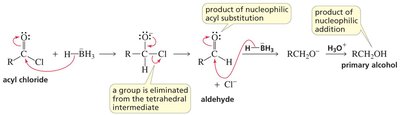
Nucleophilic Acyl Substitution
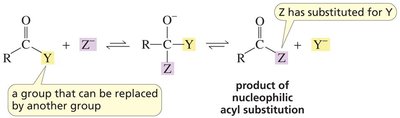
Nucleophilic acyl substitution occurs when the group attached to the carbonyl (Y) can be replaced by another group (Z). This is typical for carboxylic acid derivatives.
Mechanism: Nucleophile attacks the carbonyl carbon, forming a tetrahedral intermediate, which then eliminates the leaving group.
Product: The nucleophile replaces the original group attached to the carbonyl.
Nucleophilic Addition
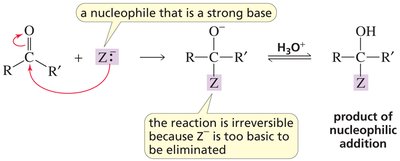
Nucleophilic addition occurs when the group attached to the carbonyl cannot be replaced, as in aldehydes and ketones. The nucleophile adds to the carbonyl carbon, forming an alcohol after protonation.
Mechanism: Nucleophile attacks the carbonyl carbon, forming an alkoxide intermediate, which is then protonated.
Product: Alcohol (hydroxyl group attached to the former carbonyl carbon).
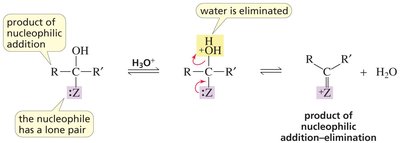
Nucleophilic Addition–Elimination
Some nucleophilic additions to aldehydes and ketones lead to addition–elimination products, especially when the nucleophile has a lone pair and water is eliminated.
Mechanism: Nucleophile adds to the carbonyl, followed by elimination of water.
Product: Addition–elimination product (e.g., imines, enamines).
Reactions with Grignard Reagents
Grignard Addition to Aldehydes and Ketones
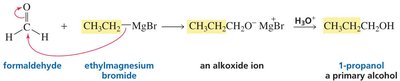
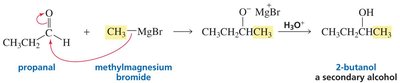
Grignard reagents (RMgX) react with aldehydes and ketones to form alcohols. The type of alcohol formed depends on the starting carbonyl compound:
Formaldehyde: Yields primary alcohols.
Aldehydes (other than formaldehyde): Yields secondary alcohols.
Ketones: Yields tertiary alcohols.

Grignard Addition to Esters and Acyl Chlorides
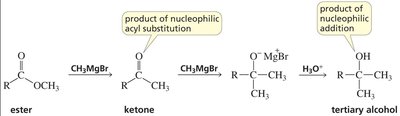
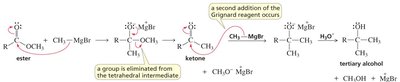
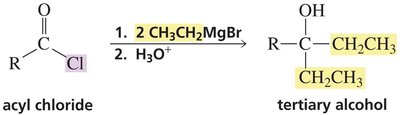
Esters and acyl chlorides react with Grignard reagents to give tertiary alcohols after two equivalents of Grignard reagent are added.
Esters: Undergo nucleophilic acyl substitution followed by nucleophilic addition.
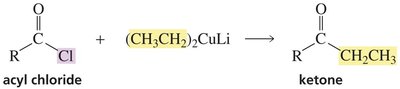
Acyl chlorides: Undergo nucleophilic acyl substitution, then addition.
Reactions with Cyanide Ion
Cyanohydrin Formation
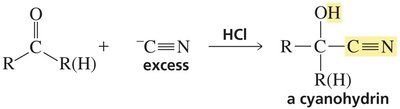
Aldehydes and ketones react with cyanide ion (CN-) to form cyanohydrins, which are useful intermediates in organic synthesis.
Mechanism: Nucleophilic addition of cyanide to the carbonyl carbon, followed by protonation.
Product: Cyanohydrin (contains both OH and CN groups).
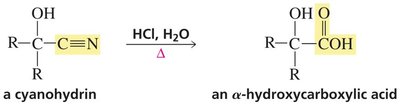
Reactions of Cyanohydrins
Hydrolysis: Cyanohydrins can be hydrolyzed to α-hydroxycarboxylic acids.
Reduction: Cyanohydrins can be reduced to primary amines with an OH group on the β-carbon.

Reduction of Aldehydes, Ketones, and Derivatives
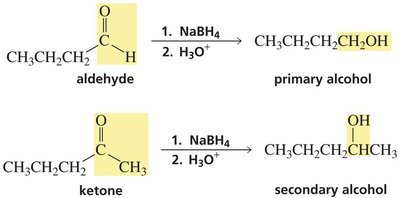
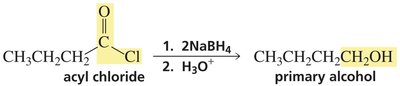
Hydride Reduction (NaBH4 and LiAlH4)
Hydride donors such as sodium borohydride (NaBH4) and lithium aluminum hydride (LiAlH4) are used to reduce carbonyl compounds to alcohols.
NaBH4: Reduces aldehydes and ketones, but not esters or carboxylic acids.
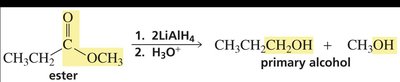
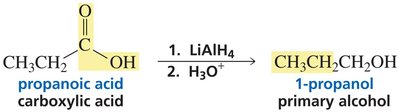
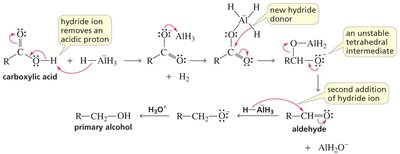
LiAlH4: Reduces aldehydes, ketones, esters, carboxylic acids, amides, and nitriles.

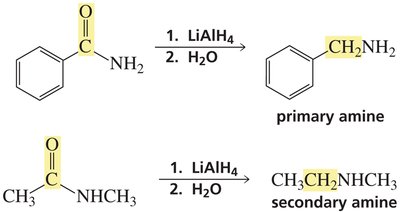
Comparison of NaBH4 and LiAlH4
NaBH4: Milder, selective for aldehydes and ketones.
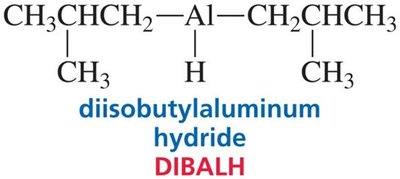
LiAlH4: Stronger, reduces a wider range of carbonyl compounds.
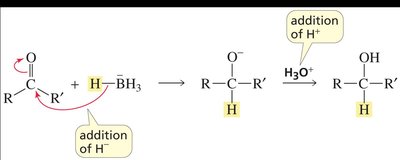

Imine and Enamine Formation
Reaction with Primary Amines: Imine Formation
Aldehydes and ketones react with primary amines to form imines via nucleophilic addition followed by elimination of water.
Mechanism: Formation of a carbinolamine intermediate, followed by dehydration.
Product: Imine (Schiff base).

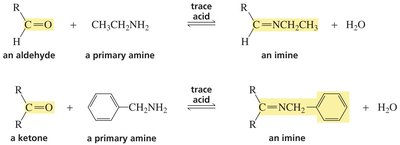
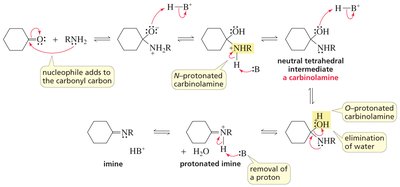
Reaction with Secondary Amines: Enamine Formation
Secondary amines react with aldehydes and ketones to form enamines, which are useful intermediates in organic synthesis.
Mechanism: Nucleophilic addition, followed by elimination of water.
Product: Enamine (contains a C=C bond adjacent to the nitrogen).
Reactions with Water and Alcohols
Hydration and Acetal Formation
Aldehydes and ketones react with water to form hydrates and with alcohols to form hemiacetals and acetals. Acid catalysis increases the electrophilicity of the carbonyl carbon, facilitating these reactions.
Acetal Formation: In the presence of excess alcohol and acid catalyst, acetals are formed.
Protecting Groups: Acetals can be used as protecting groups for carbonyls in synthetic chemistry.
Summary Table: Reactivity Toward Nucleophiles
Priority | Class |
|---|---|
1 (highest) | Carboxylic acid |
2 | Ester |
3 | Acid halide |
4 | Amide |
5 | Nitrile |
6 | Aldehyde |
7 | Ketone |
8 | Alcohol |
9 | Amine |
10 | Alkene |
11 | Alkyne |
12 | Alkane |
13 | Ether |
14 (lowest) | Alkyl halide |
Key Terms and Concepts
Carbonyl Group: Functional group with a C=O bond.
Nucleophilic Addition: Reaction where a nucleophile adds to the carbonyl carbon.
Nucleophilic Acyl Substitution: Reaction where the group attached to the carbonyl is replaced by a nucleophile.
Imine: Compound formed by reaction of a carbonyl with a primary amine.
Enamine: Compound formed by reaction of a carbonyl with a secondary amine.
Grignard Reagent: Organomagnesium compound used for nucleophilic addition to carbonyls.
Hydride Reduction: Reduction of carbonyls to alcohols using hydride donors.
Example Equations
General nucleophilic addition to carbonyl:
Reduction of aldehyde:
Grignard addition to ketone:
Additional info:
Some images provided are memes or humorous depictions and are not directly relevant to the academic explanations; only mechanistic and structural diagrams are included.
For full mechanisms and synthetic applications, refer to textbook chapters on carbonyl chemistry, nucleophilic addition, and reduction reactions.
