 Back
BackReactions of Aromatic Compounds: Electrophilic and Nucleophilic Substitution
Study Guide - Smart Notes
 Tailored notes based on your materials, expanded with key definitions, examples, and context.
Reactions of Aromatic Compounds
Aromaticity Recap
Aromaticity is a fundamental concept in organic chemistry, describing the unique stability of certain cyclic, conjugated molecules. For a molecule to be aromatic, it must satisfy four key conditions:
Conjugation: Every atom in the ring must be able to participate in π-bonding, allowing for delocalization of electrons.
Hückel’s Rule: The molecule must have 2, 6, 10, 14, 18, ... π-electrons (4n+2, where n is an integer).
Planarity: The molecule must be flat, which is generally achieved if the first three conditions are met.
Cyclic Structure: The molecule must be cyclic.
Electrophilic Aromatic Substitution (SEAr)
Electrophilic Aromatic Substitution (SEAr) is a reaction in which a hydrogen atom of an aromatic ring is replaced by an electrophile. This is the most common type of reaction for aromatic compounds.
Types of Electrophiles: Common electrophiles include NO2+ (nitronium ion), SO3 (sulfur trioxide), Br2 (bromine), and carbocations.
Generation of Electrophiles: Electrophiles are often generated in situ by reaction with acids or Lewis acids.
Mechanism: The mechanism involves two main steps:
Attack of the electrophile (E+) on the π-electron system of the aromatic ring, forming a non-aromatic, delocalized carbocation intermediate (sigma complex). This step is slow and endothermic.
Loss of a proton (H+) from the carbocation intermediate, restoring aromaticity. This step is fast and exothermic.



Main SEAr Reactions
The principal electrophilic aromatic substitution reactions include:
Nitration: Introduction of a nitro group (NO2) using nitric acid and sulfuric acid.
Sulfonation: Introduction of a sulfonic acid group (SO3H) using sulfuric acid or sulfur trioxide.
Halogenation: Introduction of halogens (Cl, Br) using halogen and a Lewis acid (e.g., FeBr3).
Friedel-Crafts Alkylation: Introduction of alkyl groups using alkyl halides and AlCl3.
Friedel-Crafts Acylation: Introduction of acyl groups using acyl halides and AlCl3.
Mechanism of SEAr
The SEAr mechanism is characterized by the formation of a sigma complex (arenium ion) and restoration of aromaticity.
Step 1: Electrophile attacks the aromatic ring, breaking aromaticity and forming a carbocation intermediate.
Step 2: Proton is lost, restoring aromaticity and yielding the substituted product.


Energy Profile of SEAr
The energy profile of SEAr shows a high activation energy for the formation of the carbocation intermediate, which is the rate-determining step.
Rate Determining Step (RDS): Formation of the sigma complex.
Fast Step: Loss of proton and restoration of aromaticity.

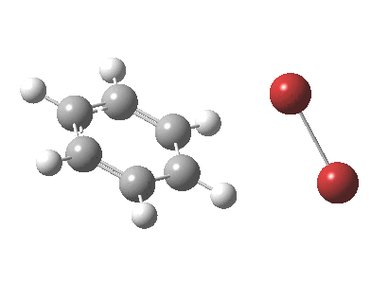
Halogenation of Benzene
Halogenation involves the reaction of benzene with halogens in the presence of a Lewis acid.
Bromination: Benzene reacts with Br2 and FeBr3 to form bromobenzene.
Chlorination: Similar mechanism as bromination, using Cl2 and FeCl3.
Nitration of Benzene
Nitration introduces a nitro group into benzene using nitric acid and sulfuric acid.
Electrophile: Nitronium ion (NO2+).
Conditions: 30–40 °C.

Sulfonation of Benzene
Sulfonation introduces a sulfonic acid group using sulfuric acid or sulfur trioxide.
Electrophile: SO3 or protonated SO3.
Conditions: Heating is often required.
Friedel-Crafts Alkylation and Acylation
Friedel-Crafts reactions are used to introduce alkyl or acyl groups into benzene.
Alkylation: Uses alkyl halides and AlCl3 to generate carbocations or activated alkyl halides.
Acylation: Uses acyl halides and AlCl3 to generate acylium ions, which do not rearrange.
Substituent Effects in SEAr
Substituents on the aromatic ring influence both the rate and orientation of SEAr reactions.
Activating Groups: Increase the rate and direct substitution to ortho and para positions (e.g., -CH3, -OH, -NH2).
Deactivating Groups: Decrease the rate and direct substitution to the meta position (e.g., -NO2, -CF3).
Halogens: Weakly deactivating but ortho/para-directing.
Regioselectivity Examples
Toluene: Undergoes nitration much faster than benzene, with main products at ortho and para positions due to the methyl group’s activating effect.
Trifluoromethylbenzene: Nitration occurs mainly at the meta position due to the CF3 group’s deactivating effect.
Friedel-Crafts Limitations and Rearrangements
Primary Alkyl Halides: Often rearrange to more stable carbocations before alkylation.
Exceptions: Methyl, ethyl, allyl, and benzyl halides do not rearrange.

Reactions of Aryl Halides
Aryl halides are less reactive in nucleophilic substitution due to the stability of the C–X bond and the aromatic ring.
SN1 Mechanism: Unlikely due to instability of aryl carbocations.
SN2 Mechanism: Sterically hindered; nucleophile cannot attack from behind.
SNAr Mechanism: Occurs via addition-elimination, especially when electron-withdrawing groups are present.
Nucleophilic Aromatic Substitution (SNAr)
SNAr reactions occur when aryl halides have strong electron-withdrawing groups (e.g., NO2) ortho or para to the halide.
Mechanism: Nucleophile adds to the ipso carbon, forming a Meisenheimer complex, which then eliminates the halide.
Stabilization: Fluorine stabilizes the intermediate more than chlorine due to its higher electronegativity.
Elimination-Addition Mechanism (Benzyne Mechanism)
When electron-withdrawing groups are absent, nucleophilic aromatic substitution can occur via elimination-addition, forming a benzyne intermediate.
Conditions: Requires strong base and high temperature/pressure.
Mechanism: Base-promoted β-elimination forms benzyne, which then reacts with the nucleophile.
Summary Table: Substituent Effects in SEAr
Substituent | Effect on Rate | Orientation |
|---|---|---|
Very strongly activating | Increase | Ortho, para |
Strongly activating | Increase | Ortho, para |
Activating | Increase | Ortho, para |
Halogen | Decrease | Ortho, para |
Deactivating | Decrease | Meta |
Strongly deactivating | Decrease | Meta |
Key Equations
Hückel’s Rule: π-electrons (where n = 0, 1, 2, ...)
General SEAr Mechanism:
Benzyne Formation:
Conclusion
The study of aromatic compounds and their substitution reactions is central to organic chemistry. Understanding the mechanisms, regioselectivity, and effects of substituents is essential for predicting and designing synthetic routes for aromatic molecules. Electrophilic aromatic substitution dominates the chemistry of benzene and its derivatives, while nucleophilic aromatic substitution is significant for aryl halides with electron-withdrawing groups or under extreme conditions. Additional info: Academic context was added to clarify mechanisms, substituent effects, and provide summary tables for exam preparation.
