 Back
BackRepresentations and Stereochemistry of Carbohydrates
Study Guide - Smart Notes
 Tailored notes based on your materials, expanded with key definitions, examples, and context.
I. Representations and Stereochemistry of Carbohydrates
A. Fischer Projections
Fischer projections are a two-dimensional representation of three-dimensional organic molecules, commonly used for carbohydrates and amino acids. They allow for the clear depiction of stereochemistry at each chiral center.
Key Features: Vertical lines represent bonds going away from the viewer, while horizontal lines represent bonds coming out toward the viewer.
Conventions: The most oxidized carbon (e.g., the carbonyl group) is placed at the top. For sugars, the D/L configuration is determined by the position of the hydroxyl group on the penultimate carbon.
Allowed Operations: 180° rotations in the plane of the paper are allowed; 90° rotations are forbidden as they invert stereochemistry. Swapping any two groups at a chiral center inverts its configuration.
Enantiomers and Diastereomers: Enantiomers are non-superimposable mirror images; diastereomers are stereoisomers that are not mirror images.
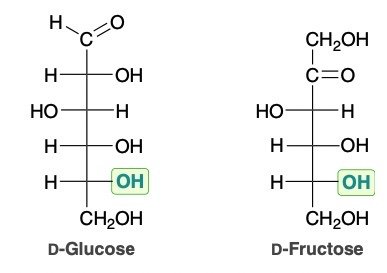
Example: The Fischer projections of D-glucose and D-fructose show the arrangement of hydroxyl groups and the carbonyl group, which are critical for distinguishing between different sugars.
B. Rules and Conventions of Fischer Projections
Understanding the manipulation of Fischer projections is essential for determining stereochemistry and for interconverting between different representations.
Rule 1: Draw the carbonyl group (C=O) as close to the top as possible.
Rule 2: 180° rotations are allowed; 90° rotations are forbidden.
Rule 3: Cyclic rotation of any three groups at a terminal carbon is allowed.
Rule 4: Swapping any two groups at a chiral center inverts the configuration (produces the enantiomer).
Rule 5: "Pancake flips" (flipping the projection over) are forbidden as they invert all chiral centers.
Rule 6: To assign R/S configuration, if the lowest priority group is horizontal, invert the result.
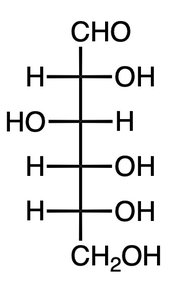
Example: The Fischer projections above show different stereoisomers of aldohexoses, illustrating how the arrangement of hydroxyl groups determines the identity of the sugar.
C. Cyclization of Monosaccharides
Monosaccharides can exist in both open-chain (linear) and cyclic forms. Cyclization occurs via nucleophilic attack of a hydroxyl group on the carbonyl carbon, forming a hemiacetal (for aldoses) or hemiketal (for ketoses).
Hemiacetal Formation: The reaction between an alcohol and an aldehyde or ketone forms a hemiacetal or hemiketal, respectively.
Pyranose and Furanose Forms: Six-membered rings are called pyranoses; five-membered rings are furanoses.
Anomers: Cyclization creates a new chiral center at the anomeric carbon, resulting in alpha (α) and beta (β) anomers. These can interconvert in solution (mutarotation).
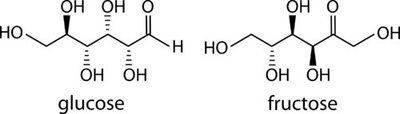
Example: Glucose and fructose can cyclize to form pyranose and furanose rings, respectively. The formation of a new chiral center at the anomeric carbon leads to the existence of α and β anomers.
D. The Cyclic Representations of Carbohydrates
Cyclic forms of carbohydrates are often represented using Haworth projections and chair conformations. These representations help visualize the stereochemistry and conformational preferences of the rings.
Haworth Projections: A simplified planar representation of the cyclic form, showing the relative positions of substituents above or below the ring.
Chair Structures: More accurate three-dimensional representations of six-membered rings (pyranoses), showing axial and equatorial positions of substituents.
Axial vs. Equatorial: Substituents in the equatorial position are generally more stable due to reduced steric hindrance.
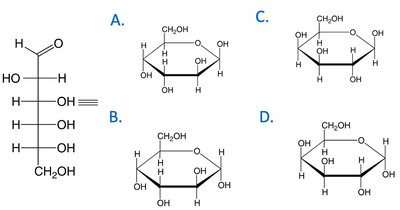
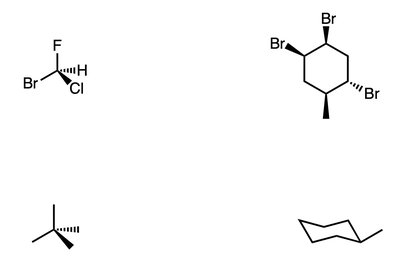
Example: The Haworth projection and chair conformation of glucose show the spatial arrangement of hydroxyl groups, which is important for understanding reactivity and recognition by enzymes.
E. Interconversion Between Representations
It is important to be able to convert between Fischer, Haworth, and chair representations to fully understand carbohydrate structure and reactivity.
Fischer to Haworth: Groups on the right in the Fischer projection point down in the Haworth projection; groups on the left point up.
Haworth to Chair: The Haworth projection can be translated into a chair conformation, assigning substituents to axial or equatorial positions based on their orientation.
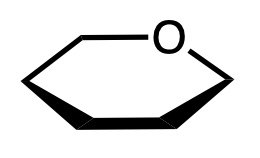
Example: The conversion from Fischer to Haworth to chair representations allows for the prediction of the most stable conformer and the reactivity of the carbohydrate.
F. Stereochemistry and Isomerism in Carbohydrates
Carbohydrates often have multiple chiral centers, leading to a large number of possible stereoisomers. The number of stereoisomers is given by , where is the number of chiral centers.
Enantiomers: Non-superimposable mirror images.
Diastereomers: Stereoisomers that are not mirror images.
Anomers: Isomers differing at the anomeric carbon formed during cyclization.
Term | Definition | Example |
|---|---|---|
Enantiomers | Mirror images, non-superimposable | D-Glucose vs. L-Glucose |
Diastereomers | Not mirror images | D-Glucose vs. D-Galactose |
Anomers | Isomers at the anomeric carbon | α-D-Glucose vs. β-D-Glucose |
Example: The four Fischer projections in the table above represent different stereoisomers of aldohexoses, illustrating the diversity of carbohydrate structures.
G. Mechanism of Anomer Interconversion (Mutarotation)
In aqueous solution, the α and β anomers of a sugar interconvert via the open-chain form. This process is called mutarotation and is catalyzed by acid or base.
Mechanism: The cyclic form opens to the linear aldehyde or ketone, which can then reclose to form either anomer.
Result: An equilibrium mixture of α and β anomers is established.
Example: D-glucose in water exists as a mixture of α- and β-pyranose forms, with a small amount of the open-chain form present.
H. Summary Table: Common Representations of Carbohydrates
Representation | Purpose | Example |
|---|---|---|
Fischer Projection | Shows stereochemistry at each carbon |
|
Haworth Projection | Shows cyclic structure and anomeric configuration |
|
Chair Conformation | Shows 3D conformation and axial/equatorial positions |
|
Additional info: The QR codes and some images in the provided materials are not directly relevant to the organic chemistry content and have been omitted. The notes above synthesize the key learning objectives and provide academic context for the representations and stereochemistry of carbohydrates, as outlined in the source material.
