 Back
BackSN2 Reaction and Leaving Groups: Substitution and Elimination Mechanisms
Study Guide - Smart Notes
 Tailored notes based on your materials, expanded with key definitions, examples, and context.
SN2 Reaction Mechanism
Overview of SN2 Reactions
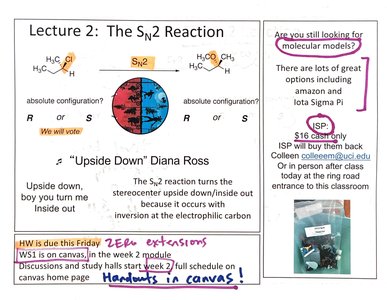
The SN2 (bimolecular nucleophilic substitution) reaction is a fundamental mechanism in organic chemistry, involving the direct displacement of a leaving group by a nucleophile. This process is characterized by a single concerted step, where bond formation and bond breaking occur simultaneously.
Definition: SN2 stands for Substitution Nucleophilic Bimolecular.
Mechanism: The nucleophile attacks the electrophilic carbon from the opposite side of the leaving group, resulting in inversion of configuration.
Example:
Configuration Change: The stereochemistry of the carbon center is inverted ("upside down" mechanism).
Absolute Configuration and Stereochemistry
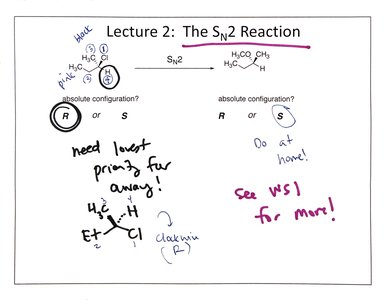
SN2 reactions are notable for their effect on the absolute configuration of chiral centers. The nucleophile attacks from the side opposite the leaving group, causing a complete inversion of configuration (Walden inversion).
R/S Configuration: The configuration changes from R to S or vice versa, depending on the starting material.
Example: If the starting material is R, the product will be S after SN2.
Substitution and Elimination Mechanisms
Classification of Mechanisms
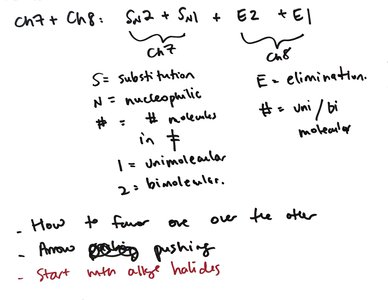
Organic reactions involving alkyl halides can proceed via substitution or elimination mechanisms. These are classified based on the number of molecules involved in the rate-determining step.
SN2: Bimolecular nucleophilic substitution (Chapter 7)
SN1: Unimolecular nucleophilic substitution (Chapter 7)
E2: Bimolecular elimination (Chapter 8)
E1: Unimolecular elimination (Chapter 8)
Key factors include the nature of the substrate, the strength of the nucleophile/base, and the leaving group.
Favoring One Mechanism Over Another
To determine which mechanism predominates, consider the substrate, nucleophile/base, and leaving group. Arrow pushing is used to illustrate electron flow in these reactions.
Substrate: Alkyl halides are common starting materials.
Arrow Pushing: Shows movement of electrons during the reaction.
Leaving Groups in Substitution and Elimination
Importance of Leaving Groups
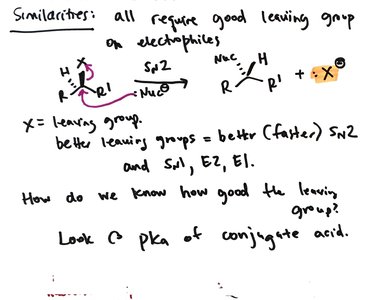
All substitution and elimination reactions require a good leaving group attached to the electrophilic carbon. The quality of the leaving group affects the rate and feasibility of SN2, SN1, E2, and E1 reactions.
Leaving Group: The atom or group that departs with a pair of electrons.
Better Leaving Groups: Lead to faster reactions.
Assessment: The pKa of the conjugate acid of the leaving group is a useful predictor.
Conjugate Acids and Bases
The stability of the conjugate base determines the effectiveness of the leaving group. A stable conjugate base corresponds to a good leaving group.
Conjugate Acid: The acid formed when the leaving group accepts a proton.
Conjugate Base: The leaving group itself after departure.
pKa: Lower pKa of the conjugate acid indicates a better leaving group.
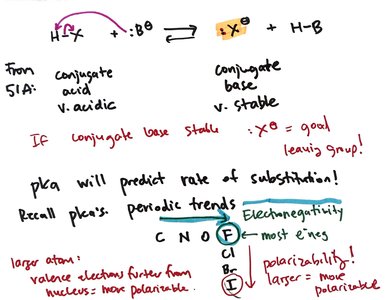
Periodic Trends and Leaving Group Ability
Periodic trends such as electronegativity and polarizability influence leaving group ability. Atoms with higher electronegativity or greater polarizability tend to form more stable conjugate bases, making them better leaving groups.
Electronegativity: More electronegative atoms stabilize negative charge better.
Polarizability: Larger atoms are more polarizable and stabilize charge through dispersion.
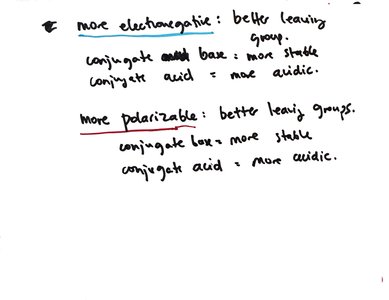
Table: Leaving Group Comparison
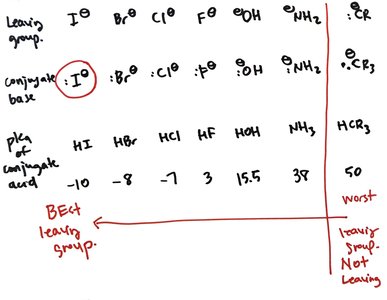
The following table compares common leaving groups, their conjugate bases, and the pKa values of their conjugate acids. The best leaving groups have the lowest pKa values.
Leaving Group | Conjugate Base | pKa of Conjugate Acid |
|---|---|---|
I- | I- | -10 |
Br- | Br- | -8 |
Cl- | Cl- | -7 |
F- | F- | 3 |
OH- | OH- | 15.5 |
NH2- | NH2- | 38 |
CR3- | CR3- | 50 |
Electronegativity and Polarizability Effects
Both electronegativity and polarizability contribute to leaving group ability. More electronegative and more polarizable atoms form more stable conjugate bases, which are better leaving groups.
Electronegativity: More electronegative = better leaving group, more stable conjugate base, more acidic conjugate acid.
Polarizability: More polarizable = better leaving group, more stable conjugate base, more acidic conjugate acid.
Comparing SN2 Reaction Rates
Effect of Leaving Group on SN2 Rate
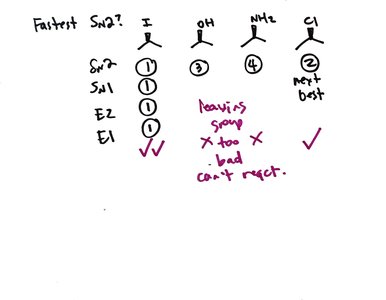
The rate of SN2 reactions is highly dependent on the leaving group. The best leaving groups (such as iodide) enable the fastest SN2 reactions, while poor leaving groups (such as hydroxide or amine) prevent the reaction.
Best Leaving Group: Iodide (I-)
Poor Leaving Groups: OH-, NH2-
Example: Alkyl iodides react fastest in SN2, alkyl chlorides are next best, alkyl hydroxides and amines do not react.
Arrow Pushing in Organic Chemistry
Arrow Pushing Conventions
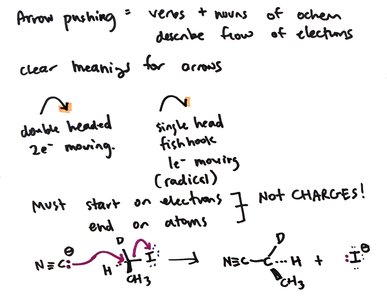
Arrow pushing is a visual tool used to describe the flow of electrons in organic reactions. Double-headed arrows indicate movement of electron pairs, while single-headed arrows (fishhook) indicate movement of single electrons (radicals).
Double-headed Arrow: Movement of two electrons.
Single-headed Arrow: Movement of one electron (radical).
Arrow Origin: Arrows must start on electrons, not charges, and end on atoms.
Example: Nucleophilic attack and leaving group departure in SN2.
Other Arrow Types
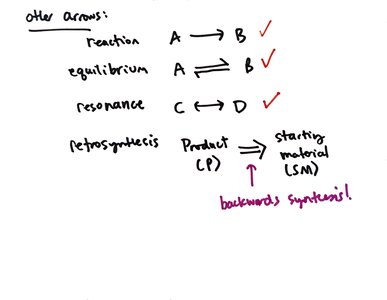
Arrows are also used to represent reactions, equilibria, resonance, and retrosynthesis in organic chemistry.
Reaction: A → B
Equilibrium: A → B
Resonance: C ↔ D
Retrosynthesis: Product → Starting Material (backwards synthesis)
Summary Table: Leaving Group Ability
Leaving Group | Conjugate Base | pKa of Conjugate Acid | SN2 Rate |
|---|---|---|---|
I- | I- | -10 | Fastest |
Cl- | Cl- | -7 | Next Best |
OH- | OH- | 15.5 | Poor |
NH2- | NH2- | 38 | Poor |
Additional Info
Handouts and worksheets are available on Canvas for further practice.
Model kits can be purchased for hands-on learning of stereochemistry.
