 Back
BackStep-by-Step Guidance for Alkynes (Organic Chemistry, Chapter 9)
Study Guide - Smart Notes
 Tailored notes based on your materials, expanded with key definitions, examples, and context.
Q1. How are alkynes prepared from dihalides?
Background
Topic: Preparation of Alkynes
This question tests your understanding of how alkynes can be synthesized from dihalides using strong bases, a fundamental transformation in organic chemistry.
Key Terms and Formulas
Dihalide: A molecule with two halogen atoms attached to adjacent carbons.
Alkyne: A molecule containing a carbon-carbon triple bond ().
E2 Elimination: A bimolecular elimination mechanism where a base removes a proton and a leaving group simultaneously.
Step-by-Step Guidance
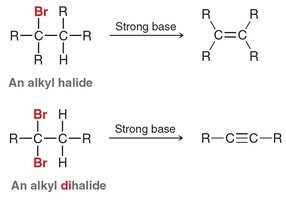
Identify the starting material: a geminal or vicinal dihalide (two halogens on adjacent carbons).
Recognize that a strong base (such as ) is required to promote elimination.
Understand that two successive E2 eliminations occur: the first forms an alkene, and the second forms an alkyne.
Write the general reaction: .
Try solving on your own before revealing the answer!
Final Answer:
Alkynes are prepared from dihalides by treating them with excess strong base (such as NaNH2), which removes two equivalents of HX, resulting in the formation of a carbon-carbon triple bond.
This process involves two E2 eliminations: the first forms an alkene, and the second forms an alkyne.
Q2. What is the mechanism for dissolving metal reduction of alkynes?
Background
Topic: Reduction of Alkynes (Birch Reduction)
This question tests your understanding of the stepwise mechanism for converting alkynes to trans alkenes using sodium metal and liquid ammonia.
Key Terms and Formulas
Birch Reduction: A method for reducing alkynes to trans alkenes using sodium metal and ammonia.
Radical Anion: An intermediate formed by electron transfer.
Anti Addition: Addition of atoms to opposite sides of a double bond or triple bond.
Step-by-Step Guidance
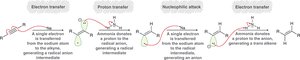
Start with an alkyne and sodium metal in liquid ammonia.
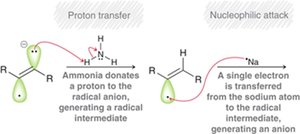
First, sodium donates an electron to the alkyne, forming a radical anion intermediate.
Ammonia donates a proton to the radical anion, generating a radical intermediate.
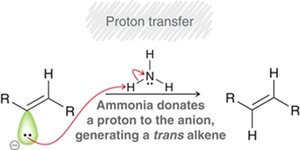
A second sodium atom donates another electron, forming an anion, which is then protonated by ammonia to yield a trans alkene.
Try solving on your own before revealing the answer!
Final Answer:
The dissolving metal reduction mechanism involves alternating electron transfers and protonations, resulting in anti addition of hydrogen atoms and formation of a trans alkene.
This stereoselective process is characteristic of the Birch reduction.
Q3. What are the products of ozonolysis of an internal alkyne?
Background
Topic: Ozonolysis of Alkynes
This question tests your ability to predict the products formed when an internal alkyne undergoes ozonolysis, a reaction that cleaves the triple bond.
Key Terms and Formulas
Ozonolysis: A reaction where ozone cleaves carbon-carbon multiple bonds.
Internal Alkyne: An alkyne with the triple bond not at the end of the carbon chain.
Carboxylic Acid: The typical product of ozonolysis of internal alkynes.
Step-by-Step Guidance
Identify the internal alkyne structure.
Apply ozonolysis conditions: followed by .
Recognize that the triple bond is cleaved, and each carbon of the triple bond becomes a carboxylic acid group.
Draw the products, ensuring each fragment is converted to a carboxylic acid.

Try solving on your own before revealing the answer!
Final Answer:
Ozonolysis of an internal alkyne produces two carboxylic acids, each derived from the carbons of the triple bond.
For symmetrical alkynes, only one carboxylic acid product is formed, but two equivalents are produced.
