 Back
BackStep-by-Step Guidance for Electrophilic Addition Reactions in Organic Chemistry
Study Guide - Smart Notes
 Tailored notes based on your materials, expanded with key definitions, examples, and context.
Q1. Provide the mechanism for the following addition reaction: Cyclopentene + HX (hydrohalogenation)
Background
Topic: Electrophilic Addition to Alkenes
This question tests your understanding of how alkenes react with hydrogen halides (HX) to form alkyl halides via an electrophilic addition mechanism.
Key Terms and Formulas
Electrophilic Addition: A reaction where an electrophile (such as H+) adds to a double bond, followed by nucleophilic attack.
Carbocation Intermediate: The positively charged intermediate formed after the alkene reacts with the electrophile.
Markovnikov's Rule: The hydrogen atom adds to the carbon with more hydrogens, and the halide adds to the more substituted carbon.
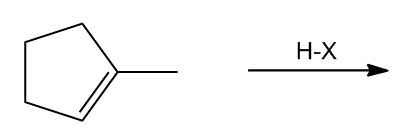
Step-by-Step Guidance
Identify the double bond in cyclopentene as the site of electrophilic attack.
Consider the addition of HX: the H+ will add to one carbon of the double bond, forming a carbocation intermediate.
Apply Markovnikov's Rule to determine which carbon will become the carbocation (the more substituted carbon).
The halide ion (X-) will then attack the carbocation, forming the final alkyl halide product.
Try solving on your own before revealing the answer!
Final Answer:
The product is a Markovnikov alkyl halide, with the halide attached to the more substituted carbon of the original double bond.
This follows the classic hydrohalogenation mechanism for alkenes.
Q2. Provide the mechanism for the following addition reaction: 2-methylpropene + HX (hydrohalogenation)
Background
Topic: Electrophilic Addition to Alkenes (Markovnikov vs. Anti-Markovnikov)
This question tests your ability to predict the product and mechanism for hydrohalogenation of an asymmetric alkene.
Key Terms and Formulas
Markovnikov's Rule: The hydrogen adds to the carbon with more hydrogens; the halide adds to the more substituted carbon.
Carbocation Rearrangement: Sometimes, the carbocation can rearrange to a more stable position.
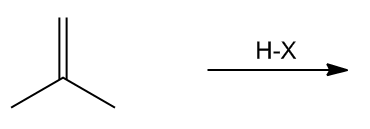
Step-by-Step Guidance
Identify the double bond in 2-methylpropene as the site of electrophilic attack.
Determine which carbon will become the carbocation based on Markovnikov's Rule.
Check for possible carbocation rearrangements to a more stable (tertiary) position.
The halide ion (X-) attacks the carbocation to form the final product.
Try solving on your own before revealing the answer!
Final Answer:
The product is a Markovnikov alkyl halide, with the halide attached to the tertiary carbon.
Carbocation rearrangement may occur if it leads to a more stable intermediate.
Q3. Provide the mechanism and predict the product for the following reaction: Cyclopentene + H2O/H2SO4 (acid-catalyzed hydration)
Background
Topic: Acid-Catalyzed Hydration of Alkenes
This question tests your understanding of how alkenes react with water in the presence of acid to form alcohols via Markovnikov addition.
Key Terms and Formulas
Acid-Catalyzed Hydration: Addition of water to an alkene using an acid catalyst.
Carbocation Intermediate: Formed after protonation of the alkene.
Markovnikov's Rule: The OH group attaches to the more substituted carbon.
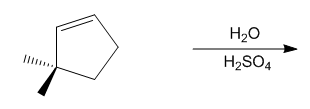
Step-by-Step Guidance
Protonate the alkene with H+ from H2SO4 to form a carbocation intermediate.
Water acts as a nucleophile and attacks the carbocation.
Deprotonate the oxonium ion to yield the alcohol product.
Apply Markovnikov's Rule to determine the position of the OH group.
Try solving on your own before revealing the answer!
Final Answer:
The product is a Markovnikov alcohol, with the OH group on the more substituted carbon of the original double bond.
This follows the acid-catalyzed hydration mechanism.
Q4. Provide the mechanism and predict the product for the following reaction: Methylcyclohexene + Hg(OAc)2, H2O / NaBH4, NaOH (oxymercuration-reduction)
Background
Topic: Oxymercuration-Reduction of Alkenes
This question tests your understanding of the oxymercuration-demercuration mechanism, which hydrates alkenes without carbocation rearrangement.
Key Terms and Formulas
Oxymercuration: Addition of Hg(OAc)2 and water to an alkene.
Demercuration: Removal of mercury using NaBH4.
Markovnikov Addition: OH group attaches to the more substituted carbon.
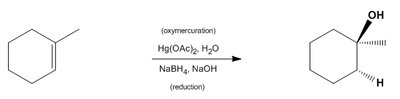
Step-by-Step Guidance
Mercury(II) acetate reacts with the alkene to form a mercurinium ion intermediate.
Water attacks the more substituted carbon, opening the ring.
NaBH4 reduces the intermediate, replacing mercury with hydrogen.
Result is Markovnikov alcohol, with no carbocation rearrangement.
Try solving on your own before revealing the answer!
Final Answer:
The product is a Markovnikov alcohol, with the OH group on the more substituted carbon.
Oxymercuration-reduction avoids carbocation rearrangement.
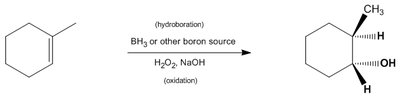
Q5. Provide the mechanism and predict the product for the following reaction: Methylcyclohexene + BH3 / H2O2, NaOH (hydroboration-oxidation)
Background
Topic: Hydroboration-Oxidation of Alkenes
This question tests your understanding of anti-Markovnikov hydration, where the OH group attaches to the less substituted carbon.
Key Terms and Formulas
Hydroboration: Addition of BH3 to the alkene.
Oxidation: Replacement of boron with OH using H2O2, NaOH.
Anti-Markovnikov Addition: OH group attaches to the less substituted carbon.
Step-by-Step Guidance
BH3 adds to the alkene in a syn addition, attaching to the less substituted carbon.
Oxidation with H2O2, NaOH replaces boron with OH.
Result is anti-Markovnikov alcohol, with syn stereochemistry.
Check for stereochemical outcomes (both H and OH add to the same face).
Try solving on your own before revealing the answer!
Final Answer:
The product is an anti-Markovnikov alcohol, with OH on the less substituted carbon and syn addition.
This is characteristic of hydroboration-oxidation.
Q6. Provide the mechanism and predict the product for the following reaction: Cyclohexene + X2, H2O (halohydrin formation)
Background
Topic: Halohydrin Formation from Alkenes
This question tests your understanding of the addition of halogen and water to an alkene, forming a halohydrin.
Key Terms and Formulas
Halohydrin: Compound with both a halogen and an alcohol group on adjacent carbons.
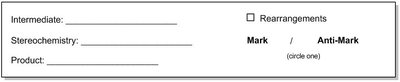
Mechanism: Electrophilic addition of X2 forms a halonium ion, followed by nucleophilic attack by water.
Step-by-Step Guidance
X2 adds to the alkene, forming a halonium ion intermediate.
Water attacks the more substituted carbon, opening the halonium ion.
Deprotonation yields the halohydrin product.
Check for stereochemistry: anti addition (halogen and OH on opposite faces).
Try solving on your own before revealing the answer!
Final Answer:
The product is a halohydrin, with halogen and OH on adjacent carbons in anti configuration.
This follows the halohydrin formation mechanism.
Q7. Predict the products and show the full mechanism for the following reaction: Ozonolysis of an alkene
Background
Topic: Ozonolysis of Alkenes
This question tests your understanding of oxidative cleavage of alkenes using ozone, resulting in carbonyl compounds.
Key Terms and Formulas
Ozonolysis: Cleavage of double bonds by ozone to form aldehydes, ketones, or carboxylic acids.
Workup: Reductive (S(CH3)2, Zn/HOAc) or oxidative (H2O2).
Step-by-Step Guidance
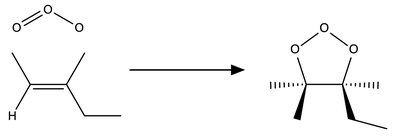
Ozone reacts with the alkene to form a molozonide intermediate.
The molozonide rearranges to a more stable ozonide.
Workup conditions determine whether aldehydes, ketones, or carboxylic acids are formed.
Draw the carbonyl products based on the original alkene structure.
Try solving on your own before revealing the answer!
Final Answer:
The products are carbonyl compounds (aldehydes, ketones, or carboxylic acids) depending on the workup.
Ozonolysis cleaves the double bond and forms these products.
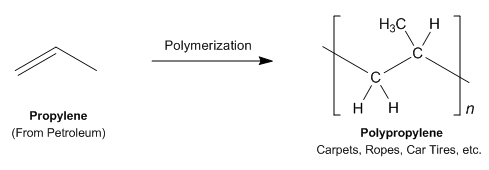
Q8. Use the polymerization mechanism to draw the polymer formula for propylene (free radical polymerization)
Background
Topic: Free Radical Polymerization
This question tests your understanding of how alkenes (like propylene) are converted into polymers via radical mechanisms.
Key Terms and Formulas
Initiation: Formation of a radical species.
Propagation: Radical adds to monomer, extending the chain.
Termination: Radicals combine to end the chain.
Step-by-Step Guidance
Initiate the reaction by generating a radical (often using peroxide).
The radical adds to the double bond of propylene, forming a new radical at the chain end.
Continue propagation by adding more propylene units to the growing chain.
Termination occurs when two radicals combine or disproportionate.
Try solving on your own before revealing the answer!
Final Answer:
The polymer formed is polypropylene, with repeating units derived from propylene.
This is a classic example of free radical polymerization.
