 Back
BackStereochemistry & Chirality: Foundations and Applications
Study Guide - Smart Notes
 Tailored notes based on your materials, expanded with key definitions, examples, and context.
Stereochemistry
Definition and Importance
Stereochemistry is the branch of chemistry concerned with the three-dimensional arrangement of atoms within molecules. This spatial arrangement profoundly affects the physical and chemical properties of organic compounds, especially in biological systems.
Stereochemistry explores how the orientation of atoms influences molecular behavior and reactivity.
Many organic molecules, such as amino acids, carbohydrates, and nucleic acids, exhibit handedness due to their tetrahedral carbon centers.
Molecular handedness is crucial for enzyme-substrate interactions and the specificity of biological reactions.

Mirror Images and Handedness
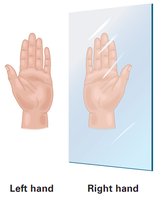
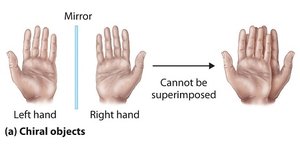
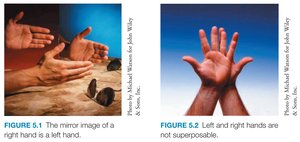
The concept of handedness (chirality) is illustrated by comparing left and right hands, which are mirror images but not superimposable. This analogy extends to organic molecules.
Mirror images of molecules may not be identical, leading to distinct chemical properties.
Handedness arises from the tetrahedral geometry of sp3-hybridized carbon atoms.
Chirality and Chiral Centers
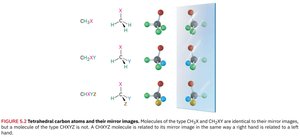
Tetrahedral Carbon Atoms and Their Mirror Images
Organic molecules with tetrahedral carbon atoms bonded to four different substituents can exhibit chirality.
Molecules of the type CHXY (where two substituents are identical) are superimposable on their mirror images and are achiral.
Molecules of the type CHXYZ (all four substituents different) are not superimposable and are chiral.
Chiral Center
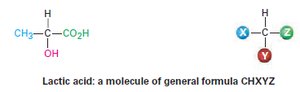
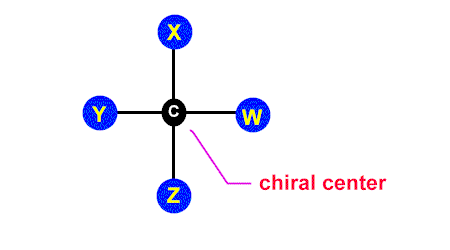
A chiral center is a carbon atom attached to four different groups. The presence of a chiral center is the most common cause of chirality in organic molecules.
Chiral centers are also known as stereocenters, asymmetric centers, or stereogenic centers.
Chirality is a property of the entire molecule, while the chiral center is the cause of chirality.
Stereoisomers
Definition and Examples
Stereoisomers are compounds with the same structural formula but different spatial arrangements of atoms.
They differ in the orientation of their atoms in space, not in connectivity.
Chiral molecules are a subset of stereoisomers.
Chiral and Achiral Molecules
Definitions and Distinctions
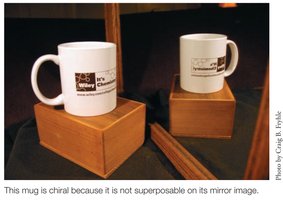
A chiral molecule cannot be superimposed on its mirror image, regardless of rotation.
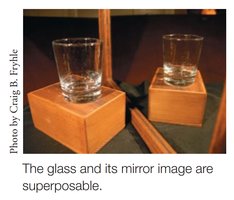
An achiral molecule is identical to its mirror image and can be superimposed.
Human bodies are chiral; objects like a glass are achiral.
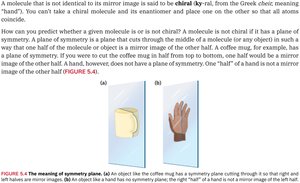

Plane of Symmetry
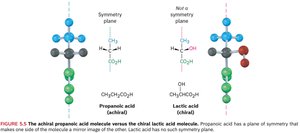
The presence or absence of a plane of symmetry determines whether a molecule is chiral or achiral.
A molecule with a plane of symmetry is achiral.
A molecule without a plane of symmetry is chiral.

Enantiomers and Racemic Mixtures
Enantiomers
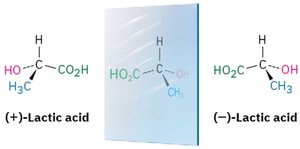
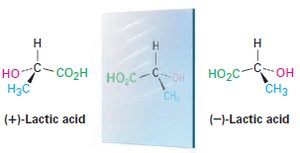
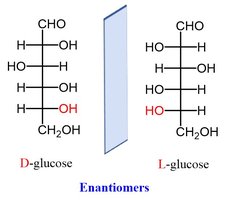
Enantiomers are pairs of molecules that are non-superimposable mirror images of each other.
They arise when a tetrahedral carbon is bonded to four different substituents.
Example: Lactic acid exists as (+)-lactic acid and (−)-lactic acid, which are enantiomers.
Racemic Mixture
A racemic mixture contains equal amounts of left- and right-handed enantiomers of a chiral molecule.
Racemic mixtures show no optical rotation because the effects of each enantiomer cancel out.
Notation: (±) or d,l prefix.
Identifying Chiral Carbons
Criteria and Examples
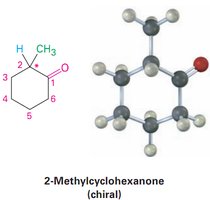
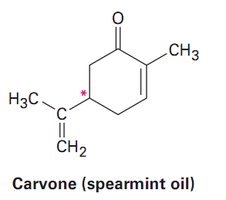
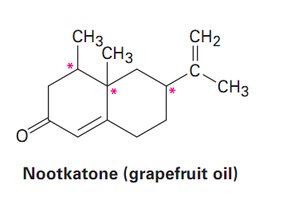
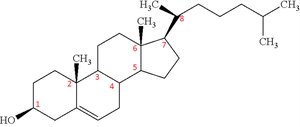
A chiral carbon is bonded to four different groups.
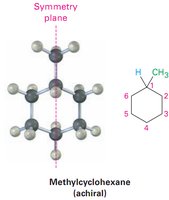
Example: 2-methylcyclohexanone is chiral, while methylcyclohexane is achiral due to the presence of a symmetry plane.
Optical Activity
Polarization and Optical Rotation
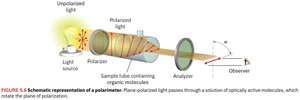
Optical activity is the ability of certain organic molecules to rotate the plane of polarized light.
A polarizer produces plane-polarized light, which can be rotated by optically active substances.
Levorotatory compounds rotate light to the left (−), dextrorotatory compounds to the right (+).
Examples: (−)-Morphine is levorotatory, (+)-Sucrose is dextrorotatory.
Relative and Absolute Configuration
Relative Configuration
Configuration refers to the arrangement of atoms or groups in a molecule.
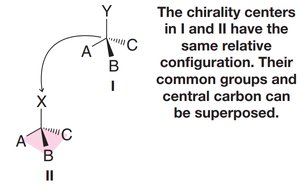
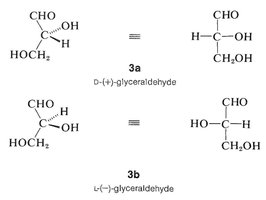
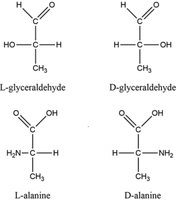
Relative configuration compares the arrangement of groups in different molecules based on a standard, such as glyceraldehyde.
Chirality centers in different molecules have the same relative configuration if three groups in common can be superposed in a pyramidal arrangement.

Absolute Configuration
Absolute configuration describes the spatial arrangement of atoms independent of other molecules, using the R/S system.
R (Rectus) and S (Sinister) nomenclature is used to specify the exact arrangement.
Absolute configuration is determined by the Cahn-Ingold-Prelog rules.
Sequence Rules (Cahn-Ingold-Prelog Rules)
Rules for Specifying Configuration
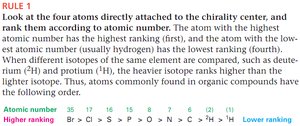
The Cahn-Ingold-Prelog (CIP) rules are used to rank the four groups attached to a chiral center and determine its configuration.
Rule 1: Rank atoms by atomic number; higher atomic number gets higher priority.
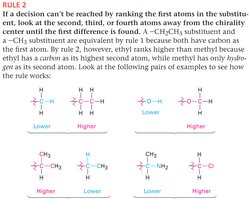
Rule 2: If ranking cannot be determined by the first atom, compare the next atoms outward until a difference is found.
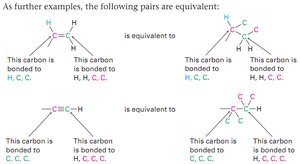
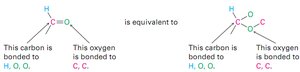
Rule 3: Multiple-bonded atoms are treated as equivalent to the same number of single-bonded atoms.

Summary Table: Chiral vs. Achiral Molecules
Property | Chiral Molecule | Achiral Molecule |
|---|---|---|
Superimposability | Not superimposable on mirror image | Superimposable on mirror image |
Plane of Symmetry | Absent | Present |
Optical Activity | Usually optically active | Not optically active |
Example | Lactic acid | Propanoic acid |
Summary Table: Sequence Rules for Configuration
Rule | Description |
|---|---|
Rule 1 | Rank by atomic number |
Rule 2 | Compare next atoms outward if needed |
Rule 3 | Multiple bonds treated as equivalent to single bonds |
Conclusion
Stereochemistry and chirality are foundational concepts in organic chemistry, influencing molecular properties, biological activity, and chemical reactivity. Understanding chiral centers, enantiomers, optical activity, and configuration rules is essential for mastering organic chemistry and its applications in biochemistry and pharmaceuticals. Additional info: Expanded explanations and tables were added for completeness and clarity.
