 Back
BackStereochemistry: Chirality, Enantiomers, Diastereomers, and Optical Activity
Study Guide - Smart Notes
 Tailored notes based on your materials, expanded with key definitions, examples, and context.
Chapter 5: Stereochemistry
Introduction to Stereochemistry
Stereochemistry is the study of the spatial arrangement of atoms in molecules and its impact on their chemical behavior. It is a fundamental topic in organic chemistry, influencing molecular properties, biological activity, and reactivity.
Chirality and Achirality
Chirality: Definition and Examples
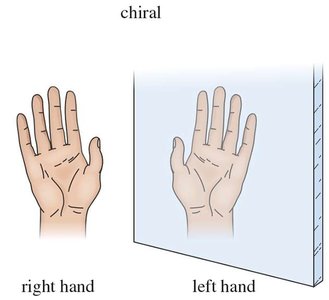
A molecule is chiral if its mirror image is not superimposable on the original, much like a right hand does not fit a left-hand glove. Chirality is often referred to as "handedness."
Chiral objects have non-superimposable mirror images.
Example: Human hands are chiral; their mirror images cannot be superimposed.
Achirality: Definition and Examples
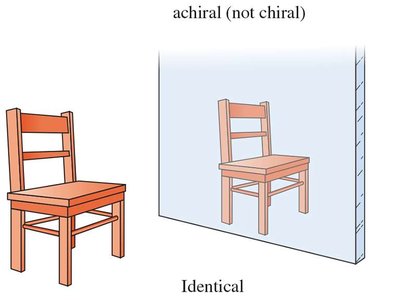
An object or molecule is achiral if its mirror image can be superimposed onto the original. Achiral molecules do not exhibit handedness.
Achiral objects have superimposable mirror images.
Example: A chair is achiral; its mirror image is identical to the original.
Stereoisomers: Enantiomers and Diastereomers
Enantiomers
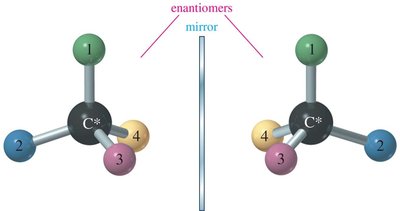
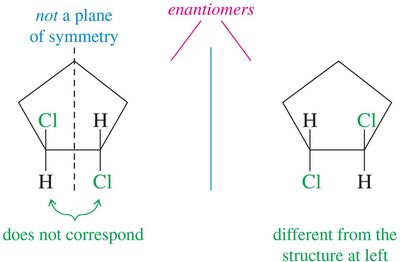
Enantiomers are pairs of molecules that are nonsuperimposable mirror images of each other. Any chiral molecule must have an enantiomer.
Enantiomers have identical physical properties except for their interaction with polarized light and other chiral substances.
They rotate plane-polarized light in equal magnitude but opposite directions.
Chiral Carbon Atoms and Stereocenters
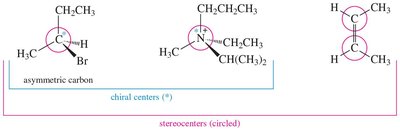
A chiral carbon atom (asymmetric carbon) is bonded to four different groups. This atom is a common example of a chirality center, which is a type of stereocenter. Stereocenters are atoms where the interchange of two groups produces a stereoisomer.
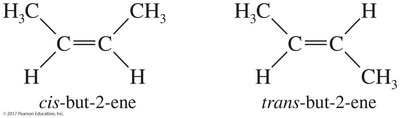
Asymmetric carbons and double-bonded carbons in cis-trans isomers are typical stereocenters.
Symmetry and Chirality
Planes of Symmetry
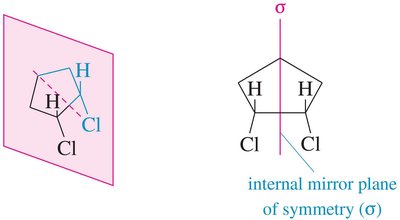
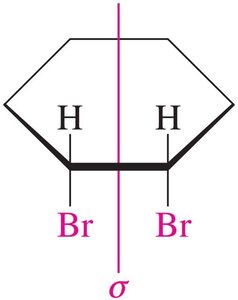
A molecule with a plane of symmetry is achiral. The presence of an internal mirror plane allows the molecule and its mirror image to be superimposed.
Cis-1,2-dichlorocyclohexane is achiral due to its internal plane of symmetry.
Trans Cyclic Compounds
Trans-1,2-dichlorocyclohexane lacks a plane of symmetry, making it chiral and giving rise to two enantiomers.
(R) and (S) Configuration: Cahn-Ingold-Prelog Convention
Assigning Configuration
The Cahn-Ingold-Prelog (CIP) convention is used to assign (R) or (S) configuration to chirality centers based on the spatial arrangement of groups.
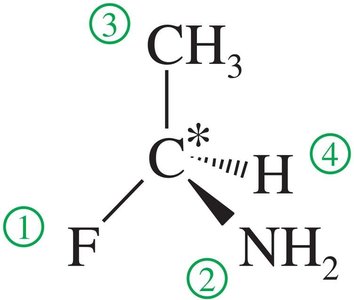
Assign priorities to groups attached to the chiral carbon based on atomic number (higher atomic number = higher priority).
In case of ties, examine the next atoms along the chain.
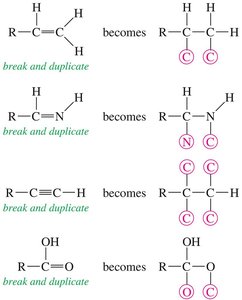
For multiple bonds, treat them as if each bond is to a separate atom.
Determining (R) or (S) Configuration
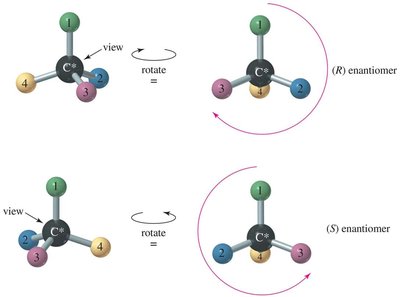
After assigning priorities, rotate the molecule so the lowest priority group is in the back. Draw an arrow from the highest to lowest priority group:
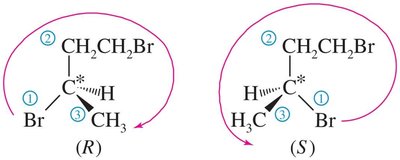
Clockwise = (R) configuration
Counterclockwise = (S) configuration
Example: 1,3-Dibromobutane
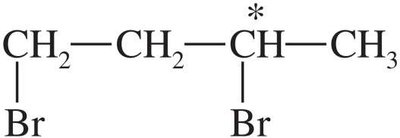
For 1,3-dibromobutane, the third carbon is asymmetric. Assign priorities and draw the enantiomers, labeling them as (R) and (S).
Optical Activity and Polarimetry
Polarized Light and Optical Activity
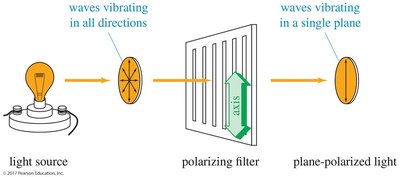
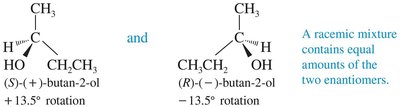
Plane-polarized light vibrates in only one plane. Chiral molecules (enantiomers) rotate the plane of polarized light in opposite directions but by the same magnitude.
Polarimeter and Specific Rotation
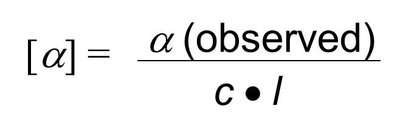
A polarimeter measures the rotation of plane-polarized light by a chiral compound. The direction of rotation is called dextrorotatory (+, clockwise) or levorotatory (–, counterclockwise), which is not related to (R) or (S) configuration.
The specific rotation is calculated as:
Racemic Mixtures and Optical Purity
Racemic Mixtures
A racemic mixture contains equal quantities of d- and l-enantiomers and exhibits no optical activity. Racemic mixtures may have different boiling and melting points compared to pure enantiomers.
Optical Purity (Enantiomeric Excess)
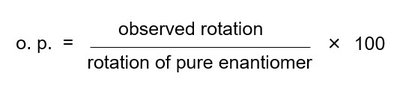
Optical purity (o.p.) or enantiomeric excess (e.e.) measures the proportion of one enantiomer in excess over the other. It is calculated as:
Chirality in Conformers and Allenes
Chirality of Conformers
If equilibrium exists between two chiral conformers, the molecule is not chiral. Chirality is judged by the most symmetrical conformer.
Chirality in Allenes
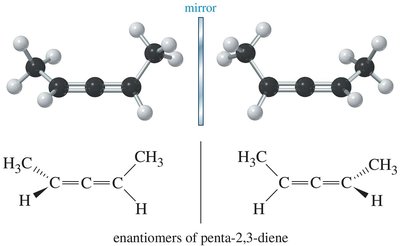
Some allenes are chiral even though they lack a chiral carbon. The central carbon is sp hybridized, and chirality arises if the end carbons have different groups.
Fischer Projections
Fischer Projection Rules
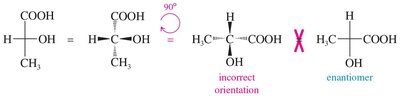
Fischer projections are flat representations of 3-D molecules, useful for visualizing chiral centers and assigning (R) and (S) configurations.
Carbon chain is vertical; highest oxidized carbon at the top.
180° rotation in the plane does not change the molecule; 90° rotation is not allowed.

Diastereomers and Meso Compounds
Diastereomers
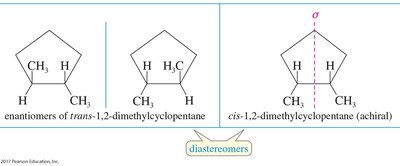
Diastereomers are stereoisomers that are not mirror images. They arise in molecules with two or more chiral centers and have different physical properties, making them easier to separate than enantiomers.
Meso Compounds
Meso compounds have chiral centers but are achiral due to an internal plane of symmetry. They can be superimposed on their mirror image after a 180° rotation.
Number of Stereoisomers
2n Rule and Exceptions
The maximum number of stereoisomers for a compound with n chiral centers is 2n. However, the presence of a plane of symmetry (meso compounds) reduces the number of possible stereoisomers.
Resolution of Enantiomers
Physical and Chemical Resolution
Enantiomers are difficult to separate due to their identical physical properties. Resolution can be achieved by converting enantiomers into diastereomers, which can then be separated.
Louis Pasteur first accomplished resolution by physically separating enantiomeric crystals.
Chemical resolution involves reacting a racemic mixture with a pure chiral compound to form diastereomers.
Summary Table: Types of Stereoisomers
Type | Mirror Image | Superimposable? | Physical Properties |
|---|---|---|---|
Enantiomers | Yes | No | Identical except for optical activity and reaction with chiral substances |
Diastereomers | No | No | Different |
Meso Compounds | Yes | Yes | Achiral, identical |
Additional info: Academic context was added to clarify definitions, examples, and formulas, and to ensure completeness for exam preparation.
