 Back
BackStereochemistry: Structure, Properties, and Classification of Stereoisomers
Study Guide - Smart Notes
 Tailored notes based on your materials, expanded with key definitions, examples, and context.
Stereochemistry
Introduction to Stereochemistry
Stereochemistry is the study of the three-dimensional arrangement of atoms within molecules and how this affects their chemical properties and reactions. Understanding stereochemistry is essential for interpreting molecular behavior, especially in organic chemistry.
Stereoisomers: Compounds with the same connectivity but different spatial arrangements.
Enantiomers: Stereoisomers that are non-superimposable mirror images of each other.
Diastereomers: Stereoisomers that are not mirror images; they have different physical properties.
Key Definitions
Chirality and Asymmetric Centers
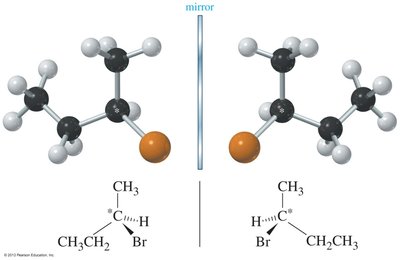
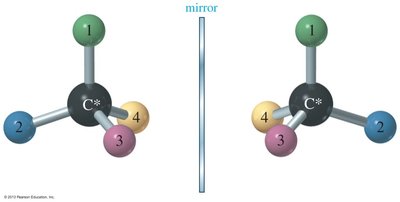
Chirality is a property of a molecule that makes it non-superimposable on its mirror image, much like left and right hands. The most common source of chirality in organic molecules is an asymmetric carbon atom (also called a chirality center), which is a carbon atom bonded to four different groups.
Chiral compound: A compound that is optically active and can rotate plane-polarized light.
Achiral compound: A compound whose mirror image can be superimposed; it does not rotate light.
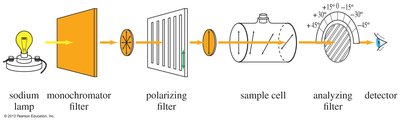
Polarimeter: Device used to measure optical rotation.
Stereocenters
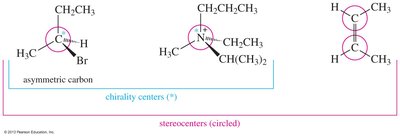
A stereocenter (or stereogenic atom) is any atom at which the interchange of two groups produces a stereoisomer. Asymmetric carbons and the double-bonded carbon atoms in cis-trans isomers are common types of stereocenters.
Chirality and Achirality
Chiral and Achiral Objects
An object is chiral if its mirror image is different from the original object. If the mirror image can be superimposed, the object is achiral.
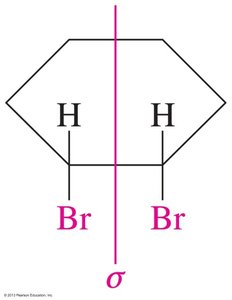
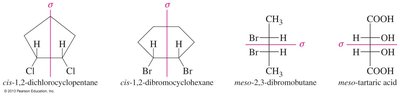
Plane of symmetry: A molecule with a plane of symmetry is achiral.
Enantiomers and Diastereomers
Enantiomers
Enantiomers are pairs of molecules that are nonsuperimposable mirror images. Any molecule that is chiral must have an enantiomer.
Diastereomers
Diastereomers are stereoisomers that are not mirror images. They have different physical properties and can be separated more easily than enantiomers.
Configuration: (R) and (S) System
Cahn–Ingold–Prelog Priority System
The Cahn–Ingold–Prelog system is used to assign absolute configuration to chirality centers. Each asymmetric carbon atom is assigned a letter (R) or (S) based on its three-dimensional configuration.
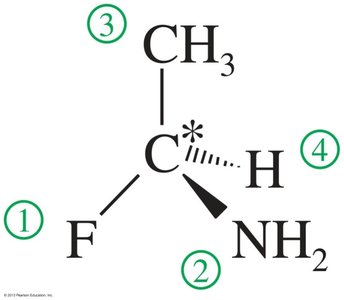
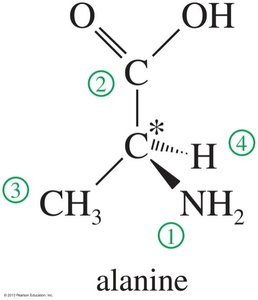
Assign priorities to each group attached to the asymmetric carbon based on atomic number (higher atomic number = higher priority).
In case of ties, use the next atoms along the chain as tiebreakers.
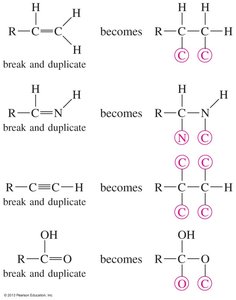
For multiple bonds, treat each bond as if it were to a separate atom.
Determining (R) and (S) Configuration
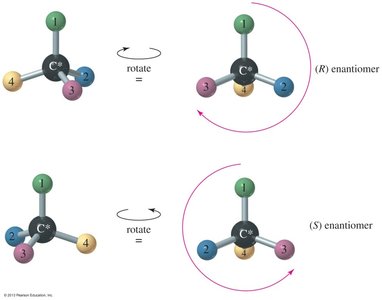
After assigning priorities, rotate the molecule so the lowest priority group is in the back. Draw an arrow from highest (1) to second highest (2) to lowest (3) priority group:
Clockwise = (R)
Counterclockwise = (S)
Properties of Enantiomers
Physical and Biological Properties
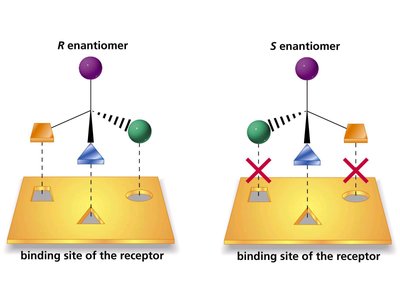
Enantiomers have identical physical properties except for the direction in which they rotate plane-polarized light. They interact differently with other chiral molecules, such as enzymes and receptors.
Same boiling point, melting point, and density.
Same refractive index.
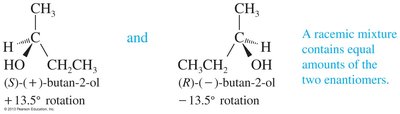
Rotate plane-polarized light in equal magnitude but opposite directions.
Different biological activity (e.g., only one enantiomer may be biologically active).
Optical Activity
Polarized Light and Measurement
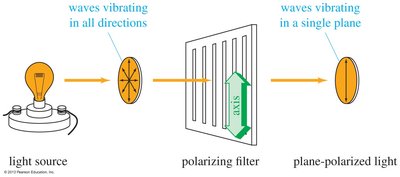
Plane-polarized light is composed of waves that vibrate in only one plane. Chiral compounds rotate this light, a property measured using a polarimeter.
Dextrorotatory (+): Rotates light clockwise.
Levorotatory (-): Rotates light counterclockwise.
Specific Rotation
The specific rotation is calculated using the formula:
Where is the observed rotation, is concentration (g/mL), and is path length (dm).
Racemic Mixtures and Optical Purity
Racemic Mixtures
A racemic mixture contains equal quantities of d- and l-enantiomers and is optically inactive. The mixture may have different boiling and melting points from the pure enantiomers.
Optical Purity (Enantiomeric Excess)
Optical purity (o.p.) or enantiomeric excess (e.e.) is calculated as:
Chirality in Conformers and Special Cases
Conformational Isomers
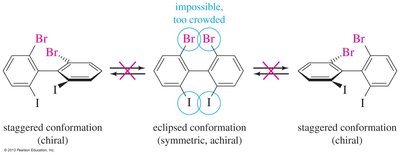
If equilibrium exists between two chiral conformers, the molecule is not chiral. Chirality is judged by the most symmetrical conformer.
Nonmobile Conformers
Some molecules, such as biphenyl derivatives, can be conformationally locked and thus chiral.
Allenes and Dienes
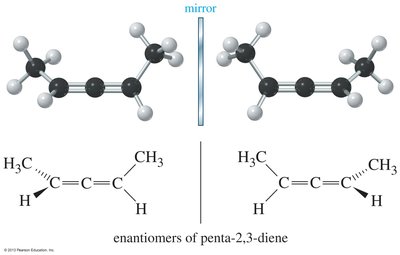
Allenes and certain dienes can be chiral if their substituents are arranged so that the molecule is not superimposable on its mirror image.
Fischer Projections
Fischer Projection Rules
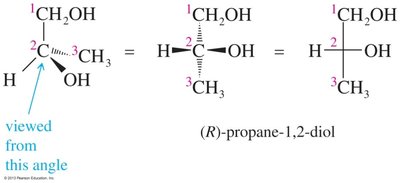
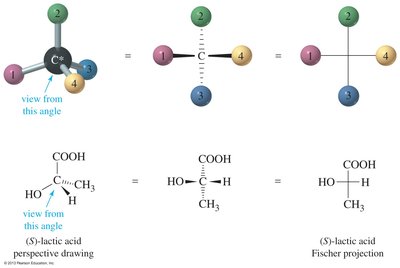
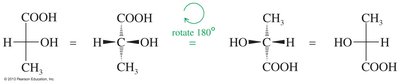
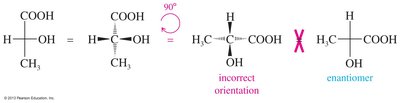
Fischer projections are flat representations of 3-D molecules, useful for visualizing chirality and stereochemistry. The carbon chain is placed vertically, and the highest oxidized carbon is at the top. Rotation of 180° in the plane does not change the molecule, but 90° rotation is not allowed.
Classification and Properties of Stereoisomers
Number of Stereoisomers
The maximum number of stereoisomers for a compound with n chiral centers is . However, the presence of a plane of symmetry (meso compounds) reduces this number.
Meso Compounds
Meso compounds have chiral centers but are achiral due to an internal plane of symmetry. They are optically inactive.
Properties of Diastereomers
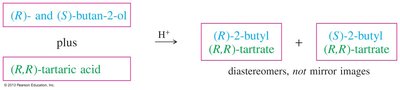
Diastereomers have different physical properties and can be separated easily. Enantiomers differ only in their interaction with other chiral molecules and the direction of optical rotation.
Chemical Resolution of Enantiomers
Enantiomers can be separated by converting them into diastereomers using a pure chiral compound, such as tartaric acid, and then separating the diastereomers.
Summary Table: Types of Stereoisomers
Type | Mirror Image | Superimposable? | Optical Activity |
|---|---|---|---|
Enantiomers | Yes | No | Equal magnitude, opposite direction |
Diastereomers | No | No | Different |
Meso Compounds | Yes | Yes | None (optically inactive) |
Additional info: Academic context was added to clarify the Cahn–Ingold–Prelog system, optical activity, and the classification of stereoisomers. Examples and images were selected strictly for direct relevance to the explained concepts.
