 Back
BackORGO: Chapter 1
Study Guide - Smart Notes
 Tailored notes based on your materials, expanded with key definitions, examples, and context.
Structure and Bonding
Introduction to Organic Chemistry
Organic chemistry is the study of carbon compounds, which form the basis of life and many synthetic materials. Carbon's unique ability to form stable covalent bonds with itself and other elements leads to a vast array of molecular structures. - Key Point: Organic molecules include natural substances (like proteins, DNA, and sugars) and synthetic compounds (such as plastics and pharmaceuticals). - Example: The structure of luciferin, the molecule responsible for bioluminescence in fireflies, demonstrates the complexity and diversity of organic compounds. 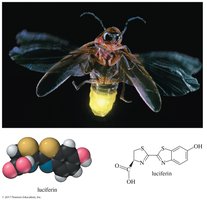
Electronic Structure of the Atom
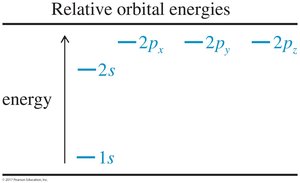
Understanding atomic structure is fundamental to predicting chemical bonding and molecular properties. Electrons occupy orbitals, regions of space around the nucleus, with specific shapes and energies. - Key Point: The electron density in orbitals determines the likelihood of finding an electron at a particular location. - Example: The 2s orbital has a spherical shape, while the 2p orbitals are dumbbell-shaped and oriented at right angles. 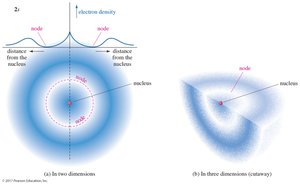
The 2p Orbitals
The three 2p orbitals (2px, 2py, 2pz) are oriented at 90° angles to each other and are essential for bonding in organic molecules. - Key Point: Each p orbital consists of two lobes separated by a nodal plane. - Example: The spatial arrangement of p orbitals allows for the formation of pi bonds in double and triple bonds. 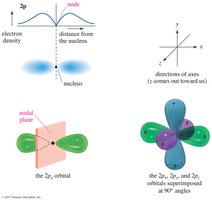
Isotopes
Isotopes are atoms of the same element with different numbers of neutrons. - Key Point: The mass number is the sum of protons and neutrons. - Example: Carbon-12 and Carbon-13 are isotopes of carbon, differing in neutron count.
Electronic Configurations of Atoms
The arrangement of electrons in an atom's orbitals is described by its electronic configuration. - Key Point: The aufbau principle states that electrons fill the lowest energy orbitals first. Hund’s rule states that electrons occupy degenerate orbitals singly before pairing. - Example: The electronic configuration of carbon is . 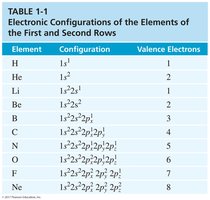
Ionic and Covalent Bonding
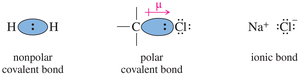
Atoms achieve stable electron configurations by transferring or sharing electrons. - Key Point: Ionic bonds result from electron transfer, while covalent bonds result from electron sharing. - Example: Sodium chloride (NaCl) forms via ionic bonding, while methane (CH4) forms via covalent bonding. 
Lewis Structures
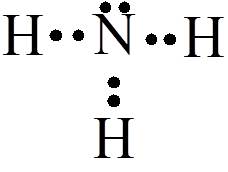
Lewis structures represent the arrangement of electrons in molecules, showing bonds and lone pairs. - Key Point: Each atom achieves a stable configuration (octet rule) through bonding. - Example: Methane (CH4), ammonia (NH3), and water (H2O) are classic examples. 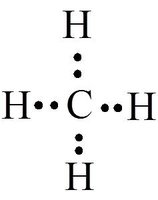
Multiple Bonding
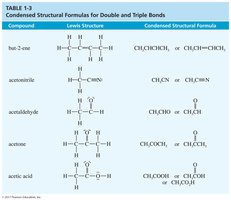
Double and triple bonds involve the sharing of two or three pairs of electrons, respectively. - Key Point: Double bonds consist of one sigma and one pi bond; triple bonds consist of one sigma and two pi bonds. 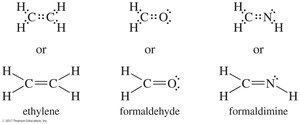
Electronegativity and Bond Polarity
Electronegativity is the tendency of an atom to attract electrons in a bond. - Key Point: Differences in electronegativity determine whether a bond is polar or nonpolar. - Example: C—H bonds are nonpolar, while O—H bonds are polar. 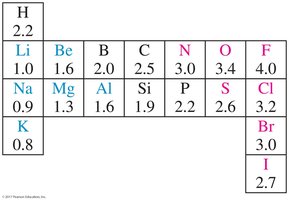
Formal Charges
Formal charge helps track electron distribution in molecules. - Key Point: Formal charge = [group number] – [nonbonding electrons] – ½ [shared electrons]. - Example: Water (H2O) and nitrous oxide (N2O) can be analyzed for formal charges. 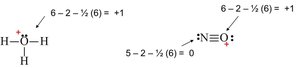
Resonance Forms
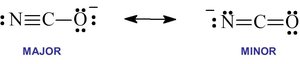
Some molecules are best represented by multiple Lewis structures, called resonance forms. - Key Point: The true structure is a hybrid of all resonance contributors. - Example: The resonance in formaldehyde and formaldimine. 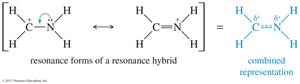
Criteria for Resonance Contributors
Resonance forms are evaluated based on octet fulfillment, number of bonds, charge placement, and charge separation. - Key Point: The major contributor has the negative charge on the most electronegative atom and minimal charge separation. 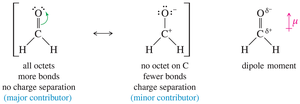
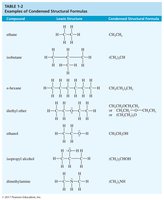
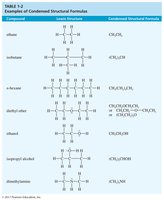
Condensed Structural Formulas
Condensed formulas simplify the representation of organic molecules by omitting some bonds and grouping atoms. - Key Point: Parentheses and subscripts are used for repeated groups. - Example: Ethane can be written as CH3CH3. 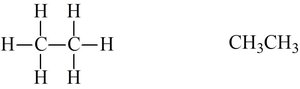
Line-Angle Drawings
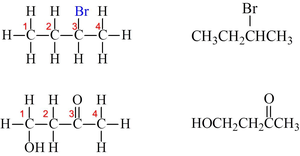
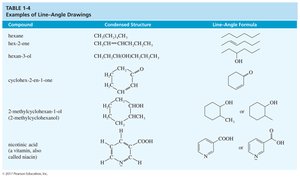
Line-angle (skeletal) drawings are a shorthand for organic structures, where lines represent bonds and vertices represent carbon atoms. - Key Point: Hydrogens attached to carbon are omitted; heteroatoms and multiple bonds are shown explicitly. 

Hybridization and Molecular Orbitals
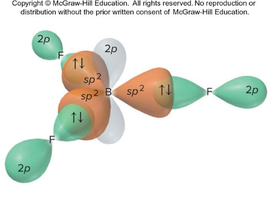
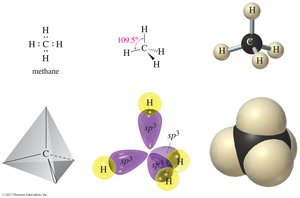
Atomic orbitals combine to form molecular orbitals during bonding. Hybridization explains molecular shapes and bond angles. - Key Point: sp3 hybridization leads to tetrahedral geometry (109.5°), sp2 to trigonal planar (120°), and sp to linear (180°). - Example: Methane (CH4) is sp3 hybridized; ethylene (C2H4) is sp2; acetylene (C2H2) is sp. 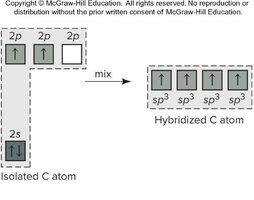

Bonding in Ethylene and Acetylene
Ethylene and acetylene illustrate the role of hybridization and pi bonding in double and triple bonds. - Key Point: Ethylene has a planar structure with a double bond; acetylene is linear with a triple bond.
Rotation and Isomerism
Single bonds allow free rotation, while double bonds restrict rotation, leading to geometric isomerism. - Key Point: Isomers have the same formula but different structures; constitutional isomers differ in connectivity, stereoisomers differ in spatial arrangement. - Example: Cis and trans isomers arise from restricted rotation around double bonds.
Summary Table: Electronic Configurations
Purpose: Comparison of electronic configurations and valence electrons for first and second row elements.
Element | Configuration | Valence Electrons |
|---|---|---|
H | 1s1 | 1 |
He | 1s2 | 2 |
Li | 1s22s1 | 1 |
Be | 1s22s2 | 2 |
B | 1s22s22p1 | 3 |
C | 1s22s22p2 | 4 |
N | 1s22s22p3 | 5 |
O | 1s22s22p4 | 6 |
F | 1s22s22p5 | 7 |
Ne | 1s22s22p6 | 8 |
Summary Table: Condensed Structural Formulas
Purpose: Classification and comparison of condensed and Lewis structural formulas.
Compound | Lewis Structure | Condensed Structural Formula |
|---|---|---|
Ethane | H3C-CH3 | CH3CH3 |
Isopropyl alcohol | CH3CH(OH)CH3 | CH3CH(OH)CH3 |
Acetone | CH3COCH3 | CH3COCH3 |
Summary Table: Line-Angle Drawings
Purpose: Comparison of condensed, Lewis, and line-angle formulas for common organic compounds.
Compound | Condensed Structure | Line-Angle Formula |
|---|---|---|
Hexane | CH3(CH2)4CH3 | Line-angle drawing |
Hexan-2-ol | CH3CH(OH)(CH2)3CH3 | Line-angle drawing |
Cyclohexan-3-one | Ring structure | Line-angle drawing |
Additional info:
Some explanations and examples were expanded for clarity and completeness, including definitions, formula derivations, and context for tables and images.
