 Back
BackStructure and Stereochemistry of Alkanes: Nomenclature, Conformations, and Cycloalkanes
Study Guide - Smart Notes
 Tailored notes based on your materials, expanded with key definitions, examples, and context.
Hydrocarbon Classifications
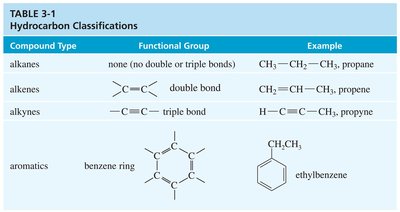
Types of Hydrocarbons
Hydrocarbons are organic compounds composed exclusively of carbon and hydrogen. They are classified based on the types of bonds and ring structures present in their molecules.
Alkanes: Saturated hydrocarbons with only single bonds. General formula: .
Alkenes: Unsaturated hydrocarbons containing at least one double bond. General formula: .
Alkynes: Unsaturated hydrocarbons containing at least one triple bond. General formula: .
Aromatics: Hydrocarbons containing a benzene ring, characterized by resonance stabilization.
Example Table:
Compound Type | Functional Group | Example |
|---|---|---|
alkanes | none (no double or triple bonds) | CH3–CH2–CH3, propane |
alkenes | double bond | CH2=CH–CH3, propene |
alkynes | triple bond | HC≡C–CH3, propyne |
aromatics | benzene ring | ethylbenzene |
Nomenclature of Alkanes and Cycloalkanes
Systematic Naming of Alkanes
Alkanes are named according to IUPAC rules to ensure clarity and consistency. The process involves identifying the longest carbon chain, naming substituents, and assigning locants.
Step 1: Find the longest continuous chain of carbon atoms (the parent chain).
Step 2: Identify and name all substituents branching from the main chain.
Step 3: Number the chain from the end nearest a substituent. If equidistant, start from the end with the substituent that comes first alphabetically.
Step 4: Use prefixes (di-, tri-, tetra-) for multiple identical substituents and separate numbers with commas, letters with hyphens.
Examples:
3-methylhexane: Hexane chain with a methyl group on carbon 3.
3-ethyl-6-methylnonane: Nonane chain with ethyl on carbon 3 and methyl on carbon 6.

Special Substituents and Trivial Names
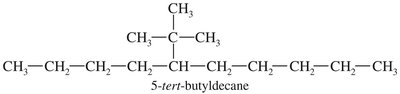
Certain alkyl groups have common names that are still widely used, such as isopropyl and tert-butyl. These names are only used when the group is not part of a longer chain.
Isopropyl: –CH(CH3)2
Tert-butyl: –C(CH3)3
Primary, Secondary, Tertiary Carbons and Alkyl Groups
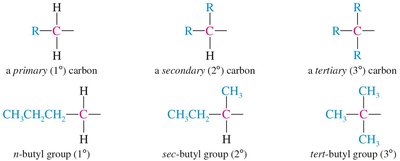
Carbons are classified based on the number of other carbons to which they are attached:
Primary (1°): Attached to one other carbon.
Secondary (2°): Attached to two other carbons.
Tertiary (3°): Attached to three other carbons.
Nomenclature of Cycloalkanes
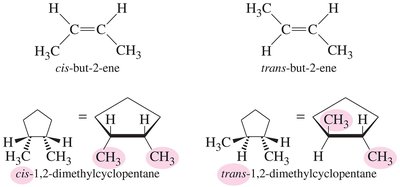
Cycloalkanes are named based on the number of carbons in the ring. Substituents are named and numbered to give the lowest possible locants, and cis/trans isomers are specified when there are exactly two substituents.
Step 1: Name the ring (e.g., cyclobutane, cyclohexane).
Step 2: Identify and alphabetize substituents.
Step 3: For two substituents, use cis/trans to indicate relative positions.
Structure and Conformations of Alkanes
Molecular Geometry of Methane and Ethane
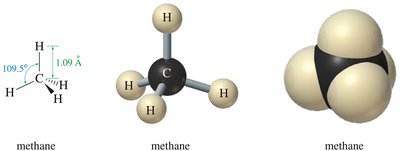
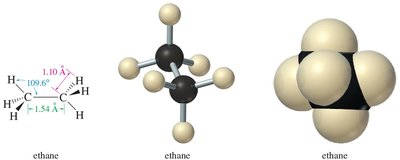
Alkanes have tetrahedral geometry around each carbon atom due to sp3 hybridization. Methane and ethane are classic examples.
Methane: Bond angle is approximately 109.5°, C–H bond length is 1.09 Å.
Ethane: Similar tetrahedral geometry, C–C bond length is 1.54 Å.
Bond Rotation and Conformations
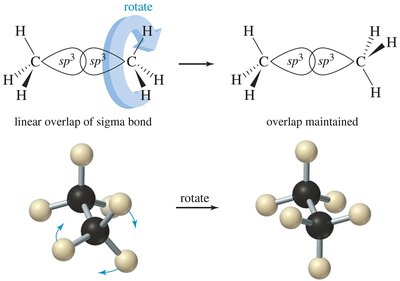
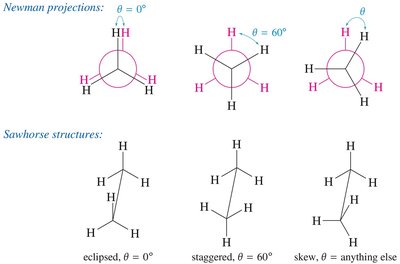
Rotation about the axis of a sigma bond is possible, leading to different conformations. The most important conformations are staggered and eclipsed.
Staggered: Atoms are as far apart as possible, minimizing repulsion.
Eclipsed: Atoms are aligned, maximizing repulsion and torsional strain.
Newman Projections and Sawhorse Structures
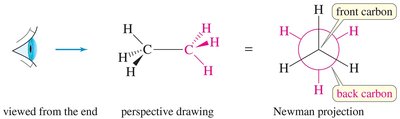
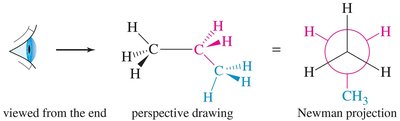
Newman projections are used to visualize the spatial arrangement of atoms around a bond, especially for analyzing conformational isomerism.
Newman Projection: View along the axis of a bond to show relative positions of substituents.
Sawhorse Structure: Shows the molecule at an angle, highlighting the dihedral angle between groups.
Conformational Analysis: Ethane and Propane
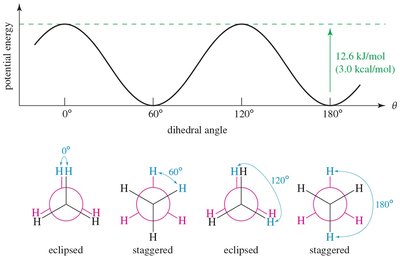
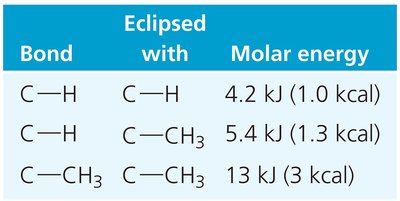
Conformational analysis involves studying the energy changes as a molecule rotates about its bonds. Ethane and propane exhibit torsional strain in the eclipsed conformation.
Torsional Strain: Increase in energy due to eclipsing bonds, typically C–H/C–H or C–H/C–CH3.
Energy Difference: For ethane, the energy difference between staggered and eclipsed is about 3.0 kcal/mol.
Conformational Analysis: Butane
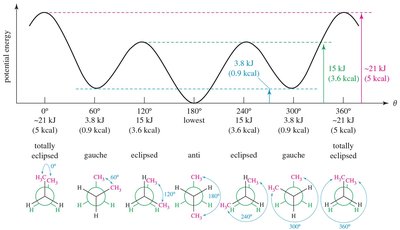
Butane has additional steric strain due to the presence of methyl groups. The anti conformation is the most stable, while the totally eclipsed conformation is the least stable.
Steric Strain: Increase in energy when atoms are forced too close together.
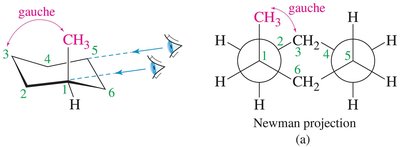
Gauche Interaction: Methyl groups 60° apart cause 0.9 kcal/mol of strain.
Anti Conformation: Methyl groups are 180° apart, minimizing strain.

Cycloalkanes: Structure and Strain
Ring Strain in Cycloalkanes
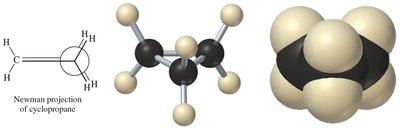
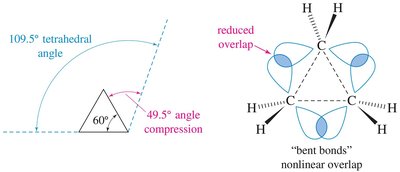
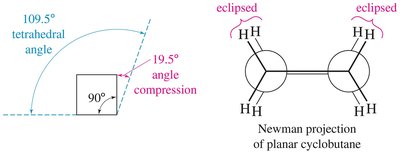
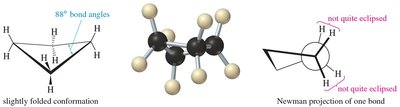
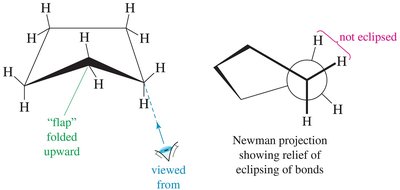
Cycloalkanes experience ring strain due to deviations from ideal bond angles and eclipsing interactions. The amount of strain depends on ring size.
Cyclopropane: Significant angle and torsional strain due to 60° bond angles.
Cyclobutane: Less angle strain, but still significant due to 90° bond angles.
Cyclopentane and Cyclohexane: Minimal strain due to near-ideal bond angles and conformational flexibility.
Conformations of Cyclohexane
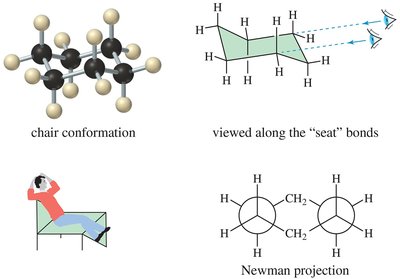
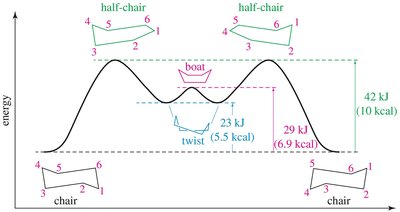
Cyclohexane adopts several conformations to minimize strain, with the chair conformation being the most stable.
Chair: All bond angles are close to 109.5°, and all hydrogens are staggered.
Boat, Twist-Boat, Half-Chair: Higher energy conformations due to increased strain.
Axial and Equatorial Positions in Cyclohexane
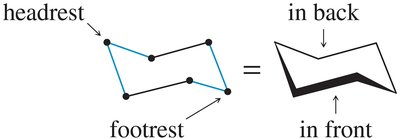
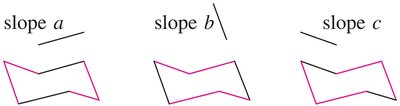
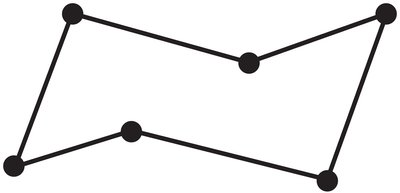
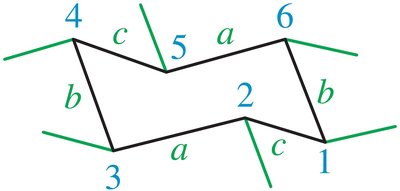
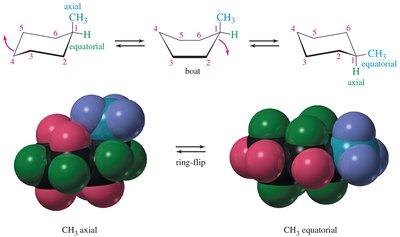
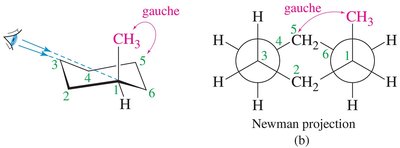
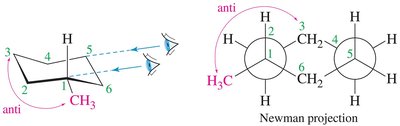
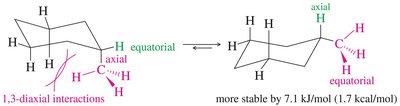
In the chair conformation, substituents can occupy axial (parallel to the ring axis) or equatorial (around the ring equator) positions. Equatorial positions are generally more stable due to reduced steric interactions.
Ring Flip: Interconversion between chair forms swaps axial and equatorial positions.
1,3-Diaxial Interactions: Axial substituents experience steric repulsion with other axial hydrogens, destabilizing the molecule.


Energy Differences in Monosubstituted Cyclohexanes
The stability of axial versus equatorial substituents can be quantified by measuring the energy difference () between the two conformations.
X | (kJ/mol) | (kcal/mol) |
|---|---|---|
F | 0.8 | 0.2 |
CN | 0.8 | 0.2 |
Cl | 0.8 | 0.2 |
Br | 2.1 | 0.5 |
OH | 4.1 | 1.0 |
COOH | 5.9 | 1.4 |
CH3 | 7.6 | 1.8 |
CH2CH3 | 10.8 | 2.6 |
CH(CH3)2 | 8.8 | 2.1 |
C(CH3)3 | 23 | 5.4 |
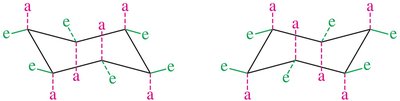
Chair Conformations of Disubstituted Cyclohexanes
Disubstituted cyclohexanes can have both substituents axial, both equatorial, or one of each. The diequatorial conformation is generally the most stable due to minimized steric interactions.
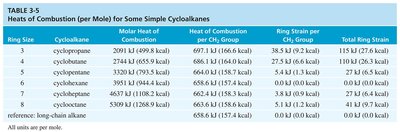
Summary Table: Heats of Combustion and Ring Strain in Cycloalkanes
Heats of combustion provide insight into the relative stabilities and ring strain of cycloalkanes. Lower ring strain correlates with greater stability.
Ring Size | Cycloalkane | Molar Heat of Combustion (kJ/mol) | Heat of Combustion per CH2 Group (kJ/mol) | Ring Strain per CH2 Group (kJ/mol) | Total Ring Strain (kJ/mol) |
|---|---|---|---|---|---|
3 | cyclopropane | 2091.1 | 697.1 | 38.5 | 115.0 |
4 | cyclobutane | 2741.4 | 685.1 | 27.5 | 110.0 |
5 | cyclopentane | 3304.7 | 660.9 | 5.4 | 27.1 |
6 | cyclohexane | 3977.1 | 663.0 | 1.1 | 6.6 |
8 | cyclooctane | 5309.1 | 663.6 | 5.1 | 41.1 |
Key Terms and Concepts
Alkane: Saturated hydrocarbon with only single bonds.
Cycloalkane: Alkane with carbon atoms arranged in a ring.
Torsional Strain: Energy increase due to eclipsing bonds.
Steric Strain: Energy increase when atoms are forced too close together.
Newman Projection: Visualization tool for conformational analysis.
Chair Conformation: Most stable conformation of cyclohexane.
Axial/Equatorial: Positions of substituents in cyclohexane.
Ring Strain: Instability due to angle and torsional strain in cyclic compounds.
Example Equation:
General formula for alkanes:
General formula for cycloalkanes:
Additional info:
All images included are directly relevant to the explanation and reinforce the concepts described in the adjacent paragraphs.
