 Back
BackStudy Guide: Electrophilic Addition to Alkenes (Organic Chemistry)
Study Guide - Smart Notes
 Tailored notes based on your materials, expanded with key definitions, examples, and context.
Q1. Circle the correct product of this reaction: Addition of HBr to 1,2-dimethylcyclohexene
Background
Topic: Electrophilic Addition to Alkenes (Markovnikov vs. Anti-Markovnikov)
This question tests your understanding of regioselectivity and stereochemistry in the addition of HBr to a substituted cyclohexene.
Key Terms and Formulas:
Markovnikov Rule: The hydrogen atom adds to the carbon with more hydrogens, and the bromine adds to the more substituted carbon.
Carbocation Intermediate: Stability of carbocation determines the major product.
Stereochemistry: Consider possible syn and anti addition.
Step-by-Step Guidance
Identify the double bond in the cyclohexene and determine which carbon is more substituted.
Apply the Markovnikov rule: predict where the H and Br will add.
Draw the carbocation intermediate and consider possible rearrangements for stability.
Consider the stereochemistry of the addition (syn vs. anti).
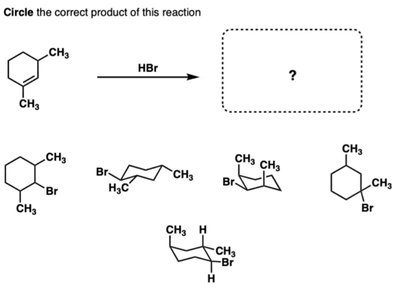
Try solving on your own before revealing the answer!
Final Answer: The correct product is the Markovnikov addition with Br on the more substituted carbon.
The product is the cyclohexane ring with Br and H added across the double bond, following Markovnikov's rule.
Q2. Draw the product and show the mechanism for HCl addition to cyclopentene
Background
Topic: Electrophilic Addition Mechanism
This question tests your ability to draw the product and the stepwise mechanism for the addition of HCl to an alkene.
Key Terms and Formulas:
Electrophilic Addition: Alkene reacts with HCl, forming a carbocation intermediate.
Mechanism: Show movement of electrons with curved arrows.
Step-by-Step Guidance
Draw the starting cyclopentene structure.
Show the alkene attacking the hydrogen of HCl, forming a carbocation intermediate.
Draw the chloride ion attacking the carbocation to form the final product.
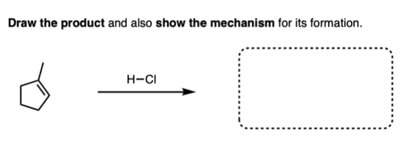
Try solving on your own before revealing the answer!
Final Answer: The product is chlorocyclopentane, formed via Markovnikov addition.
The mechanism involves carbocation formation and nucleophilic attack by Cl-.
Q3. Draw two possible products of HBr addition to cyclohexylpropene. Which one will be favored?
Background
Topic: Regioselectivity in Electrophilic Addition
This question tests your understanding of Markovnikov vs. anti-Markovnikov addition and product preference.
Key Terms and Formulas:
Markovnikov Product: Br adds to the more substituted carbon.
Anti-Markovnikov Product: Br adds to the less substituted carbon (usually with peroxides).
Step-by-Step Guidance
Identify the alkene and label the carbons for possible addition sites.
Draw the Markovnikov product (Br on the more substituted carbon).
Draw the anti-Markovnikov product (Br on the less substituted carbon).
Discuss which product is favored based on reaction conditions.
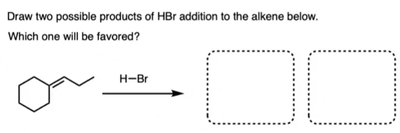
Try solving on your own before revealing the answer!
Final Answer: The Markovnikov product is favored unless peroxides are present.
Br adds to the more substituted carbon due to carbocation stability.
Q4. Draw curved arrows in the mechanism of HCl addition to 2-butene
Background
Topic: Reaction Mechanism (Curved Arrow Notation)
This question tests your ability to illustrate electron movement in electrophilic addition.
Key Terms and Formulas:
Curved Arrows: Show electron flow from alkene to HCl.
Carbocation Intermediate: Formed after protonation.
Step-by-Step Guidance
Draw the alkene and HCl approaching each other.
Show the pi electrons attacking the hydrogen, forming a carbocation.
Show the chloride ion attacking the carbocation.
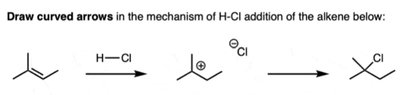
Try solving on your own before revealing the answer!
Final Answer: The product is 2-chlorobutane, formed via Markovnikov addition.
Curved arrows show the stepwise electron movement.
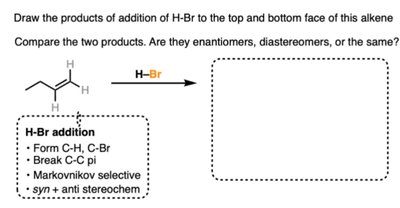
Q5. Draw the products of HBr addition to the top and bottom face of the alkene. Compare the two products: enantiomers, diastereomers, or the same?
Background
Topic: Stereochemistry of Electrophilic Addition
This question tests your understanding of syn and anti addition, and how stereochemistry affects product relationships.
Key Terms and Formulas:
Syn Addition: Both groups add to the same face.
Anti Addition: Groups add to opposite faces.
Enantiomers: Non-superimposable mirror images.
Diastereomers: Stereoisomers that are not mirror images.
Step-by-Step Guidance
Draw the alkene and indicate the top and bottom faces.
Show HBr addition to each face, forming two stereoisomers.
Compare the products to determine their relationship (enantiomers, diastereomers, or identical).
Try solving on your own before revealing the answer!
Final Answer: The two products are enantiomers.
Each addition creates a chiral center, leading to a pair of enantiomers.
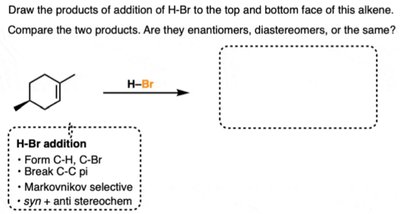
Q6. Draw the products of HBr addition to the top and bottom face of cyclohexene. Compare the two products: enantiomers, diastereomers, or the same?
Background
Topic: Stereochemistry in Cyclic Systems
This question tests your understanding of stereochemical outcomes in cyclic alkene addition.
Key Terms and Formulas:
Syn and Anti Addition: Possible in cyclic systems.
Enantiomers vs. Diastereomers: Depends on symmetry and chiral centers.
Step-by-Step Guidance
Draw cyclohexene and indicate the top and bottom faces.
Show HBr addition to each face, forming two products.
Analyze the relationship between the products.
Try solving on your own before revealing the answer!
Final Answer: The products are diastereomers.
Due to the ring structure, the products are not mirror images.
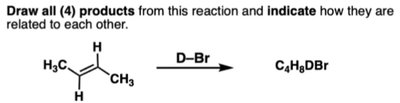
Q7. Draw all (4) products from the reaction of 2-methyl-2-butene with DBr. Indicate how they are related to each other.
Background
Topic: Isomerism and Stereochemistry in Electrophilic Addition
This question tests your ability to enumerate all possible stereoisomers and relate them (enantiomers, diastereomers, identical).
Key Terms and Formulas:
Deuterium (D): Isotope of hydrogen.
Stereoisomers: Same connectivity, different spatial arrangement.
Step-by-Step Guidance
Draw the possible products with D and Br added across the double bond.
Consider both syn and anti addition.
Label the products and compare their relationships.
Try solving on your own before revealing the answer!
Final Answer: The four products are two pairs of enantiomers.
Each pair is related as enantiomers; the pairs are diastereomers.
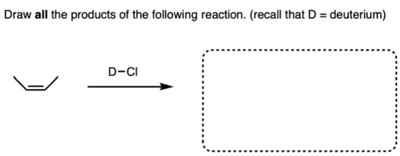
Q8. Draw all the products of the reaction of 1,3-butadiene with DCl.
Background
Topic: Electrophilic Addition to Conjugated Dienes
This question tests your understanding of 1,2- and 1,4-addition products in conjugated systems.
Key Terms and Formulas:
1,2-Addition: D and Cl add to adjacent carbons.
1,4-Addition: D and Cl add to terminal carbons.
Step-by-Step Guidance
Draw the 1,2-addition product (D and Cl on carbons 1 and 2).
Draw the 1,4-addition product (D and Cl on carbons 1 and 4).
Label and compare the products.
Try solving on your own before revealing the answer!
Final Answer: Both 1,2- and 1,4-addition products are formed.
Thermodynamic and kinetic control determines the favored product.
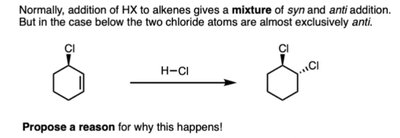
Q9. Propose a reason for why HCl addition to cyclohexene with Cl gives almost exclusively anti addition.
Background
Topic: Stereochemistry and Mechanism of Electrophilic Addition
This question tests your understanding of why anti addition predominates in certain cases.
Key Terms and Formulas:
Anti Addition: Groups add to opposite faces.
Intermediate: Possible formation of a cyclic intermediate (e.g., halonium ion).
Step-by-Step Guidance
Consider the mechanism of HCl addition to the alkene.
Analyze the possible intermediates (carbocation vs. halonium ion).
Explain how the intermediate leads to anti addition.
Try solving on your own before revealing the answer!
Final Answer: Anti addition occurs due to the formation of a cyclic intermediate.
The intermediate restricts attack to the opposite face.
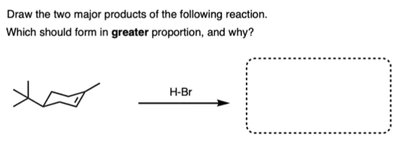
Q10. Draw the two major products of HBr addition to a bicyclic alkene. Which should form in greater proportion, and why?
Background
Topic: Regioselectivity and Stereochemistry in Bicyclic Systems
This question tests your understanding of product distribution based on carbocation stability and steric effects.
Key Terms and Formulas:
Bicyclic Alkene: Unique regioselectivity due to ring structure.
Carbocation Stability: Determines major product.
Step-by-Step Guidance
Draw the two possible products based on where Br adds.
Analyze carbocation stability for each pathway.
Discuss which product is favored and why.
Try solving on your own before revealing the answer!
Final Answer: The product from the more stable carbocation forms in greater proportion.
Br adds to the carbon that leads to the most stable intermediate.
