 Back
BackStudy Notes: Carbonyl Alpha-Substitution Reactions
Study Guide - Smart Notes
 Tailored notes based on your materials, expanded with key definitions, examples, and context.
Carbonyl Alpha-Substitution Reactions
Introduction to Alpha-Substitution
Alpha-substitution reactions are a fundamental class of transformations in carbonyl chemistry, involving the replacement of an alpha hydrogen (adjacent to the carbonyl group) with an electrophile. These reactions proceed via enol or enolate ion intermediates and are crucial for forming new carbon–carbon bonds, enabling the construction of larger organic molecules from smaller precursors.
Keto–Enol Tautomerism
Definition and Mechanism
Keto–enol tautomerism is the equilibrium between a carbonyl compound (keto form) and its corresponding enol (a compound with a C=C double bond and an OH group). This process involves the migration of a hydrogen atom and the shift of a double bond.
Tautomers are constitutional isomers that differ in the placement of a proton and a double bond.
Most simple carbonyl compounds exist predominantly in the keto form, with the enol form present only in trace amounts unless stabilized by conjugation or intramolecular hydrogen bonding.
Tautomerism is catalyzed by both acids and bases.
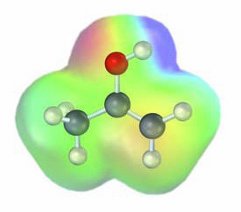
Image: Electrostatic potential map of a carbonyl compound, illustrating electron density distribution.
Acid- and Base-Catalyzed Tautomerism
Acid-catalyzed: Protonation of the carbonyl oxygen followed by deprotonation at the alpha carbon yields the enol.
Base-catalyzed: Deprotonation at the alpha carbon forms an enolate ion, which is then protonated on oxygen to yield the enol.
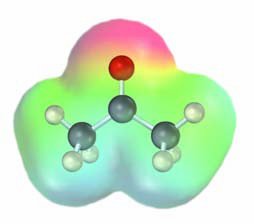
Image: Another view of the electrostatic potential map, highlighting the reactive sites.
Reactivity of Enols: Mechanism of Alpha-Substitution
Nucleophilicity of Enols
Enols are nucleophilic at the alpha carbon due to the electron-rich double bond, further enhanced by resonance donation from the adjacent oxygen. This makes enols more reactive than typical alkenes toward electrophiles.
Enols react with electrophiles (E+) to form alpha-substituted carbonyl compounds.
The reaction mechanism involves initial attack by the enol on the electrophile, followed by deprotonation to regenerate the carbonyl group.
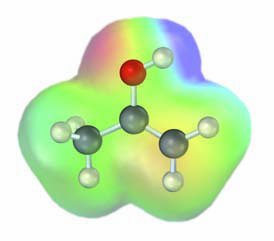
Image: Electrostatic potential map of an enol tautomer, showing high electron density at the alpha carbon.
Alpha Halogenation of Aldehydes and Ketones
Mechanism and Applications
Alpha-halogenation is a classic laboratory reaction where aldehydes and ketones react with halogens (Cl2, Br2, I2) in acid to yield alpha-halo carbonyl compounds. The reaction proceeds via enol intermediates and is important for further synthetic transformations, such as the formation of alpha, beta-unsaturated carbonyl compounds through elimination.
The rate-determining step is enol formation, not halogen addition.
Alpha-halogenated products can undergo elimination (E2) to form unsaturated carbonyl compounds.
Alpha Bromination of Carboxylic Acids: The Hell–Volhard–Zelinskii (HVZ) Reaction
Mechanism
Carboxylic acids can be alpha-brominated using Br2 and PBr3 in the HVZ reaction. The process involves conversion to an acid bromide, enolization, bromination, and hydrolysis to yield the alpha-bromo acid.
Acidity of Alpha Hydrogens and Enolate Ion Formation
Acidity Trends and Resonance Stabilization
Alpha hydrogens of carbonyl compounds are weakly acidic due to resonance stabilization of the resulting enolate ion. The acidity is much greater than that of alkanes or ethers, and is further increased when the alpha carbon is flanked by two carbonyl groups (as in beta-dicarbonyl compounds).
Enolate ions are resonance hybrids, with negative charge delocalized between oxygen and the alpha carbon.
Strong bases such as lithium diisopropylamide (LDA) are used to generate enolate ions quantitatively.
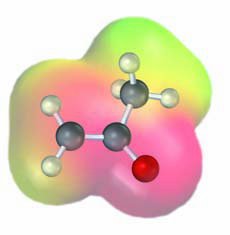
Image: Electrostatic potential map of an enolate ion, illustrating delocalization of negative charge.
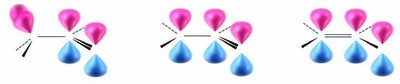
Image: Resonance structures of an enolate ion, showing electron delocalization between oxygen and carbon.
Reactivity of Enolate Ions
Alpha-Substitution and Alkylation
Enolate ions are highly nucleophilic and can react with electrophiles at either the oxygen or the alpha carbon. Reaction at the alpha carbon is more common and leads to alpha-substituted carbonyl compounds. Enolate ions are also key intermediates in base-promoted halogenation and alkylation reactions.
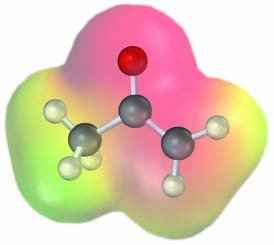
Image: Electrostatic potential map of an enolate ion, highlighting nucleophilic sites for electrophilic attack.
Alkylation of Enolate Ions
Malonic Ester and Acetoacetic Ester Syntheses
Alkylation of enolate ions is a powerful method for forming new C–C bonds. Two classic synthetic applications are:
Malonic ester synthesis: Converts an alkyl halide into a carboxylic acid with two additional carbons.
Acetoacetic ester synthesis: Converts an alkyl halide into a methyl ketone with three additional carbons.
Direct Alkylation of Ketones, Esters, and Nitriles
Monocarbonyl compounds can also be directly alkylated using strong, non-nucleophilic bases (e.g., LDA) in aprotic solvents. The reaction is most efficient with primary or methyl halides due to the SN2 mechanism.
Summary Table: Acidity Constants for Some Organic Compounds
Functional Group | Example | pKa |
|---|---|---|
Carboxylic acid | CH3COOH | 5 |
1,3-Diketone | CH3COCH2COCH3 | 9 |
3-Keto ester | CH3COCH2COOCH3 | 11 |
1,3-Diester | CH3OCOCH2COOCH3 | 13 |
Alcohol | CH3OH | 16 |
Aldehyde | CH3CHO | 17 |
Ketone | CH3COCH3 | 19 |
Ester | CH3COOCH3 | 25 |
Nitrile | CH3CN | 25 |
Dialkylamine | HN(i-C3H7)2 | 36 |
Applications: Synthesis of Barbiturates
Medicinal Chemistry Example
Barbiturates are synthesized via enolate alkylation and nucleophilic acyl substitution, starting from malonic ester and urea. This demonstrates the utility of alpha-substitution and enolate chemistry in pharmaceutical synthesis.

Image: Various barbiturate drugs, illustrating the diversity of compounds accessible via enolate chemistry.
Key Terms
Enol: A compound with a C=C double bond and an OH group, in equilibrium with a carbonyl compound.
Enolate ion: The resonance-stabilized anion formed by deprotonation of the alpha hydrogen of a carbonyl compound.
Alpha-substitution reaction: Replacement of an alpha hydrogen by an electrophile via enol or enolate intermediates.
Malonic ester synthesis: Preparation of carboxylic acids from alkyl halides using malonic ester.
Acetoacetic ester synthesis: Preparation of methyl ketones from alkyl halides using acetoacetic ester.
Tautomer: Isomers that differ in the position of a proton and a double bond.
Summary of Reactions
Aldehyde/ketone halogenation:
Hell–Volhard–Zelinskii bromination:
Dehydrobromination of alpha-bromo ketones:
Haloform reaction:
Malonic ester synthesis:
Acetoacetic ester synthesis:
Direct alkylation of ketones/esters/nitriles:
