 Back
BackSubstitution and Elimination Reactions of Alkyl Halides (SN1 and SN2 Mechanisms)
Study Guide - Smart Notes
 Tailored notes based on your materials, expanded with key definitions, examples, and context.
Alkyl Halides: Structure, Reactivity, and Mechanisms
Introduction to Alkyl Halides
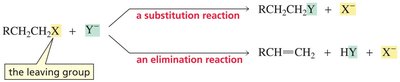
Alkyl halides are organic compounds in which a halogen atom (Cl, Br, I, or F) is bonded to an sp3 hybridized carbon atom. These compounds are important in organic chemistry due to their ability to undergo substitution and elimination reactions, which are foundational for the synthesis of more complex molecules.
Leaving Group: The atom or group that departs with a pair of electrons during a reaction. Good leaving groups are typically weak bases or stable anions.
Substitution Reaction: A reaction where the leaving group is replaced by a nucleophile.
Elimination Reaction: A reaction where the leaving group and a hydrogen atom are removed, forming a double bond.
Substitution Mechanisms: SN2 and SN1
SN2 Mechanism (Bimolecular Nucleophilic Substitution)
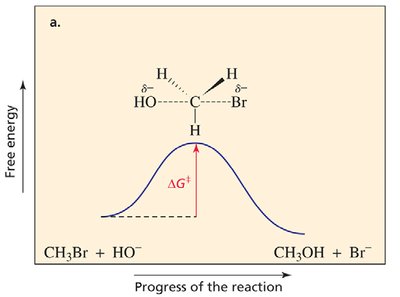
The SN2 mechanism is a one-step, concerted process where the nucleophile attacks the electrophilic carbon from the side opposite the leaving group, resulting in inversion of configuration at the carbon center. This mechanism is characterized by its dependence on both the nucleophile and the substrate.
Mechanism: The nucleophile attacks the carbon, forming a transition state where bonds are partially formed and broken, and the leaving group departs simultaneously.
Kinetics: The rate law is .
Stereochemistry: Inversion of configuration occurs due to backside attack.
Reactivity Order: Methyl halide > 1° alkyl halide > 2° alkyl halide > 3° alkyl halide (steric hindrance slows the reaction).
Leaving Group: Better leaving groups (more stable anions) increase the reaction rate.
Nucleophile: Stronger (more basic or negatively charged) nucleophiles increase the reaction rate.


Effect of Leaving Group on SN2 Rate
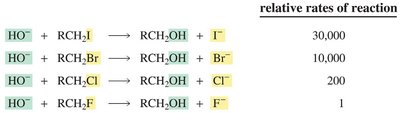
The rate of SN2 reactions is highly dependent on the nature of the leaving group. The better the leaving group, the faster the reaction proceeds.
Reaction | Relative Rate |
|---|---|
HO− + RCH2I → RCH2OH + I− | 30,000 |
HO− + RCH2Br → RCH2OH + Br− | 10,000 |
HO− + RCH2Cl → RCH2OH + Cl− | 200 |
HO− + RCH2F → RCH2OH + F− | 1 |
Biological Example of SN2
SN2 mechanisms are not limited to alkyl halides; they also occur in biological systems, such as the methylation of norepinephrine to form epinephrine.




SN1 Mechanism (Unimolecular Nucleophilic Substitution)
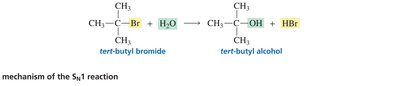
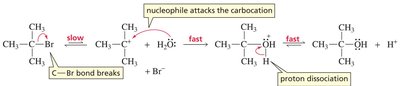
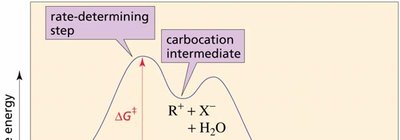
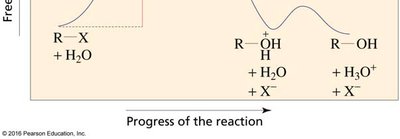
The SN1 mechanism is a two-step process involving the formation of a carbocation intermediate after the leaving group departs. The nucleophile then attacks the planar carbocation, which can lead to a mixture of stereoisomers if the carbon is chiral.
Mechanism: Step 1: Leaving group departs, forming a carbocation. Step 2: Nucleophile attacks the carbocation.
Kinetics: The rate law is (unimolecular, depends only on substrate).
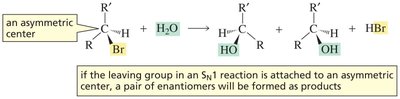
Stereochemistry: Mixtures of stereoisomers are formed due to planar carbocation intermediate.
Reactivity Order: 3° alkyl halide > 2° alkyl halide > 1° alkyl halide (carbocation stability is key).
Leaving Group: Better leaving groups increase the reaction rate.
Nucleophile: Strength of nucleophile does not affect the rate-determining step.
Stereochemical Consequences of SN1
Because the carbocation intermediate is planar, nucleophilic attack can occur from either side, leading to racemization if the reacting center is chiral.

Comparison of SN1 and SN2 Mechanisms
Key Differences and Predicting Mechanism
The SN1 and SN2 mechanisms differ in their kinetics, stereochemistry, and substrate preferences. Understanding these differences allows chemists to predict which pathway will dominate under given conditions.
Feature | SN2 | SN1 |
|---|---|---|
Rate Law | Second order: | First order: |
Stereochemistry | Inversion of configuration | Racemization (mixture of stereoisomers) |
Substrate Reactivity | Methyl > 1° > 2° > 3° | 3° > 2° > 1° |
Nucleophile | Strong required | Not important |
Leaving Group | Good required | Good required |
Summary
SN2 reactions are favored by strong nucleophiles, good leaving groups, and substrates with low steric hindrance.
SN1 reactions are favored by substrates that can form stable carbocations, good leaving groups, and weak nucleophiles.
Stereochemical outcomes differ: SN2 gives inversion, SN1 gives racemization.
