 Back
BackSubstitution and Elimination Reactions of Alkyl Halides: Mechanisms, Selectivity, and Synthetic Applications
Study Guide - Smart Notes
 Tailored notes based on your materials, expanded with key definitions, examples, and context.
Substitution and Elimination Reactions of Alkyl Halides
Overview of Substitution (SN) and Elimination (E) Mechanisms
Alkyl halides undergo two major types of reactions with nucleophiles and bases: nucleophilic substitution (SN1 and SN2) and elimination (E1 and E2). The competition between these pathways depends on the structure of the alkyl halide, the strength and steric bulk of the base/nucleophile, and the reaction conditions.
Substitution reactions replace the leaving group (halide) with a nucleophile.
Elimination reactions remove a proton and the leaving group, forming a double bond (alkene).
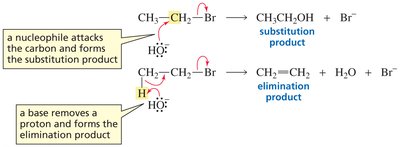
Mechanistic Pathways: SN2, E2, SN1, and E1
The four main mechanisms are distinguished by their kinetics and molecularity:
SN2 (bimolecular nucleophilic substitution): Concerted, single-step mechanism; favored by primary alkyl halides and strong nucleophiles.
E2 (bimolecular elimination): Concerted, single-step mechanism; favored by strong bases, especially with steric hindrance.
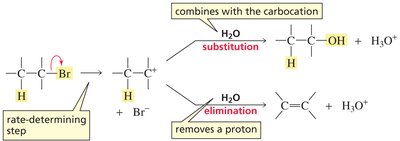
SN1 (unimolecular nucleophilic substitution): Two-step mechanism via carbocation intermediate; favored by tertiary alkyl halides and weak nucleophiles.
E1 (unimolecular elimination): Two-step mechanism via carbocation intermediate; favored by tertiary alkyl halides and weak bases.
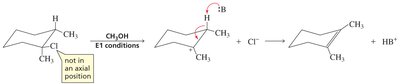
Factors Affecting Substitution vs. Elimination
Effect of Alkyl Halide Structure
The structure of the alkyl halide (primary, secondary, tertiary) is a key determinant of the reaction pathway:
Primary alkyl halides: Favor SN2 unless there is significant steric hindrance, which can favor E2.
Secondary alkyl halides: Both SN2 and E2 are possible; the outcome depends on the base/nucleophile and temperature.
Tertiary alkyl halides: SN2 is not possible due to steric hindrance; E2 is favored with strong bases, while SN1/E1 occur with weak nucleophiles/bases.



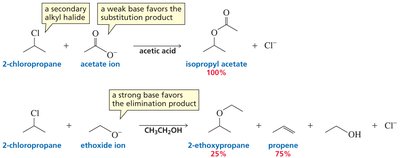
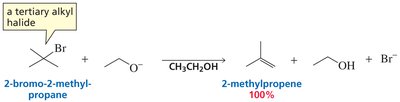
Effect of Base/Nucleophile Strength and Bulk
The strength and steric bulk of the base/nucleophile influence the reaction pathway:
Strong, unhindered nucleophiles: Favor SN2.
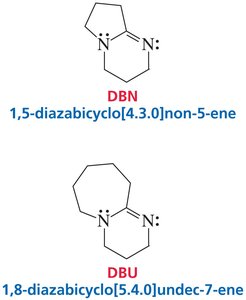
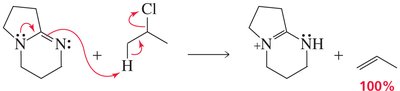
Strong, bulky bases: Favor E2 by abstracting protons rather than attacking the carbon.
Weak bases/nucleophiles: Favor SN1/E1 in substrates capable of forming stable carbocations.
Effect of Temperature
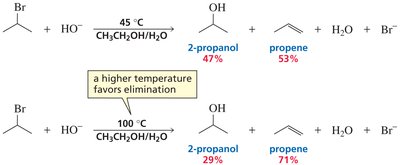
Higher temperatures favor elimination (E2/E1) over substitution (SN2/SN1) due to the greater increase in entropy () in elimination reactions.
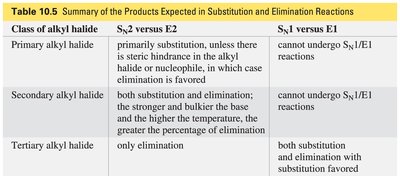
Summary Table: Products Expected in Substitution and Elimination Reactions
The following table summarizes the expected products based on alkyl halide class and reaction conditions:
Class of alkyl halide | SN2 versus E2 | SN1 versus E1 |
|---|---|---|
Primary alkyl halide | primarily substitution, unless there is steric hindrance in the alkyl halide or nucleophile, in which case elimination is favored | cannot undergo SN1/E1 reactions |
Secondary alkyl halide | both substitution and elimination; the stronger and bulkier the base and the higher the temperature, the greater the percentage of elimination | cannot undergo SN1/E1 reactions |
Tertiary alkyl halide | only elimination | both substitution and elimination with substitution favored |
Applications: Synthesis of Ethers and Alkenes
Williamson Ether Synthesis (SN2 Reaction)
The Williamson ether synthesis is a classic SN2 reaction where an alkoxide ion reacts with an alkyl halide to form an ether. The reaction is most efficient with primary alkyl halides to avoid elimination side products.
Equation:


Effect of Steric Hindrance in Ether Synthesis
Steric hindrance in either the alkyl halide or the alkoxide can lead to increased elimination, reducing ether yield. The more hindered group should be provided by the alkyl halide for optimal ether synthesis.
Synthesizing Alkenes and Alkynes
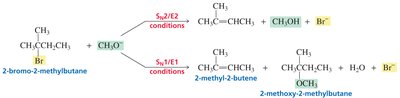
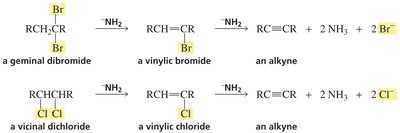
Elimination reactions (E2 or E1) are used to synthesize alkenes from alkyl halides. For tertiary alkyl halides, elimination is the exclusive pathway under SN2/E2 conditions.
Examples and Product Distribution
Product Distribution in Substitution and Elimination
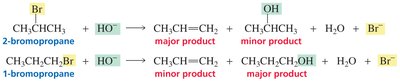
The ratio of substitution to elimination products depends on the substrate, base/nucleophile, and reaction conditions. Examples illustrate how steric hindrance and base strength affect product ratios.
Key Mechanistic Details
Carbocation Intermediates in SN1/E1
In SN1 and E1 reactions, the rate-determining step is the formation of a carbocation intermediate. The nucleophile or base then reacts with the carbocation to give substitution or elimination products, respectively.
Summary
Substitution and elimination reactions of alkyl halides are fundamental to organic synthesis.
The outcome depends on substrate structure, base/nucleophile strength and bulk, and reaction conditions.
Understanding these factors allows chemists to control product distribution and design efficient synthetic routes.
