 Back
BackSummary of Alkene and Alkyne Reactions: Addition and Synthesis Pathways
Study Guide - Smart Notes
 Tailored notes based on your materials, expanded with key definitions, examples, and context.
Alkenes and Alkynes: Addition and Synthesis Reactions
Introduction
This guide summarizes key reactions for the synthesis and transformation of alkenes and alkynes, which are central topics in organic chemistry. Understanding these reactions is essential for predicting products and designing synthetic routes in organic synthesis.
Reactions of Alkenes
Addition Reactions
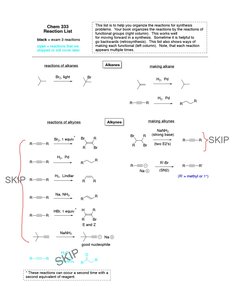
Alkenes undergo a variety of addition reactions, where reagents add across the carbon-carbon double bond, converting it into a single bond and forming new functional groups.
Hydrogenation: Addition of H2 across the double bond using a metal catalyst (e.g., Pd, Pt, or Ni) to yield an alkane.
General equation:
Halogenation: Addition of X2 (e.g., Br2, Cl2) to form vicinal dihalides.
General equation:
Hydrohalogenation: Addition of HX (e.g., HBr, HCl) to form alkyl halides, following Markovnikov's rule.
General equation:
Hydration (Acid-Catalyzed): Addition of water in the presence of acid (H2SO4) to yield alcohols.
General equation:
Oxymercuration-Reduction: A two-step process using Hg(OAc)2, H2O followed by NaBH4 to add water across the double bond with Markovnikov selectivity, avoiding carbocation rearrangement.
General equation:
Reactions of Alkynes
Addition Reactions
Alkynes can undergo similar addition reactions as alkenes, but can add reagents twice due to the presence of two π bonds.
Hydrogenation: Complete hydrogenation yields alkanes, while partial hydrogenation (using Lindlar's catalyst) yields cis-alkenes.
General equation:
Partial:
Halogenation: Addition of X2 (e.g., Br2) can yield tetrahalides.
General equation:
Hydrohalogenation: Addition of HX (e.g., HBr) can yield geminal dihalides.
General equation:
Hydration (Acid-Catalyzed): Addition of water in the presence of acid and HgSO4 yields ketones (via enol intermediates).
General equation:
Making Alkynes
Alkylation of Terminal Alkynes
Terminal alkynes can be deprotonated with a strong base (e.g., NaNH2) to form acetylide anions, which are good nucleophiles for alkylation reactions.
Deprotonation:
Alkylation:
Additional info: This method is useful for chain elongation in organic synthesis.
Summary Table: Key Addition Reactions of Alkenes and Alkynes
Reaction Type | Reagents | Product | Regioselectivity | Stereochemistry |
|---|---|---|---|---|
Hydrogenation (Alkene) | H2, Pd/C | Alkane | -- | Syn addition |
Halogenation (Alkene) | Br2 or Cl2 | Vicinal dihalide | -- | Anti addition |
Hydrohalogenation (Alkene) | HBr, HCl | Alkyl halide | Markovnikov | -- |
Oxymercuration-Reduction | Hg(OAc)2, H2O; NaBH4 | Alcohol | Markovnikov | No rearrangement |
Hydration (Alkyne) | HgSO4, H2SO4 | Ketone | Markovnikov | -- |
Alkylation (Alkyne) | NaNH2, R-X | Alkyne (chain extended) | -- | -- |
