 Back
BackThe Organic Chemistry of Carbohydrates: Structure, Stereochemistry, and Reactivity
Study Guide - Smart Notes
 Tailored notes based on your materials, expanded with key definitions, examples, and context.
The Organic Chemistry of Carbohydrates
Introduction to Carbohydrates
Carbohydrates are a fundamental class of biomolecules, serving as energy sources and structural components in living organisms. They are defined as polyhydroxy aldehydes or polyhydroxy ketones, with the general molecular formula .
Monosaccharides: Simple sugars containing a single polyhydroxy aldehyde or ketone unit.
Disaccharides: Composed of two monosaccharide units linked by a glycosidic bond.
Oligosaccharides: Contain 3–10 monosaccharide units.
Polysaccharides: Polymers with more than 10 monosaccharide units.
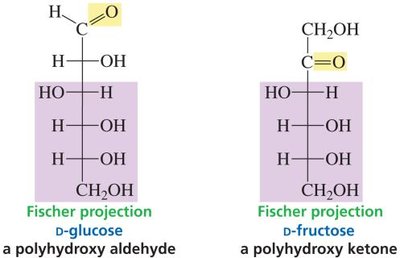
Example: Glucose (an aldohexose) and fructose (a ketohexose) are common monosaccharides that differ in the position of their carbonyl group.
Photosynthesis and Abundance of Glucose
Glucose is the most abundant carbohydrate in nature, produced by photosynthesis in plants. It serves as a primary energy source for many organisms.
Classification of Carbohydrates
Carbohydrates are classified based on the number of sugar units:
Monosaccharides (e.g., glucose, fructose)
Disaccharides (e.g., sucrose, lactose)
Oligosaccharides (3–10 units)
Polysaccharides (e.g., starch, cellulose)

Example: Hydrolysis of polysaccharides yields monosaccharide subunits.
Structure and Stereochemistry of Monosaccharides
The Smallest Aldose: Glyceraldehyde
Glyceraldehyde is the simplest aldose and contains a single asymmetric (chiral) center, making it optically active.
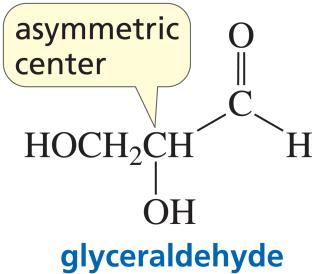
Enantiomers and Stereochemistry
Monosaccharides with chiral centers exist as enantiomers—non-superimposable mirror images. The D- and L- notation refers to the configuration relative to D-glyceraldehyde.

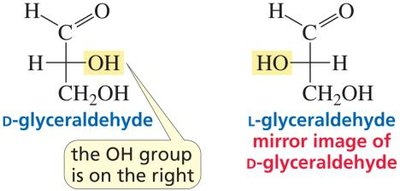
Key Point: In Fischer projections, the OH group on the right at the penultimate carbon indicates a D-sugar; on the left, an L-sugar.
D- and L- Sugars
D- and L- sugars are mirror images. Most naturally occurring sugars are D-isomers.
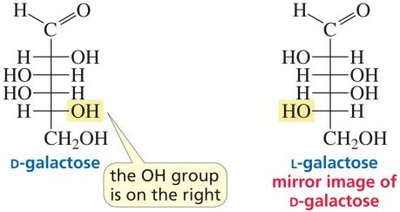
Optical Activity: (+) and (−) vs. D and L
The D/L system describes configuration, not optical rotation. (+) and (−) indicate the direction of plane-polarized light rotation, which is not directly related to D/L configuration.
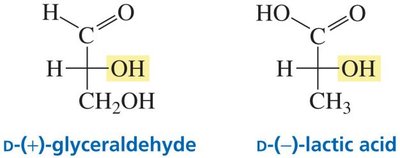
R/S Nomenclature vs. D/L and (+)/(−)
D/L: Configuration of the whole molecule (relative to glyceraldehyde).
R/S: Absolute configuration at a specific chiral center (Cahn-Ingold-Prelog rules).
(+)/(-): Direction of optical rotation.
Aldotetroses and Stereoisomers
Aldotetroses have two asymmetric centers, resulting in four stereoisomers (2n, where n = number of chiral centers).
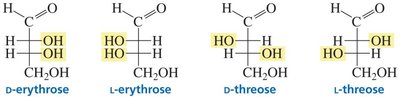
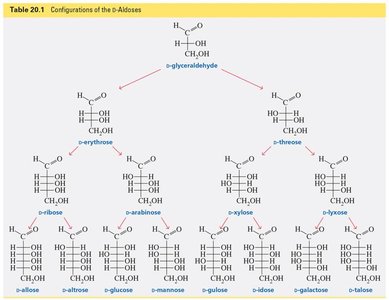
Configurations of the D-Aldoses
The configuration of D-aldoses can be systematically derived from D-glyceraldehyde by adding chiral centers.
Epimers
Epimers are sugars that differ in configuration at only one chiral center.
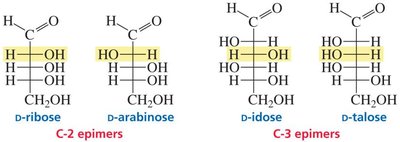
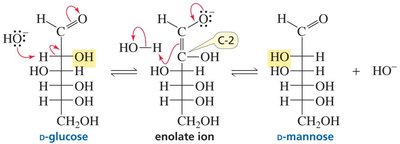
Example: D-mannose is a C-2 epimer of D-glucose; D-galactose is a C-4 epimer of D-glucose.
Epimerization and Enediol Rearrangement
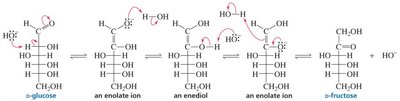
Epimerization is the process of converting one epimer to another, often via an enediol intermediate.
Chemical Reactions of Monosaccharides
Reduction of Monosaccharides
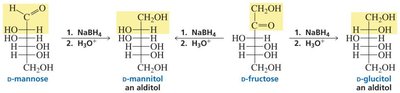
Reduction of aldoses and ketoses with sodium borohydride () yields alditols (sugar alcohols). Aldoses give one alditol; ketoses give two due to the formation of a new chiral center.
Oxidation Reactions
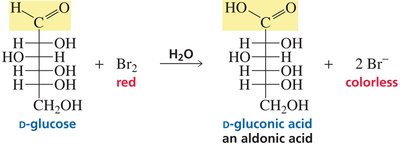
Oxidation to Aldonic Acids: Only aldehydes (aldoses) are oxidized by bromine water to aldonic acids.
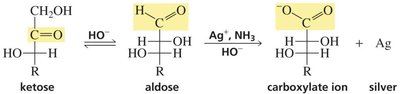
Tollens' and Benedict's Tests: Both aldoses and some ketoses can be oxidized by Tollens' reagent (Ag(NH3)2+), producing a silver mirror.
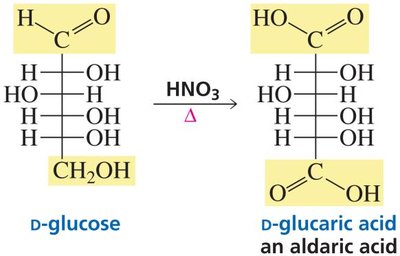
Oxidation to Aldaric Acids: Strong oxidizing agents (e.g., ) oxidize both the aldehyde and primary alcohol groups to yield aldaric acids.
Chain Lengthening and Shortening
Kiliani–Fischer Synthesis
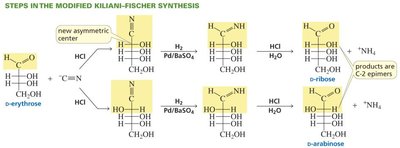
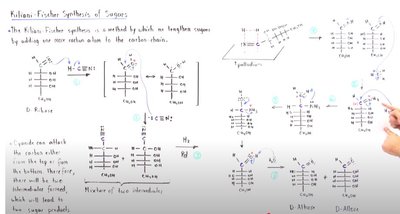
The Kiliani–Fischer synthesis increases the carbon chain of an aldose by one, producing a pair of C-2 epimers.
Wohl Degradation
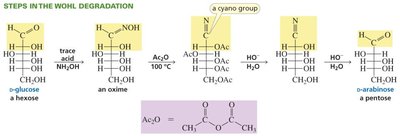
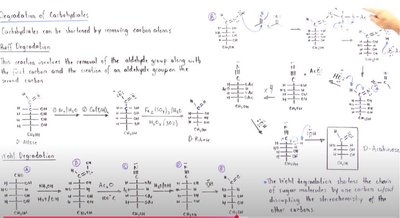
The Wohl degradation shortens the carbon chain of an aldose by one, converting the terminal aldehyde to a cyano group, then hydrolyzing and removing it.
Determining the Structure of Glucose (Fischer Proof)
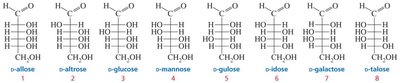
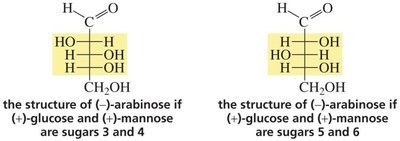
Oxidation and epimerization experiments, such as the Kiliani–Fischer synthesis and Wohl degradation, were used to deduce the structure of glucose and its relationship to other sugars.
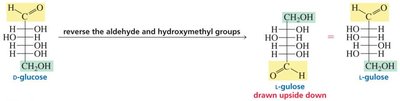
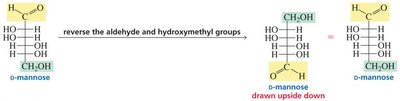
Cyclic Structure of Monosaccharides
Hemiacetal Formation and Ring Structures
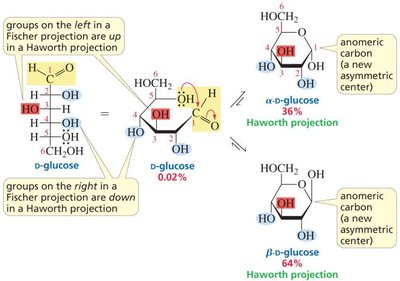
Monosaccharides with five or more carbons form cyclic hemiacetals (pyranoses or furanoses) via intramolecular reaction between the carbonyl and a hydroxyl group.
Fischer and Haworth Projections
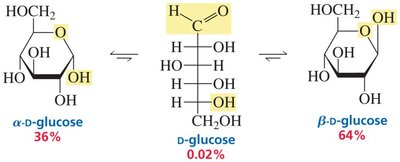
Fischer projections are linear representations, while Haworth projections depict the cyclic (ring) forms. The conversion between these forms is essential for understanding carbohydrate chemistry.
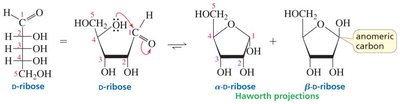
Pyranoses and Furanoses
Six-membered ring sugars are called pyranoses; five-membered ring sugars are furanoses.
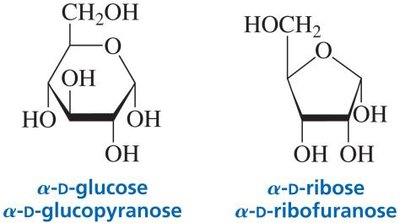
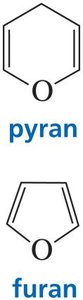
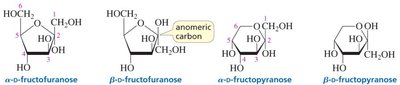
Chair Conformations and Stability
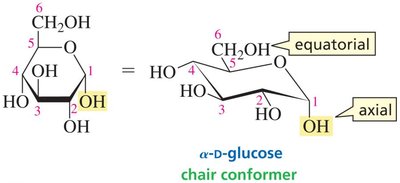
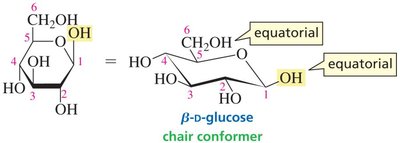
Pyranose rings can adopt chair conformations. Beta-D-glucose is more stable than alpha-D-glucose due to all substituents being equatorial.

Epimers and Anomers in Cyclic Sugars
Epimers differ at one chiral center; anomers differ at the anomeric carbon (C-1 in aldoses). Alpha and beta anomers interconvert in solution (mutarotation).
Glycosides and Glycosidic Bonds
Formation of Glycosides
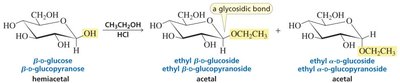
When the anomeric hydroxyl group of a monosaccharide reacts with an alcohol, an acetal (glycoside) is formed. Glycosidic bonds link monosaccharide units in oligo- and polysaccharides.
Summary Table: Key Terms and Concepts
Term | Definition | Example |
|---|---|---|
Monosaccharide | Single polyhydroxy aldehyde or ketone | Glucose, Fructose |
Disaccharide | Two monosaccharides linked by glycosidic bond | Sucrose, Lactose |
Epimer | Sugars differing at one chiral center | Glucose & Mannose (C-2) |
Anomer | Isomers differing at the anomeric carbon | Alpha- and Beta-glucose |
Glycoside | Acetal formed from a sugar | Methyl glucoside |
Additional info: This summary covers the structure, stereochemistry, and reactivity of carbohydrates, focusing on monosaccharides, their isomerism, and key reactions relevant to organic chemistry.
