 Back
BackThermodynamics, Kinetics, and Reactivity in Organic Chemistry
Study Guide - Smart Notes
 Tailored notes based on your materials, expanded with key definitions, examples, and context.
Thermodynamics and Kinetics in Organic Chemistry
Introduction to Energy and Ratios
Understanding the energetic differences between reactants and products is fundamental in organic chemistry. The ratio of products to reactants at equilibrium, as well as the rates at which reactions proceed, are governed by thermodynamic and kinetic principles. These ratios can often be interpreted in terms of orders of magnitude, which helps chemists predict reaction outcomes and yields.
Ratios: The relative amounts of products and reactants are crucial for understanding chemical equilibria and reaction yields.
Energy Units: Energetic differences are typically measured in kcal/mol or kJ/mol, which can be converted into numerical ratios for practical predictions.
Example: Comparing the value of a blue sapphire to a blue stone illustrates the importance of ratios in determining relative worth, analogous to comparing product and reactant concentrations in chemistry.

Gibbs Free Energy and Equilibrium
The relationship between free energy and equilibrium is described by the Gibbs equation. This equation allows chemists to predict the direction and extent of chemical reactions by relating the standard free energy change to the equilibrium constant.
Gibbs Free Energy Equation:
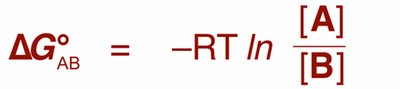
Interpretation: A negative indicates a spontaneous reaction favoring products, while a positive value favors reactants.
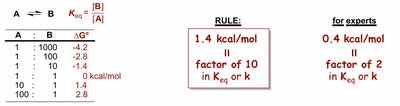
Factors of 10: A difference of 1.4 kcal/mol in free energy corresponds to a tenfold difference in equilibrium constant or rate constant.

Estimating Equilibrium and Rate Ratios
Small changes in free energy can lead to large changes in equilibrium or rate ratios. This is a practical tool for predicting reaction outcomes and understanding selectivity in organic reactions.
Rule of Thumb: 1.4 kcal/mol difference ≈ 10-fold change in or rate constant; 0.4 kcal/mol ≈ 2-fold change.
Example Table: The following table summarizes how changes in affect equilibrium ratios:
A | B | (kcal/mol) |
|---|---|---|
1 | 1000 | -4.2 |
1 | 100 | -2.8 |
1 | 10 | -1.4 |
1 | 1 | 0 |
10 | 1 | 1.4 |
100 | 1 | 2.8 |
Application: If a reaction forms products in a 20:1 ratio, the free energy difference is about 1.8 kcal/mol, favoring the major product.
Predicting Reaction Yields Using Free Energy
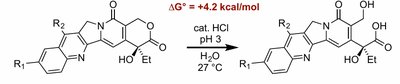
Free energy changes can be used to estimate the yield of a reaction at equilibrium. For example, a positive indicates that the starting material will predominate at equilibrium, resulting in a low product yield.
Example: Hydrolysis of a lactone with kcal/mol means the starting material is about 1000 times more abundant than the product at equilibrium.
Kinetic vs. Thermodynamic Control
Product ratios can be determined by either the relative energies of the products (thermodynamic control) or the energies of the transition states (kinetic control). For kinetic selectivity, the product distribution is set by the difference in transition state energies, not by the final product stabilities.
Example: If the endo transition state is 1.8 kcal/mol lower than the exo, the product ratio will be about 95:5, favoring the endo product.
Entropy and Molecular Organization
Conceptualizing Entropy in Reactions
Entropy () reflects the number of possible arrangements of a system. In reactions, especially those involving association or dissociation, entropy changes can significantly affect the free energy and thus the equilibrium position.
Hydrogen Bonding Example: The ideal hydrogen bond between two water molecules is stabilized by -4.6 kcal/mol, but only 1 out of 16 water molecules forms this ideal bond at equilibrium due to entropy.
Equation: kcal/mol, kcal/mol
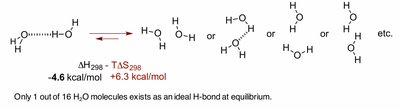
Bimolecular Reactions: Pairing up molecules in solution incurs a large entropic cost (up to +14 kcal/mol), making such reactions much less favorable compared to unimolecular (intramolecular) reactions.
Cyclization Reactions: Formation of 5- and 6-membered rings is favored due to lower entropic and enthalpic penalties, while larger rings are disfavored.
Frontier Molecular Orbitals (FMO) and Reactivity Trends
Qualitative FMO Trends
Frontier Molecular Orbital (FMO) theory helps explain and predict the reactivity of organic molecules by considering the energies and symmetries of the highest occupied and lowest unoccupied molecular orbitals (HOMO and LUMO).
Key Trends:
Electrons in orbitals with more p character are more reactive.
Electronegativity correlates with lower orbital energies.
Longer bonds are more nucleophilic and easier to break.
Conjugation raises HOMO and lowers LUMO, increasing reactivity.
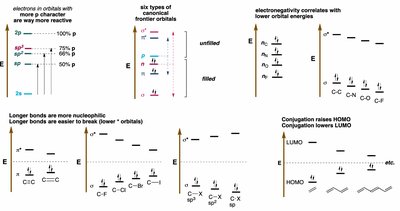
Application: These trends help rationalize why certain functional groups or bonds are more reactive in nucleophilic or electrophilic reactions.
Quantitative Reactivity Scales
Reactivity can be quantified using nucleophilicity and electrophilicity parameters. Prof. Mayr's database provides a systematic way to compare the reactivity of different nucleophiles and electrophiles, often spanning many orders of magnitude.
Nucleophilicity: Enolates are much more reactive than alkenes, sometimes by 16 orders of magnitude.
Electrophilicity: Methyl cation affinity and methyl anion affinity are used to compare polar reactivity quantitatively.
Magnitude: The difference in reactivity between the most and least reactive species can be as large as 180 orders of magnitude.
Additional info: These quantitative scales are essential for predicting outcomes in complex organic syntheses and for understanding the limits of chemical reactivity.
