Adding Vectors by Components quiz #1 Flashcards

Adding Vectors by Components quiz #1
Control buttons has been changed to "navigation" mode.
1/10
  • Which operations can be performed on a vector without changing its magnitude or direction?
    A vector will not change if it is moved parallel to itself (translation) without rotation or scaling. Operations such as translating a vector to a different position in space, as long as its magnitude and direction remain the same, do not change the vector.
  • How do you combine two or more vectors into a single resultant vector using components?
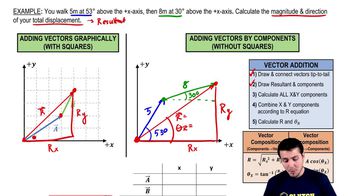
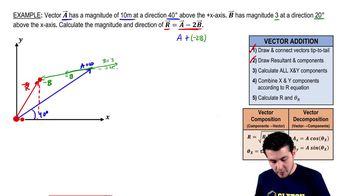
    To combine two or more vectors into a single resultant vector, decompose each vector into its x and y components using trigonometric functions (AX = A*cos(θ), AY = A*sin(θ)), sum all the x components to get the resultant x component, and sum all the y components to get the resultant y component. The resultant vector is then given by these summed components.
  • How do you determine the sum of two velocity vectors using the component method?
    To determine the sum of two velocity vectors, break each velocity into its x and y components using trigonometric functions, add the corresponding components to get the resultant x and y components, then use the Pythagorean theorem to find the magnitude of the resultant vector and the inverse tangent function to find its direction.
  • What is the first step when adding vectors by components if no grid is provided?
    The first step is to draw and connect the vectors tip to tail, starting from the origin, based on their given magnitudes and angles. This helps visualize the problem before breaking the vectors into components.
  • How do you determine the direction of the resultant vector after finding its components?
    You use the inverse tangent function (tan⁻¹) of the ratio of the resultant's y component to its x component. This gives the angle of the resultant vector relative to the x-axis.
  • Why is it helpful to organize vector components in a table during calculations?
    A table helps keep track of all x and y components for each vector, making it easier to sum them correctly. This organization reduces errors and clarifies the process.
  • What trigonometric functions are used to decompose a vector into its x and y components?
    The cosine function is used for the x component and the sine function for the y component. Specifically, AX = A*cos(θ) and AY = A*sin(θ).
  • After summing the x and y components of all vectors, what formula is used to find the magnitude of the resultant vector?
    The magnitude is found using the Pythagorean theorem: the square root of the sum of the squares of the resultant x and y components. This gives the length of the resultant vector.
  • What does the resultant vector represent in the context of displacement problems?
    The resultant vector represents the shortest path from the starting point to the final position after all displacements. It combines all individual movements into a single vector.
  • Why might the process of adding vectors by components be described as repetitive?
    The process involves the same sequence of steps—drawing, decomposing, summing components, and calculating magnitude and direction—for each problem. This repetition helps ensure accuracy and consistency.