Skip to main content
Physics with Calculus
My Course
Learn
Exam Prep
AI Tutor
Study Guides
Textbook Solutions
Flashcards
Explore
Try the app
My Course
Learn
Exam Prep
AI Tutor
Study Guides
Textbook Solutions
Flashcards
Explore
Try the app
Back
Angular Momentum of Objects in Linear Motion quiz
You can tap to flip the card.
What is the formula for the angular momentum (L) of an object in linear motion relative to a point?
You can tap to flip the card.
👆
What is the formula for the angular momentum (L) of an object in linear motion relative to a point?
The formula is L = mvr, where m is mass, v is velocity, and r is the distance from the axis of rotation to the point of interest.
Track progress
Control buttons has been changed to "navigation" mode.
1/15
Related flashcards
Related practice
Recommended videos
Angular Momentum of Objects in Linear Motion definitions
Angular Momentum of Objects in Linear Motion
15 Terms
Angular Momentum of Objects in Linear Motion
16. Angular Momentum
2 problems
Topic
David-Paige
Angular Momentum of a Point Mass
16. Angular Momentum
2 problems
Topic
David-Paige
16. Angular Momentum - Part 1 of 2
7 topics
16 problems
Chapter
Patrick
16. Angular Momentum - Part 2 of 2
1 topic
3 problems
Chapter
Guided course
07:06
Angular Momentum of Objects in Linear Motion
4641
views
43
rank
Terms in this set (15)
Hide definitions
What is the formula for the angular momentum (L) of an object in linear motion relative to a point?
The formula is L = mvr, where m is mass, v is velocity, and r is the distance from the axis of rotation to the point of interest.
When do you use angular momentum instead of linear momentum in collision problems?
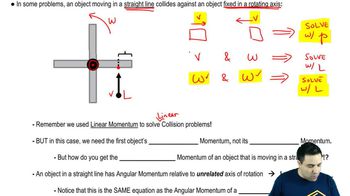
You use angular momentum when the collision involves rotational motion, such as when a linear object collides with a rotating object.
In the example, what is the mass and velocity of the bird before it collides with the door?
The bird has a mass of 4 kg and a velocity of 30 m/s.
How far from the axis of rotation does the bird collide with the door in the example?
The bird collides 2.5 meters from the axis of rotation.
What is the angular momentum of the bird just before it hits the door?
The angular momentum is L = 4 kg × 30 m/s × 2.5 m = 300 kg·m²/s.
Why can an object moving in a straight line have angular momentum relative to a point?
Because angular momentum can be calculated relative to any axis, even if the object is not rotating or has not yet reached the axis.
What does the 'r' represent in the formula L = mvr?
'r' is the perpendicular distance from the axis of rotation to the point where the object will collide or is measured.
If two objects both have linear velocities during a collision, which conservation law do you use?
You use the conservation of linear momentum.
If two objects both have angular velocities during a collision, which conservation law do you use?
You use the conservation of angular momentum.
What is the key factor to consider in collisions involving both linear and rotational effects?
The key factor is angular momentum (L), not linear momentum (P).
What is the unit of angular momentum in the SI system?
The unit is kilogram meter squared per second (kg·m²/s).
Why is the angular momentum calculated before the bird collides with the door?
Because angular momentum is conserved during the collision, and its value just before impact is needed for further calculations.
What happens to the door after the bird collides with it?
The door begins to spin about its axis of rotation.
What is the significance of the axis of rotation in calculating angular momentum?
The axis of rotation is the reference point from which the distance 'r' is measured to calculate angular momentum.
Can you calculate the angular momentum of an object relative to an axis it has not yet reached?
Yes, you can calculate angular momentum relative to any axis, even if the object has not yet collided with or reached it.
 BackBack

 07:06
07:06