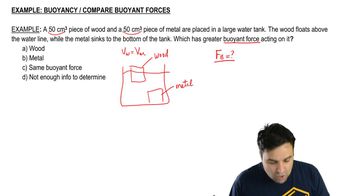
Does the volume of an object alone determine whether it will float or sink in a liquid?
No, volume alone does not determine whether an object will float or sink. Both the mass and the volume (i.e., the density) of the object relative to the liquid are what determine floating or sinking.
What determines an object's ability to float in water?
An object's ability to float in water is determined by its density relative to the density of water. If the object's density is less than that of water, it will float; if greater, it will sink.
Why do hot air balloons rise?
Hot air balloons rise because the hot air inside the balloon is less dense than the cooler air outside, resulting in a buoyant force that pushes the balloon upward.
Explain the reason a hot air balloon rises.
A hot air balloon rises because heating the air inside reduces its density, making the overall density of the balloon less than the surrounding air, so the buoyant force lifts it.
How can the rock pumice float even if its density is greater than water?
Pumice can float if it contains trapped air pockets, which lower its average density (including the air) to less than that of water, allowing it to float.
What must happen for a balloon to float in air?
For a balloon to float in air, the weight of the air it displaces (the buoyant force) must be equal to or greater than the weight of the balloon.
What causes a hot-air balloon to rise?
A hot-air balloon rises because the heated air inside is less dense than the cooler air outside, resulting in a net upward buoyant force.
In which layer of the atmosphere can a hot-air balloon travel?
A hot-air balloon can travel in the lower atmosphere, specifically the troposphere, where buoyancy effects are significant.
Why do some objects float in water?
Objects float in water if their density is less than the density of water, causing the buoyant force to balance or exceed their weight.
In what type of water would a person float most easily?
A person would float most easily in water with a higher density, such as saltwater, because the buoyant force is greater.
Why does hot air rise and cold air sink?
Hot air rises because it is less dense than cold air, so the buoyant force pushes it upward, while cold air sinks because it is denser.
What happens if the buoyant force of water is less than the weight of a stick placed in it?
If the buoyant force is less than the weight of the stick, the stick will sink.
How does the volume of a completely submerged object compare to the volume of water it displaces?
The volume of a completely submerged object is equal to the volume of water it displaces.
How is the buoyant force acting on a block in a liquid calculated?
The buoyant force is calculated as FB = (density of liquid) × g × (volume of the block submerged).
Does hot water tend to rise or sink? Explain.
Hot water tends to rise because it is less dense than cold water, so the buoyant force pushes it upward.
What happens if the buoyant force of water is more than the weight of a ball placed in it?
If the buoyant force is more than the weight of the ball, the ball will rise to the surface and float.
Why does a small pebble sink in water?
A small pebble sinks in water because its density is greater than that of water, so the buoyant force is less than its weight.
How much must an object weigh to be able to float in water?
An object will float if its weight is less than or equal to the weight of the water it displaces (i.e., if its density is less than or equal to that of water).
Why does cool air sink?
Cool air sinks because it is denser than warm air, so the buoyant force is not enough to keep it aloft.
Why does warm air rise?
Warm air rises because it is less dense than the surrounding cooler air, resulting in a net upward buoyant force.
Why does an ocean liner float?
An ocean liner floats because its average density (including the air inside) is less than the density of water, so the buoyant force supports its weight.
What fraction of your body will be submerged when floating gently in freshwater with a density of 1000 kg/m³?
The fraction submerged is equal to the ratio of your body's density to the density of freshwater.
How is the density of a floating object related to the density of the fluid it is floating in?
The density of a floating object is equal to the fraction of its volume submerged multiplied by the density of the fluid.
What happens if an object in water weighs less than the water it displaces?
If an object weighs less than the water it displaces, it will float.
What fraction of the volume of ice will be above the water when the ice is floating in water?
The fraction above water is 1 minus the ratio of the density of ice to the density of water.
Why is it easier to float in saltwater than in freshwater?
It is easier to float in saltwater because saltwater has a higher density than freshwater, resulting in a greater buoyant force.
What is Archimedes' principle?
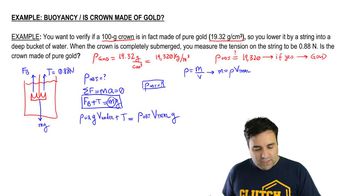
Archimedes' principle states that the buoyant force on a submerged object is equal to the weight of the liquid displaced by the object.
How much force is needed to push a floating ball completely under water?
The force needed is equal to the difference between the buoyant force when fully submerged and the weight of the ball.
Will the same ship float higher in salt water than in freshwater? Explain.
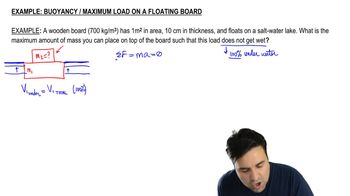
Yes, a ship will float higher in salt water because salt water is denser, so less of the ship's volume needs to be submerged to displace enough water to balance its weight.
Does the buoyant force on an object increase with depth?
No, the buoyant force depends only on the volume submerged and the density of the liquid, not on the depth.
What happens to the buoyant force if an entire apparatus is submerged in water?
The buoyant force equals the weight of the water displaced by the entire submerged volume of the apparatus.
How do you calculate the magnitude of the buoyant force on a balloon?
The magnitude of the buoyant force is FB = (density of air) × g × (volume of the balloon).
What is the best way to dock a boat if the current is pushing you toward the dock?
The best way is to approach the dock slowly and at a shallow angle, using the current to help control your movement.
What do floating objects have in common?
Floating objects all have an average density less than or equal to the density of the fluid they are floating in.
How much air must a 100-ton blimp displace to float and neither rise nor sink?
The blimp must displace a volume of air whose weight equals 100 tons, so the required volume is (100 tons) divided by the density of air.
What happens when floating a ping-pong ball with a hairdryer?
The upward force from the air (similar to a buoyant force) balances the weight of the ball, allowing it to float in the air stream.
According to Archimedes' principle, if the buoyancy of an object is positive, what will happen to the object?
If the buoyancy is positive (buoyant force exceeds weight), the object will rise.
An object is most likely to sink in water if what condition is met?
An object is most likely to sink if its density is greater than the density of water.
Does mass alone determine whether an object will float or sink?
No, mass alone does not determine floating or sinking; both mass and volume (i.e., density) relative to the fluid are important.
Does volume alone determine whether an object will float or sink?
No, volume alone does not determine floating or sinking; the object's density compared to the fluid's density is what matters.
 Back
Back

 06:55
06:55