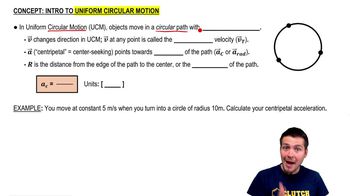
What must be true of a force that causes an object to move in a circular motion?
The force must act towards the center of the circle, providing the necessary centripetal force to keep the object moving in a circular path.
How will an object in circular motion behave if the centripetal force is removed?
If the centripetal force is removed, the object will move off in a straight line tangent to the circle at the point where the force was removed.
Which force is responsible for pushing a vehicle away from the center of the road in a turn?
There is no actual force pushing the vehicle away from the center; rather, inertia causes the vehicle to continue in a straight line while the centripetal force is needed to keep it moving in a circle.
Why does a satellite in a circular orbit travel at a constant speed?
A satellite in a circular orbit travels at a constant speed because the net force (gravity) acts perpendicular to its motion, changing only the direction of its velocity, not its magnitude.
Which quantities point towards the center of the circle in uniform circular motion?
Both the centripetal acceleration and the net force responsible for circular motion point towards the center of the circle.
Which quantity is constant for an object in uniform circular motion?
The speed (magnitude of velocity) is constant for an object in uniform circular motion.
In which direction must the net force act for a particle in uniform circular motion?
The net force must act towards the center of the circle.
What is the shape of the trajectory that a charged particle follows in a uniform magnetic field if it moves with constant speed perpendicular to the field?
The trajectory is a circle.
Which objects experience centripetal acceleration?
Any object moving in a circular path at constant speed experiences centripetal acceleration.
For objects in circular orbits, which has the lowest angular velocity?
An object farther from the center (with a larger radius) has a lower angular velocity if all objects complete a revolution in the same time.
Which formula can be used to find the tangential speed of an object in circular motion?
Tangential speed v = ωr, where ω is angular velocity and r is the radius.
What is an example of uniform motion?
An object moving in a circle at constant speed is an example of uniform motion (specifically, uniform circular motion).
What is an example of a centripetal force?
Tension in a string keeping a ball moving in a circle is an example of a centripetal force.
Can a merry-go-round turn either clockwise or counterclockwise?
Yes, a merry-go-round can turn either clockwise or counterclockwise; the direction does not affect the principles of uniform circular motion.
How is the angular velocity of a sphere at the bottom of an incline related to its motion?
The angular velocity at the bottom depends on the speed and the radius: ω = v/r, where v is the tangential speed at the bottom and r is the radius of the sphere.
How do you determine the time it takes for a bob to make one full revolution in circular motion?
The time for one full revolution (the period) is T = 2πr/v, where r is the radius and v is the tangential speed.
What is true about a circular orbit in uniform circular motion?
In a circular orbit, the speed is constant and the net force acts towards the center of the circle.
What must occur for an object to have a perfectly circular orbit?
A constant net force must act perpendicular to the object's velocity and towards the center of the circle.
What is true for objects moving in a circle at constant speed?
Their velocity direction changes continuously, and they experience a centripetal acceleration towards the center.
What is the speed of a point at the top edge of a rotating tire?
The speed is given by v = ωr, where ω is the angular velocity and r is the radius of the tire.
How does the centripetal force acting on a car going around a curve change when the car goes faster?
The required centripetal force increases with the square of the speed: F = mv²/r.
For a ball in uniform circular motion, what is true about its speed and velocity?
The speed (magnitude of velocity) is constant, but the direction of velocity changes continuously.
How do you determine the maximum angular velocity with which a turntable can spin without a coin sliding off?
The maximum angular velocity is determined by the condition that the required centripetal force does not exceed the maximum static friction force: μmg = mω²r, so ω_max = sqrt(μg/r).
Why do your clothes spin around in the dryer during the spin cycle?
The spinning creates a centripetal force that keeps the clothes moving in a circle, while water is flung out tangentially due to inertia.
What is the acceleration of the center of a hoop in uniform circular motion?
The acceleration of the center of the hoop is zero if the center moves in a straight line; if the center moves in a circle, its acceleration is a_c = v²/r.
What is the maximum possible speed of a ball at the top of a loop in circular motion?
The maximum speed is determined by the condition that the required centripetal force is provided; for minimum speed, set the normal force to zero: v = sqrt(gr), where g is gravity and r is the radius.
What is the outside force needed to overcome inertia when going around a curve?
The centripetal force is the outside force needed to change the direction of motion and keep the object moving in a curve.
What is true about the acceleration in uniform circular motion?
The acceleration (centripetal acceleration) is always directed towards the center of the circle and has constant magnitude.
How do you calculate the number of revolutions an object makes in a given time during uniform circular motion?
Number of revolutions = total time / period, where period T = 2πr/v.
How do you determine the number of revolutions a merry-go-round makes as it stops?
Divide the total angle rotated (in radians) by 2π to get the number of revolutions.
How do inertia and centripetal force combine to keep an object moving in circular motion?
Inertia causes the object to move in a straight line, but the centripetal force continuously changes the direction of motion, keeping the object moving in a circle.
Which situation during a basketball game involves centripetal acceleration?
Any situation where a player or the ball moves along a curved path, such as running around a defender or spinning the ball, involves centripetal acceleration.
In which situation would a space probe most likely experience centripetal acceleration?
A space probe in orbit around a planet experiences centripetal acceleration due to the gravitational force acting towards the center of the planet.
How does the tangential speed on the outer edge of a rotating carousel compare to points closer to the center?
The tangential speed is greater at the outer edge than at points closer to the center, since v = ωr.
When rounding a curve, how does a car tend to move due to inertia?
Due to inertia, a car tends to move in a straight line tangent to the curve unless a centripetal force acts to change its direction.
Which quantities are constant in uniform circular motion?
The speed (magnitude of velocity) and the radius of the path are constant in uniform circular motion.
How does a proton move in a circle of radius r in a cyclotron?
A proton moves in a circle of radius r at constant speed, experiencing a centripetal acceleration towards the center.
If a wheel is rolling to the right without slipping, what is the direction of the velocity at the top of the wheel?
At the top of the wheel, the velocity is directed forward and is the sum of the translational and rotational velocities.
How does a flywheel in the form of a uniformly thick disk behave in uniform circular motion?
Every point on the rim of the flywheel moves in a circle at constant speed, experiencing centripetal acceleration towards the center.
How does an alpha particle travel in a circular path of radius r?
An alpha particle moves at constant speed in a circle of radius r, with a centripetal acceleration directed towards the center.