Uniform Circular Motion quiz #2 Flashcards

Uniform Circular Motion quiz #2
Control buttons has been changed to "navigation" mode.
1/10
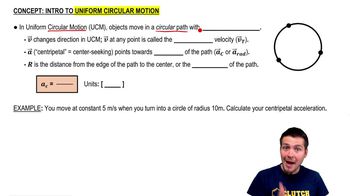
  • Why does a particle traveling around a circle at constant speed experience an acceleration?
    Because the direction of its velocity is constantly changing, resulting in a centripetal acceleration towards the center of the circle.
  • What does the term 'uniform' refer to in uniform circular motion?
    The term 'uniform' means that the object moves at a constant speed along the circular path. The magnitude of the velocity does not change, only its direction does.
  • What is tangential velocity in the context of circular motion?
    Tangential velocity is the velocity of an object moving along a circular path at any given point. It is always directed tangent to the circle at the object's position.
  • If an object in circular motion suddenly stops turning, what path will it follow?
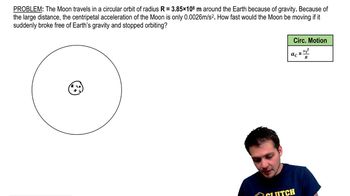
    It will move off in a straight line tangent to the circle at the point where it stopped turning. This is due to inertia, as described by Newton's first law.
  • What does 'centripetal' mean in the term 'centripetal acceleration'?
    'Centripetal' means 'center seeking,' indicating that the acceleration always points toward the center of the circle. This keeps the object moving in a circular path.
  • What are the standard units for centripetal acceleration?
    The standard units for centripetal acceleration are meters per second squared (m/s²). This is the same as for any other type of acceleration.
  • Which three variables are most important in describing uniform circular motion?
    The three most important variables are tangential velocity (v), centripetal acceleration (a), and the radius of the circle (R). These variables are related by the centripetal acceleration formula.
  • How does the direction of centripetal acceleration change as an object moves around a circle?
    The direction of centripetal acceleration continuously changes so that it always points toward the center of the circle. This ensures the object remains in circular motion.
  • What is the formula for calculating centripetal acceleration in uniform circular motion?
    The formula is centripetal acceleration equals tangential velocity squared divided by the radius (a = v²/R). This relates the speed of the object and the size of the circle.
  • If an object moves at 5 m/s in a circle of radius 10 m, what is its centripetal acceleration?
    Its centripetal acceleration is 2.5 m/s². This is calculated by squaring the velocity (25) and dividing by the radius (10).