Conceptual Problems with Position-Time Graphs quiz #1 Flashcards

Conceptual Problems with Position-Time Graphs quiz #1
Control buttons has been changed to "navigation" mode.
1/10
  • What physical quantities can be determined from a motion diagram or position-time graph, and how are they identified on the graph?
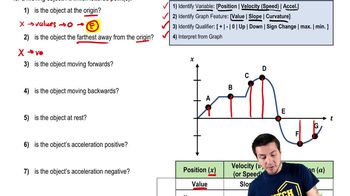
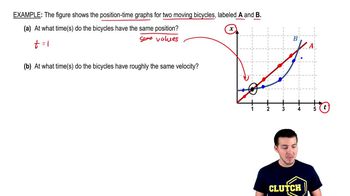
    From a motion diagram or position-time graph, you can determine position, velocity, and acceleration. Position is read directly from the values on the vertical axis. Velocity is found by analyzing the slope of the graph (positive slope for forward motion, negative for backward, and zero for rest). Acceleration is determined by the curvature of the graph (upward curvature indicates positive acceleration, downward curvature indicates negative acceleration).
  • What is the first step you should take when solving a conceptual problem involving a motion graph?
    The first step is to identify which motion variable the question is asking about: position, velocity, or acceleration. This helps determine what feature of the graph to analyze.
  • How do you determine if an object is at rest using a position-time graph?
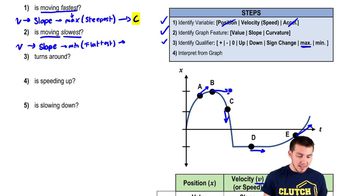
    An object is at rest when the slope of the position-time graph is flat, indicating zero velocity. You look for sections of the graph where the line is horizontal.
  • What does a maximum value on a position-time graph represent in terms of the object's motion?
    A maximum value on a position-time graph represents the point where the object is farthest from the origin. It is the greatest distance from the reference point during the motion.
  • How can you tell if an object is moving backwards on a position-time graph?
    An object is moving backwards when the slope of the position-time graph is negative, meaning the line is sloping downward. This indicates negative velocity.
  • What does a sign change in the value of a position-time graph indicate about the object's motion?
    A sign change in the value indicates the object has crossed the origin, moving from one side of the reference point to the other. This is seen when the graph crosses the horizontal axis.
  • How do you identify points of positive acceleration on a position-time graph?
    Points of positive acceleration are identified by upward curvature, resembling a smiley face, on the position-time graph. This means the slope is increasing over time.
  • What does a downward curvature on a position-time graph signify about acceleration?
    A downward curvature, or frowny face, on a position-time graph signifies negative acceleration. This means the slope is decreasing over time.
  • Why is it important to distinguish between values, slopes, and curvature when analyzing motion graphs?
    Each feature—values, slopes, and curvature—corresponds to a different motion variable: position, velocity, and acceleration, respectively. Correctly identifying which to analyze ensures accurate interpretation of the graph.
  • How does the steepness of a slope on a position-time graph relate to the object's speed?
    A steeper slope on a position-time graph indicates a higher speed, as the object covers more distance in less time. The magnitude of velocity increases with the steepness of the slope.