Dimensional Analysis quiz #1 Flashcards

Dimensional Analysis quiz #1
Control buttons has been changed to "navigation" mode.
1/10
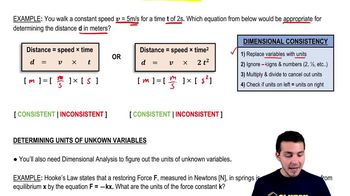
  • How can you determine if an equation is dimensionally consistent using dimensional analysis?
    To determine if an equation is dimensionally consistent, replace each variable with its units, ignore numbers and signs, and simplify both sides to check if the units match. If the units on both sides are the same, the equation is dimensionally consistent.
  • Are the units in the equation ma = mv^2/2 dimensionally consistent? Explain your reasoning.
    No, the units in ma = mv^2/2 are not dimensionally consistent. On the left, ma has units of kg·m/s^2 (force), while mv^2/2 has units of kg·(m^2/s^2) (energy). Since force and energy have different units, the equation is not dimensionally consistent.
  • What are the units on each side of the equation G·m·M/x^2 = m·v^2/x, where m and M are masses?
    On the left, G·m·M/x^2 has units of (N·m^2/kg^2)·kg·kg/m^2 = N (newtons). On the right, m·v^2/x has units of kg·(m^2/s^2)/m = kg·m/s^2 = N (newtons). Both sides have units of force (newtons), so the equation is dimensionally consistent.
  • In how many dimensions can parallel alignment error occur when performing dimensional analysis?
    Parallel alignment error can occur in any number of dimensions, as it refers to misalignment in the direction of measurement, which can happen in one, two, or three dimensions.
  • What is the first step when using dimensional analysis to check if an equation is consistent?
    The first step is to replace each variable in the equation with its corresponding unit. This allows you to focus on the units rather than the numerical values.
  • When performing dimensional analysis, what should you do with numbers and negative signs in the equation?
    You should ignore all numbers and negative signs, focusing only on the variables and their units. This simplifies the process of checking unit consistency.
  • How do you handle exponents on units during dimensional analysis?
    Apply the exponent to the unit, such as writing seconds squared as s^2. This ensures accurate cancellation and comparison of units.
  • What does it mean if, after canceling units, the left and right sides of an equation have different units?
    It means the equation is dimensionally inconsistent and cannot be correct for the physical relationship it is supposed to represent. The units must match for the equation to be valid.
  • How can dimensional analysis help determine the units of an unknown constant in an equation?
    By replacing all known variables with their units and isolating the unknown constant, you can solve for its units algebraically. This method does not require any knowledge of the equation's physical meaning.
  • Why is dimensional analysis considered a conceptual tool in physics problem-solving?
    It allows you to verify equations and deduce units without performing numerical calculations. This helps ensure the logical consistency of equations before plugging in values.