Vectors, Scalars, & Displacement quiz #2 Flashcards
Vectors, Scalars, & Displacement quiz #2
You can tap to flip the card.
Control buttons has been changed to "navigation" mode.
1/40
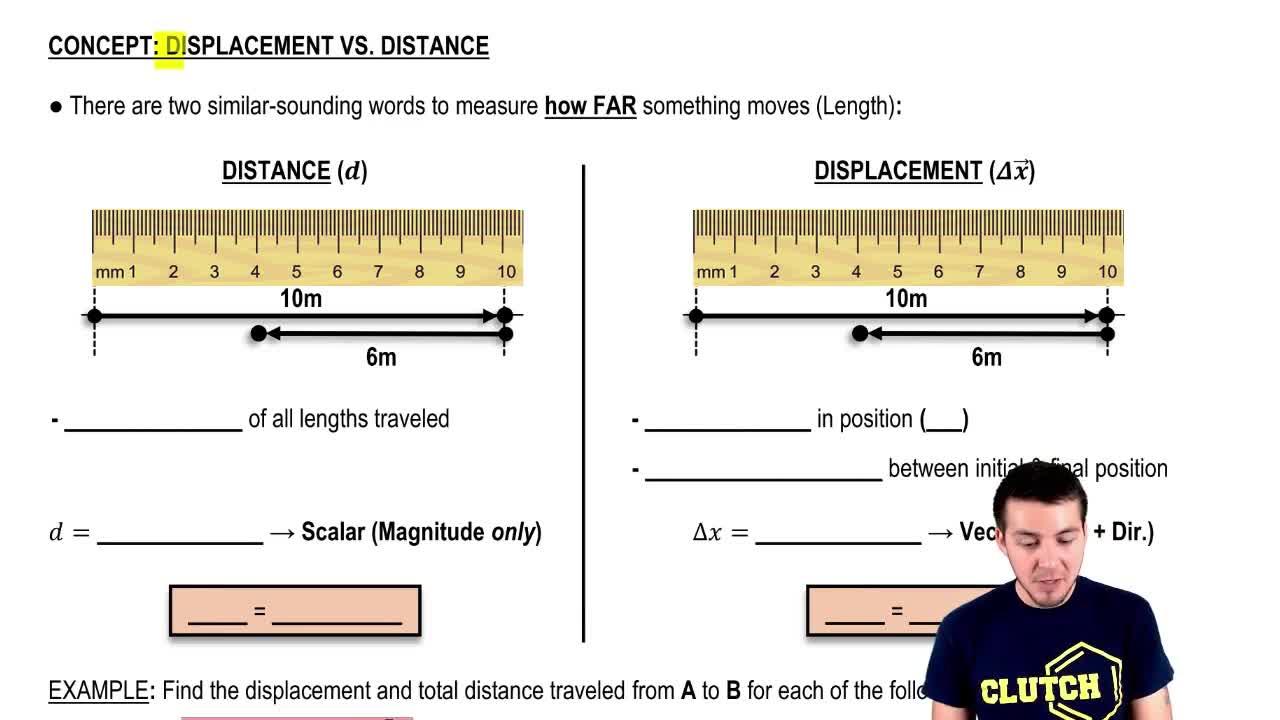
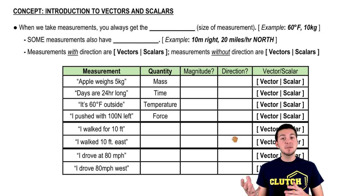
Which of the following quantities is a vector: speed or displacement?Displacement is a vector quantity.What kind of quantity is distance?Distance is a scalar quantity.Which of the following is a scalar: mass or force?Mass is a scalar quantity.What is the difference between scalar and vector quantities?Scalar quantities have magnitude only, while vector quantities have both magnitude and direction.Are speed and distance scalar or vector quantities?Speed and distance are scalar quantities.Why is a magnetic field considered a vector quantity?A magnetic field is considered a vector quantity because it has both magnitude and direction.What is the general form of a vector equation?A vector equation expresses a relationship between vectors, often using component form, such as c = a + b.What determines the direction of the impulse vector?The direction of the impulse vector is determined by the direction of the force applied over time.How do you express the x component of a vector to the nearest integer?The x component of a vector is the value along the x-axis, rounded to the nearest integer if required.What do the indices for directions indicated by two vectors represent?The indices for directions represent the axes or reference directions along which the vectors point, such as x and y.Why is distance insufficient to determine an object's location relative to another object?Distance only gives the total length traveled and does not provide direction, so it cannot specify location relative to another object.What must be included when describing the displacement of an object?Both the magnitude and direction must be included when describing displacement.If Bob walks 2 blocks east, what is his displacement?Bob's displacement is 2 blocks east, which includes both magnitude and direction.Which combination correctly pairs a vector quantity with its corresponding unit?Velocity (vector) is correctly paired with meters per second (m/s).What do circled vectors represent: distance, speed, velocity, or acceleration?Circled vectors represent quantities with both magnitude and direction, such as velocity or acceleration.Which of the following measurements is a vector measurement: 5 meters east or 5 meters?5 meters east is a vector measurement because it includes both magnitude and direction.Which direction best approximates the direction of a vector when the object is at position 2?The direction of the vector at position 2 is determined by the change in position from the initial to the final point.Which statement best describes a vector?A vector is a quantity that has both magnitude and direction.What is the difference between a scalar and a vector?A scalar has magnitude only, while a vector has both magnitude and direction.What is the difference between a vector and a scalar?A vector has both magnitude and direction; a scalar has only magnitude.A vector must always have both size and what?A vector must always have both size (magnitude) and direction.Assuming motion is on a straight path, what would result in two positive components of a vector?If the vector points in a direction where both components are positive, such as in the first quadrant of a coordinate system.The sum of two vectors has the greatest magnitude when the angle between these two vectors is what?The sum of two vectors has the greatest magnitude when the angle between them is 0 degrees (they point in the same direction).When you use more than one reference direction to describe an object's position, you are using two what?You are using two dimensions or axes to describe the object's position.Force is a vector because it has both magnitude and what?Force is a vector because it has both magnitude and direction.Which vector quantity defines the distance and direction between two positions?Displacement defines the distance and direction between two positions.If east is the reference direction, then a train that is –10 m from you is toward which direction?If east is the reference direction, a train that is –10 m from you is toward the west.What is the magnitude of a vector with components (15 m, 8 m)?The magnitude is sqrt((15 m)^2 + (8 m)^2) = sqrt(225 + 64) = sqrt(289) = 17 m.In the study of physics, what distinguishes a scalar from a vector?A scalar has magnitude only, while a vector has both magnitude and direction.If Sue walks home and her home is the origin, what is her displacement?Sue's displacement is the vector from her starting point to the origin, including both magnitude and direction.How do you match a vector field f(x, y) = x, –y with its plot?A vector field f(x, y) = x, –y assigns a vector at each point (x, y) with components x in the x-direction and –y in the y-direction.How do you draw the vector c = a + 2b?To draw c = a + 2b, add vector a to twice the vector b using vector addition rules.How do you find the sum of two velocity vectors?The sum of two velocity vectors is found by adding their corresponding components.How do you label each vector with the correct description?Label each vector according to its magnitude and direction, such as displacement, velocity, or force.How do you identify physical quantities as scalars or vectors?Physical quantities with magnitude only are scalars; those with magnitude and direction are vectors.If one vector points in the +y direction and another in the –z direction, how are their directions described?The first vector points upward along the y-axis, and the second points downward along the z-axis.If vector c has a magnitude of 28.2, what does this mean?This means the length or size of vector c is 28.2 units.How do you find the sum of the x components of two vectors a and b?Add the x components of vectors a and b together: sum_x = a_x + b_x.How do you find the magnitude of b – 3a?Subtract three times the components of a from b, then use the formula: magnitude = sqrt((b_x – 3a_x)^2 + (b_y – 3a_y)^2).How do you express a force as a Cartesian vector?Express the force as a vector in component form: F = (F_x, F_y, F_z), where each component represents the force along the respective axis.