Skip to main content
Physics
My Course
Learn
Exam Prep
AI Tutor
Study Guides
Textbook Solutions
Flashcards
Explore
Try the app
My Course
Learn
Exam Prep
AI Tutor
Study Guides
Textbook Solutions
Flashcards
Explore
Try the app
Back
Energy in Connected Objects (Systems) definitions
You can tap to flip the card.
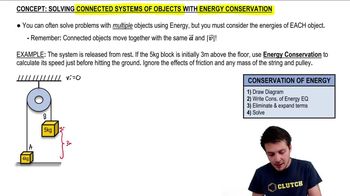
Atwood Machine
You can tap to flip the card.
👆
Atwood Machine
A system consisting of two masses connected by a string over a pulley, used to study motion and forces.
Track progress
Control buttons has been changed to "navigation" mode.
1/15
Related flashcards
Related practice
Recommended videos
Energy in Connected Objects (Systems) quiz #1
Energy in Connected Objects (Systems)
10 Terms
Energy in Connected Objects (Systems)
10. Conservation of Energy
1 problem
Topic
David-Paige
Force & Potential Energy
10. Conservation of Energy
7 problems
Topic
Patrick
10. Conservation of Energy
7 topics
15 problems
Chapter
Patrick
Guided course
10:17
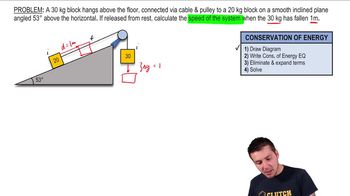
Solving System of Blocks on Incline Plane with Energy
6888
views
138
rank
6
comments
Guided course
06:48
Systems Of Objects with Energy Conservation
8265
views
130
rank
5
comments
Guided course
07:52
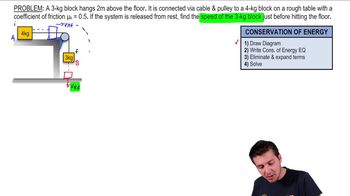
Solving Systems Problems with Friction using Energy
6602
views
118
rank
2
comments
Terms in this set (15)
Hide definitions
Atwood Machine
A system consisting of two masses connected by a string over a pulley, used to study motion and forces.
Energy Conservation
A principle stating that the total energy in an isolated system remains constant over time.
Kinetic Energy
The energy possessed by an object due to its motion, calculated as 1/2 mass times velocity squared.
Potential Energy
The energy stored in an object due to its position in a force field, such as gravitational potential energy.
Gravitational Potential
Energy an object possesses due to its position in a gravitational field, often relative to a reference point.
Non-Conservative Forces
Forces that cause energy dissipation from a system, such as friction, not present in this problem.
Pulley
A wheel on an axle designed to support movement and change of direction of a taut cable or belt.
Initial Velocity
The velocity of an object at the start of a time interval, zero in this problem as the system starts from rest.
Final Speed
The speed of an object at the end of a time interval, calculated as 2.56 m/s for both blocks in this problem.
Height
The vertical distance of an object from a reference point, 3 meters for Block B initially.
Mass
A measure of the amount of matter in an object, 5 kg for Block B and 4 kg for Block A in this problem.
Acceleration
The rate of change of velocity of an object, same for both blocks due to their connection.
String
A thin piece of material connecting two objects, transmitting force and motion in the system.
System
A set of interacting components considered in a problem, such as the blocks and pulley in this example.
Equation
A mathematical statement that asserts the equality of two expressions, used to solve for final speed.
 BackBack

 10:17
10:17