Entropy and the Second Law of Thermodynamics quiz #1 Flashcards

Entropy and the Second Law of Thermodynamics quiz #1
Control buttons has been changed to "navigation" mode.
1/10
  • What is an example of the second law of thermodynamics in everyday life?

    An example of the second law of thermodynamics is heat flowing spontaneously from a hot object to a cold object, such as when a hot cup of coffee cools down in a cooler room. This process increases the total entropy of the system and cannot spontaneously reverse.
  • What is a logical consequence of the second law of thermodynamics?

    A logical consequence of the second law of thermodynamics is that the total entropy of a system or the universe can never decrease; it can only increase or remain constant. This means that natural processes are irreversible and always proceed in the direction of increasing entropy.
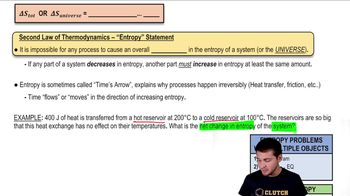
  • What does the second law of thermodynamics state?

    The second law of thermodynamics states that the total entropy of a system or the universe can never decrease; it can only increase or remain constant. This principle explains the irreversibility of natural processes and the tendency for energy to become more spread out or randomized.
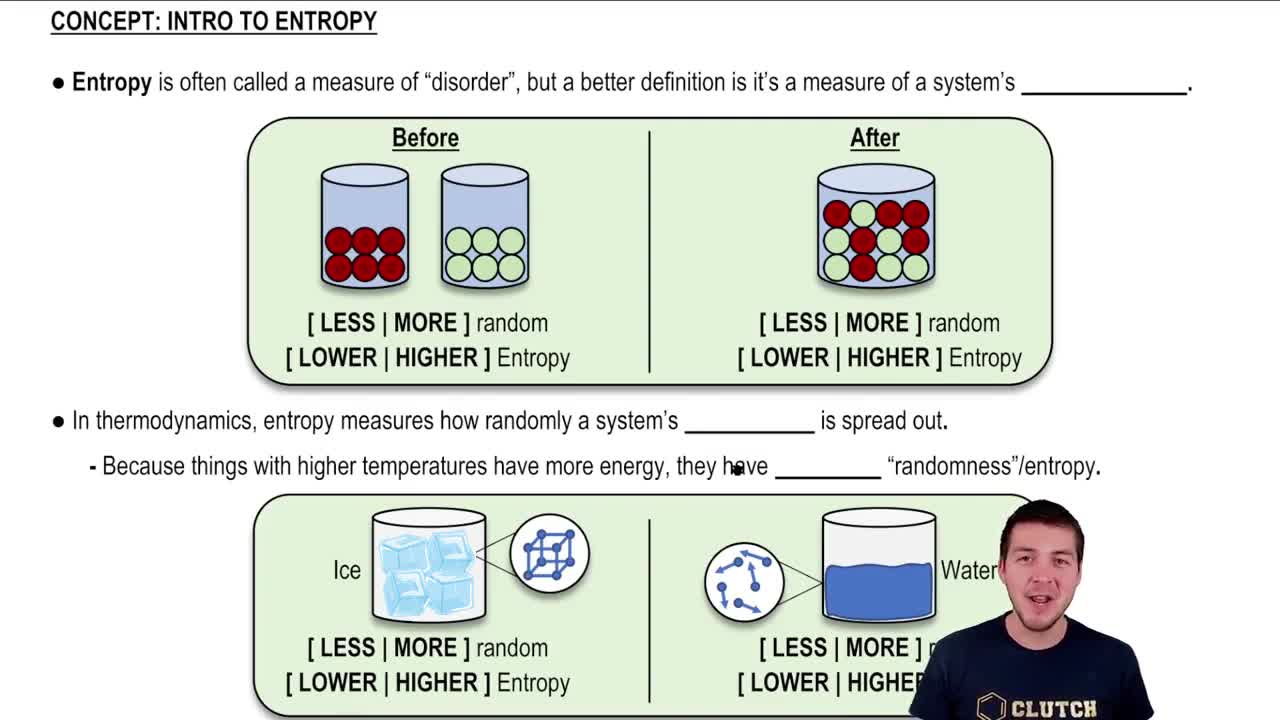
  • How does the concept of randomness relate to entropy in thermodynamics?

    Entropy measures how randomly a system's energy is spread out at the atomic level. Greater randomness in energy distribution means higher entropy.
  • Why must temperature be in Kelvin when using the entropy change equation?

    The entropy change equation, ΔS = Q/T, requires temperature in Kelvin because Kelvin is the absolute temperature scale. Using Celsius would give incorrect results since entropy is defined relative to absolute zero.
  • What is the significance of the sign of ΔS when calculating entropy change?

    A positive ΔS indicates that entropy increases, usually when heat is added to a system. A negative ΔS means entropy decreases, typically when heat is removed.
  • Why does the equation ΔS = Q/T only apply to isothermal processes?

    ΔS = Q/T assumes the temperature remains constant during the process. If temperature changes, the equation does not accurately describe the entropy change.
  • How do you calculate the total entropy change for a system with multiple objects exchanging heat?

    You sum the entropy changes of each object involved in the heat exchange. The total entropy change is ΔS_total = ΔS_1 + ΔS_2 + ... for all objects.
  • What happens to the entropy of the universe when heat flows from a hot reservoir to a cold reservoir?

    The entropy of the hot reservoir decreases while the cold reservoir's entropy increases, but the total entropy of the universe increases. This reflects the irreversibility of natural processes.
  • Why is entropy sometimes referred to as 'time's arrow'?

    Entropy is called 'time's arrow' because it indicates the direction in which time progresses, with natural processes always moving toward higher entropy. This explains why certain processes, like heat flow and friction, are irreversible.