What factors can cause a laminar flow in a fluid to become turbulent?
Laminar flow can become turbulent if the fluid speed increases significantly, the cross-sectional area changes abruptly, or if there are disturbances or obstacles in the flow. High velocity and sudden changes in pipe diameter are common causes.
Why does convection occur only in fluids?
Convection occurs only in fluids because fluids can flow and transfer heat by the movement of their particles, allowing warmer, less dense regions to rise and cooler, denser regions to sink, facilitating heat transfer.
How does a fluid move during convection?
During convection, fluid moves in a cycle where warmer, less dense fluid rises and cooler, denser fluid sinks, creating a continuous flow that transfers heat throughout the fluid.
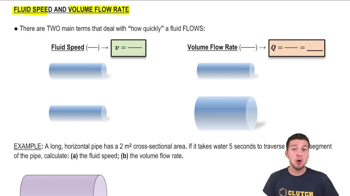
How can you calculate the speed of water in a pipe if you know the volume flow rate and the cross-sectional area?
The speed of water in a pipe can be calculated using the formula v = Q / A, where Q is the volume flow rate and A is the cross-sectional area of the pipe.
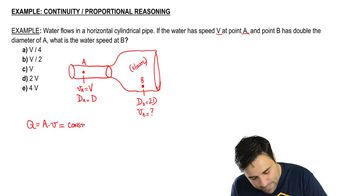
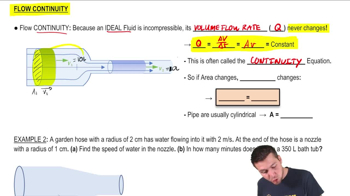
What happens to the speed of water when it flows through a pipe that becomes narrower?
When water flows through a pipe that becomes narrower, its speed increases to conserve the volume flow rate, as described by the continuity equation.
Is air considered a fluid in the context of fluid dynamics?
Yes, air is considered a fluid because it can flow and conforms to the principles of fluid dynamics, such as volume flow rate and the continuity equation.
Why is air classified as a fluid?
Air is classified as a fluid because it can flow, take the shape of its container, and its particles can move past each other, similar to liquids.
What is the term for the vertical movement of the surface of a body of water?
The vertical movement of the surface of a body of water is called a wave or oscillation, depending on the context.
How do you calculate the airflow through a rectangular hole if you know the area and the air velocity?
The airflow (volume flow rate) through a rectangular hole can be calculated using Q = A * v, where A is the area of the hole and v is the air velocity.
What can happen if a nozzle is closed too quickly in a fluid system?
Closing a nozzle too quickly can cause a sudden increase in pressure, potentially leading to water hammer or pressure surges in the system.
What is the movement called when a zone of compressed air is involved?
Movement involving a zone of compressed air is called pneumatic flow or pneumatic movement.
What is an equipment or process powered by compressed air called?
An equipment or process powered by compressed air is called pneumatic equipment or a pneumatic process.
If an apparatus is submerged in water, how would the width of the central peak of a jet change?
If an apparatus is submerged in water, the width of the central peak of a jet may change due to differences in fluid density and pressure, which affect the speed and spread of the jet according to the continuity equation.
How do you determine the volume flow rate if water flows from a pipe at a speed of 4.0 m/s?
The volume flow rate can be determined using Q = A * v, where A is the cross-sectional area of the pipe and v is the speed of the water (4.0 m/s).
What is a pitot tube used to measure in fluid flow?
A pitot tube is used to measure the speed (velocity) of a fluid flow.
What does it mean when water flows steadily with negligible viscous effects?
When water flows steadily with negligible viscous effects, it behaves as an ideal fluid, and the volume flow rate remains constant according to the continuity equation.
How does water flow from a pressurized tank according to fluid dynamics principles?
Water flows from a pressurized tank according to the principles of fluid speed and volume flow rate, with the flow rate determined by the pressure difference and the cross-sectional area of the outlet.
What happens to a vertical jet of water as it leaves a nozzle with a reduced cross-sectional area?
As a vertical jet of water leaves a nozzle with a reduced cross-sectional area, its speed increases according to the continuity equation, resulting in a faster and narrower jet.
 Back
Back

 11:08
11:08