What is the magnitude of the gravitational field at any point inside a hollow spherical shell?
The magnitude of the gravitational field anywhere inside a hollow spherical shell is zero, because the gravitational forces from all parts of the shell cancel each other out due to symmetry.
At what location inside the Earth would you experience the least gravitational pull?
The least gravitational pull inside the Earth is at the very center (r = 0), where the gravitational force is zero due to the symmetrical distribution of mass around you.
What is the magnitude of Earth's gravitational force on a 1-kg body at Earth's surface?
The magnitude of Earth's gravitational force on a 1-kg body at Earth's surface is 9.8 N, calculated using F = mg, where g = 9.8 m/s².
By what factor would your weight increase if you could stand on the Sun, assuming the Sun's surface gravity is much greater than Earth's?
Your weight would increase by a factor equal to the ratio of the Sun's surface gravity to Earth's surface gravity. If g_sun is the Sun's surface gravity and g_earth is Earth's, the factor is g_sun / g_earth.
What is the weight of a person on Mars if the gravitational acceleration there is 3.76 m/s²?
The weight of a person on Mars is calculated using W = mg, where m is the person's mass and g = 3.76 m/s².
What is the weight, in newtons, of an object with a mass of 200 kg at a location where the gravitational acceleration is 9.6 m/s²?
The weight is W = mg = 200 kg × 9.6 m/s² = 1920 N.
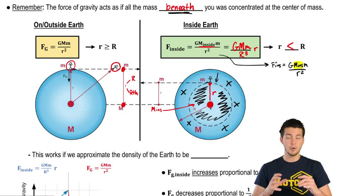
Why does the gravitational force inside the Earth only depend on the mass contained within the sphere of radius r from the center?
The gravitational force at a point inside the Earth is only affected by the mass closer to the center than that point because the mass outside that radius exerts no net gravitational force due to symmetry. This is a result of the shell theorem.
What key assumption about Earth's density is necessary for the internal gravitational force formula to be valid?
The formula assumes that Earth's density is constant throughout its volume. This allows the mass inside a given radius to be directly proportional to the volume enclosed.
How does the gravitational force change as you move from the Earth's center to its surface?
The gravitational force increases linearly with distance from the center up to the surface. This is because the force is proportional to r when inside the Earth.
What mathematical relationship explains why your weight at 80% of Earth's radius is 80% of your surface weight?
Inside the Earth, weight is directly proportional to the distance from the center, so at 80% of the radius, the weight is 80% of the surface value. This linear relationship arises from the internal gravitational force formula.