What type of heat transfer causes the pancake to cook on the stove?
Conduction.
What type of heat transfer do dryers use?
Dryers use convection, as heated air circulates to transfer heat to clothes.
Which types of heat transfer involve heat flow from hot objects to colder objects?
All three types—conduction, convection, and radiation—involve heat flow from hot objects to colder objects.
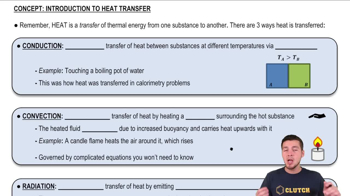
What are the three types of heat transfer?
Conduction, convection, and radiation.
Which best illustrates the way in which radiation transfers thermal energy?
The sun warming the Earth through electromagnetic waves illustrates radiation.
At which location does heat transfer begin as dense material heats up?
Heat transfer begins at the location where the temperature is highest, typically at the source of heat in the dense material.
Which best explains why hands get warm when holding a bowl of hot soup?
Heat is transferred from the hot bowl to the hands by conduction.
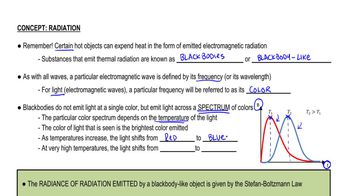
Roasting a marshmallow in the fire is an example of what type of heat transfer?
Radiation.
How does heat get from the filament to the kernel in popcorn?
Heat is transferred by radiation from the filament to the kernel.
Which type of heat transfer can be used to fly?
Convection, as rising hot air can be used for flight in hot air balloons.
What is heat energy indirectly measured by?
Heat energy is indirectly measured by temperature changes.
What type of heat transfer transfers thermal energy in a radiator's hot water to its metal parts?
Conduction.
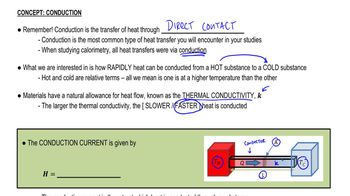
What is conduction?
Conduction is the transfer of heat through direct contact between objects or particles.
How does heat flow?
Heat flows from regions of higher temperature to regions of lower temperature.
Why is heat transfer a nonequilibrium phenomenon?
Heat transfer occurs when there is a temperature difference, meaning the system is not in thermal equilibrium.
What kind of heat transfer occurs when the sun warms the sand?
Radiation.
Which description explains the flow of heat?
Heat flows from a hotter object or region to a colder one until thermal equilibrium is reached.
Which statement best describes conductive heat loss?
Conductive heat loss occurs when heat is transferred through direct contact from a warmer object to a cooler one.
How does heat move when it is conducted between objects?
Heat moves from the object with higher temperature to the object with lower temperature through direct contact.
Which statement best describes conductive heat loss?
Conductive heat loss is the transfer of heat through direct contact from a hot object to a cold one.
What are examples of conduction, convection, and radiation?
Conduction: a metal spoon in hot soup; Convection: boiling water; Radiation: sunlight warming your skin.
Heat transfer between two substances is affected by specific heat and what other factor?
Heat transfer is affected by specific heat and thermal conductivity.
What is the process by which heat moves through air or liquid called?
Convection.
How many different methods of heat transfer are there?
There are three different methods of heat transfer: conduction, convection, and radiation.
Convection occurs when thermal energy is transferred by the movement of what?
Convection occurs when thermal energy is transferred by the movement of fluids (liquids or gases).
What type of thermal energy transfer heats our homes?
Convection, as heated air or water circulates to transfer heat throughout a home.
Which form of heat transfer does not require a medium or physical contact?
Radiation.
What is a convection current in the context of heat transfer?
A convection current is the movement of heated fluid (liquid or gas) caused by temperature differences within the fluid. As a region of the fluid is heated, it becomes less dense and rises due to increased buoyancy, while cooler, denser fluid sinks. This cycle creates a continuous flow that transfers heat indirectly through the movement of the fluid.
How does a convection current transfer heat in fluids?
A convection current transfers heat in fluids by causing the warmer, less dense regions of the fluid to rise and the cooler, denser regions to sink. This movement circulates the fluid, carrying thermal energy from hotter areas to cooler areas, resulting in the indirect transfer of heat through the bulk motion of the fluid.