Which equation expresses the law of conservation of mechanical energy for a system?
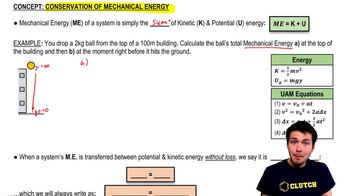
The law of conservation of mechanical energy is expressed as: kinetic energy initial plus potential energy initial equals kinetic energy final plus potential energy final, or symbolically, K_i + U_i = K_f + U_f.
What does it mean if the net external force acting on a system is zero?
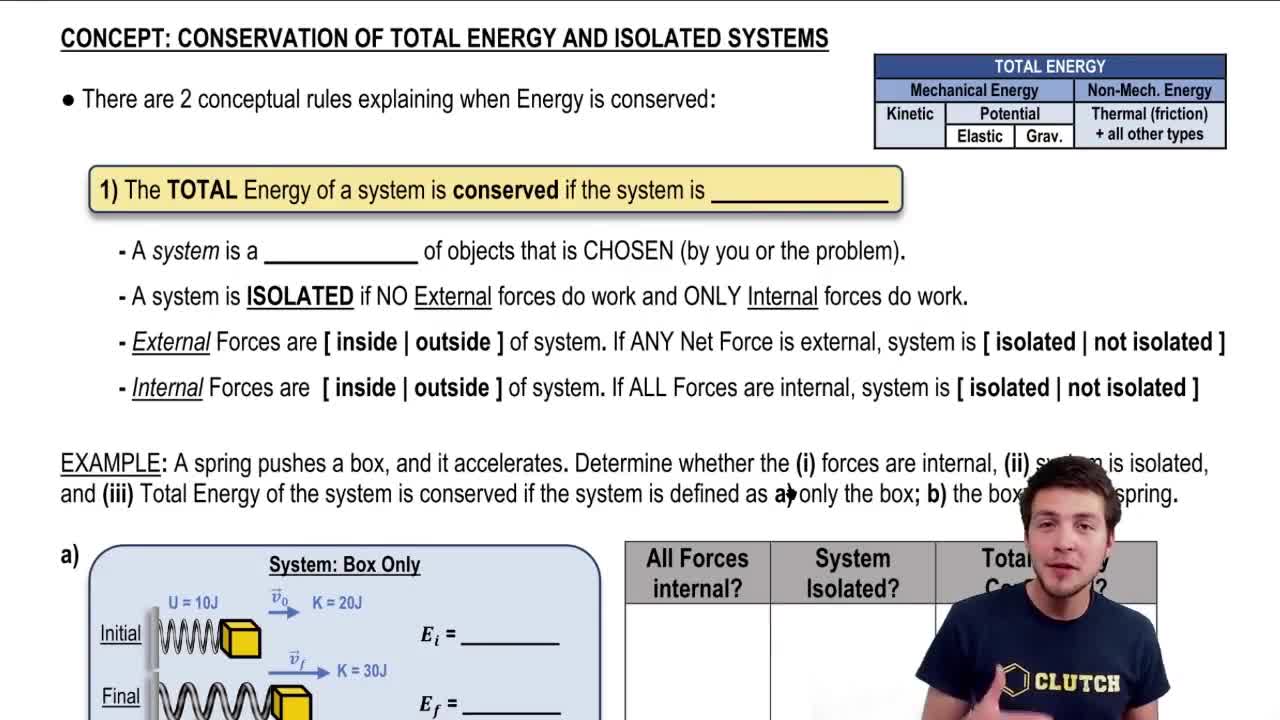
If the net external force acting on a system is zero, the system is isolated, and its total energy is conserved.
Which scenario demonstrates the law of conservation of mechanical energy?
A scenario where a ball falls from a height with no air resistance, converting potential energy to kinetic energy while the total mechanical energy remains constant, demonstrates the law of conservation of mechanical energy.
What does the law of conservation of energy state?
The law of conservation of energy states that the total energy of an isolated system remains constant; energy can be transformed between different forms but cannot be created or destroyed.
What is an example of energy conservation in a mechanical system?
An example of energy conservation is a block falling under gravity without air resistance, where gravitational potential energy is converted to kinetic energy and the total mechanical energy remains constant.
What conditions are required for energy conservation in a system?
Energy conservation requires that the system is isolated, meaning no external forces are doing work, and only internal (conservative) forces act within the system.
How can the law of conservation of energy be stated for mechanical energy?
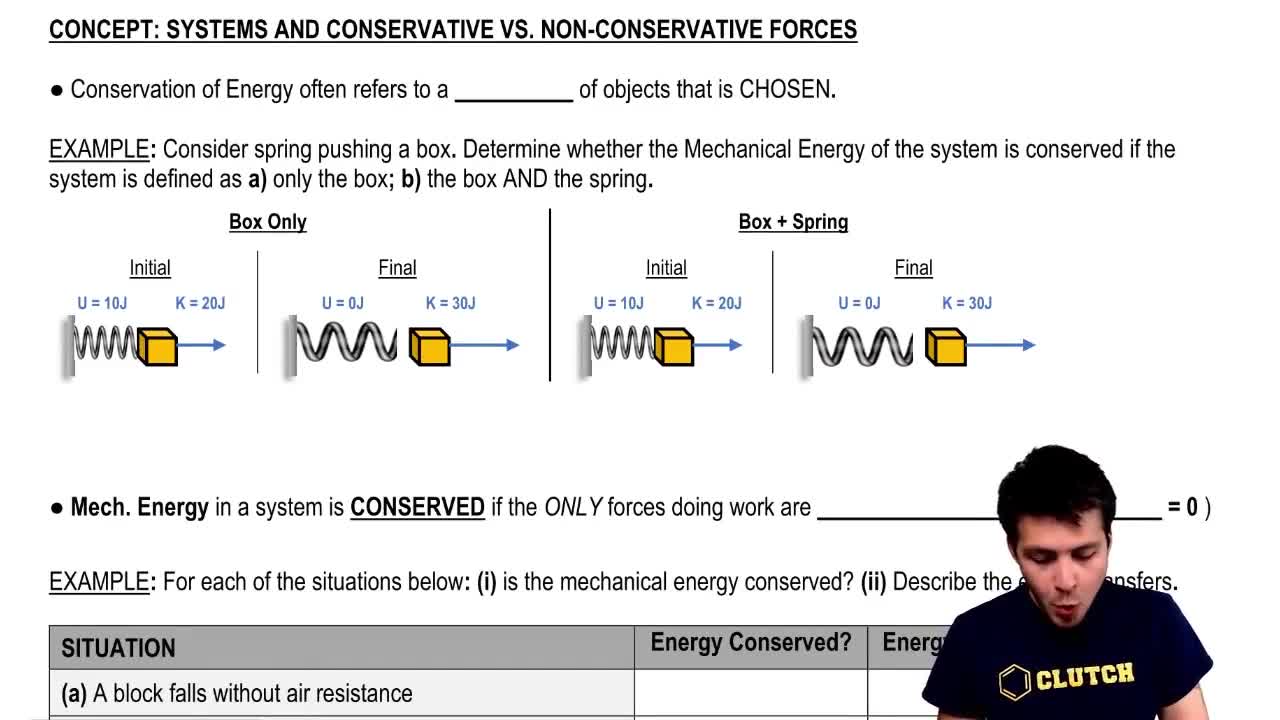
The law of conservation of mechanical energy can be stated as: the sum of kinetic and potential energies in a system remains constant if only conservative forces act, or K_i + U_i = K_f + U_f.
Which situation illustrates conservation of mechanical energy?
A situation where a moving block compresses a spring and then rebounds, with only the spring force acting (a conservative force), illustrates conservation of mechanical energy.
Which statement describes the law of conservation of energy in physics?
The law of conservation of energy in physics states that the total energy in an isolated system remains constant over time, regardless of the processes occurring within the system.
According to the law of conservation of energy, what happens to the total energy in an isolated system?
According to the law of conservation of energy, the total energy in an isolated system remains constant; energy may change forms but is neither created nor destroyed.
Based on the law of conservation of energy, how does energy transform in a system with only conservative forces?
Based on the law of conservation of energy, in a system with only conservative forces, energy transforms between kinetic and potential forms, but the total mechanical energy remains constant.
Which scenario demonstrates conservation of energy in a system?
A scenario where a block falls without air resistance or a block compresses and rebounds from a spring, with only conservative forces acting, demonstrates conservation of energy in a system.
Based on the law of conservation of energy, the sum of potential and kinetic energy in an isolated system is constant. Explain why.
In an isolated system with only conservative forces, the sum of potential and kinetic energy is constant because energy is only transformed between these forms and not lost or gained from external sources.