What is the unit of measurement used for electric current?
The unit of measurement for electric current is the ampere (A), which is equal to one coulomb per second.
How is the current through a battery in a circuit determined?
The current through a battery is determined by the total charge passing through it per unit time, using the formula I = ΔQ / ΔT, where ΔQ is the charge and ΔT is the time interval.
How does the current in a circuit change if the resistance is doubled, assuming constant voltage?
If the resistance in a circuit is doubled and the voltage remains constant, the current is halved according to Ohm's Law (I = V/R).
Why must electric circuits maintain a closed loop for current to flow?
Electric circuits must maintain a closed loop so that charges have a continuous path to flow; without a closed loop, current cannot be sustained.
Which device is commonly used to measure the current in a circuit?
An ammeter is commonly used to measure the current in a circuit.
What is electric current?
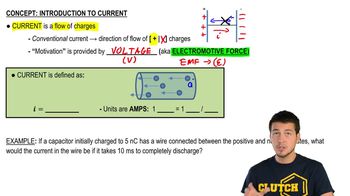
Electric current is the flow of electric charge from one place to another, quantified as the amount of charge passing through a cross-sectional area per unit time.
If a total of 600 coulombs of charge passes through a flashlight in 0.500 hours, what is the average current?
The average current is calculated as I = ΔQ / ΔT = 600 C / (0.500 × 3600 s) = 600 C / 1800 s = 0.33 A.
Which term best describes an electrical current: flow of charge, flow of energy, or flow of voltage?
Electrical current is best described as the flow of charge.
What is the relationship between electric current, charge, and time?
Electric current (I) is equal to the amount of charge (ΔQ) passing through a point divided by the time interval (ΔT): I = ΔQ / ΔT.
If a second wire delivers twice as much charge in half the time compared to a first wire, how does its current compare?
The current in the second wire is four times greater than the first, since I = ΔQ / ΔT and both the numerator is doubled and the denominator is halved.
How is the current through a battery in a circuit affected after a very long time has passed?
After a very long time, the current through the battery reaches a steady-state value determined by the circuit's resistance and voltage, following Ohm's Law.
How does the current in a series circuit change if more resistors are added?
Adding more resistors in series increases the total resistance, which decreases the current if the voltage remains constant.
What type of current does a battery produce?
A battery produces direct current (DC), where the flow of charge is in one direction.
If a wire delivers 12.0 coulombs of charge in 4.0 seconds, what is the current in the wire?
The current is I = ΔQ / ΔT = 12.0 C / 4.0 s = 3.0 A.
Is current measured in volts or amperes?
Current is measured in amperes (A), not volts.
How is the current in a circuit calculated?
Current in a circuit is calculated using I = ΔQ / ΔT, where ΔQ is the charge passing through a point and ΔT is the time interval.
What kind of current runs through the electric wiring in a typical home?
The electric wiring in a typical home carries alternating current (AC).
Which best describes an electrical current: flow of charge, flow of energy, or flow of voltage?
Electrical current is best described as the flow of charge.
What are the units for electric current?
The units for electric current are amperes (A), which are equivalent to coulombs per second.
Is the current in a series circuit the same at all points?
Yes, in a series circuit, the current is the same at all points.
How do you calculate the current flowing in an emf source?
The current flowing in an emf source is calculated using I = ΔQ / ΔT, where ΔQ is the charge passing through the source and ΔT is the time interval.
What is the basic unit of electric current?
The basic unit of electric current is the ampere (A).
What is the definition of electric current?
Electric current is the flow of electric charges from one place to another.
What is the formula for electric current in terms of charge and time?
Electric current (I) is given by I = ΔQ / ΔT, where ΔQ is the amount of charge passing through a cross-sectional area in time ΔT.
What is the conventional direction of electric current?
The conventional direction of electric current is the direction in which positive charges would flow, which is opposite to the actual flow of electrons.
What motivates the movement of electric charges in a circuit?
The movement of electric charges is motivated by a potential difference, also known as voltage or electromotive force (EMF), between two points.
What is the unit of electric current?
The unit of electric current is the ampere (A).
How is current measured with an in-line type meter?
Current is measured with an in-line type meter, such as an ammeter, by connecting the meter in series with the circuit so that the current flows through the meter.
What is the ability of a substance to conduct electrical current called?
The ability of a substance to conduct electrical current is called electrical conductivity.
What is the complete path along which an electric current flows called?
The complete path along which an electric current flows is called an electric circuit.
What is the path called along which electric current moves?
The path along which electric current moves is called a circuit.
What is a common device that uses electric current?
Any device that uses electric current is called an electrical appliance or load.
What are two common sources of electric current?
Two common sources of electric current are generators and batteries.
What creates an electric current in a battery?
An electric current in a battery is created by a potential difference (voltage) between the battery's terminals, which drives the movement of charges.
What is the direct current used in electrotherapy treatments?
The direct current used in electrotherapy treatments is a unidirectional flow of electric charge, typically supplied by a battery or DC power source.
Which device restricts current flow to a single direction?
A device that restricts current flow to a single direction is called a diode.
Which type of circuit prevents the flow of current?
An open circuit prevents the flow of current.
Which gauge of wire will carry the most current?
A wire with a lower gauge number (thicker wire) will carry the most current.
What is the relationship between current, charge, and time?
Current is equal to the amount of charge passing through a point divided by the time interval, expressed as I = ΔQ / ΔT.
What is the unit used to measure the strength of an electric current?
The unit used to measure the strength of an electric current is the ampere (A).
 Back
Back
 05:38
05:38