What are the two main forms of energy discussed in introductory physics?
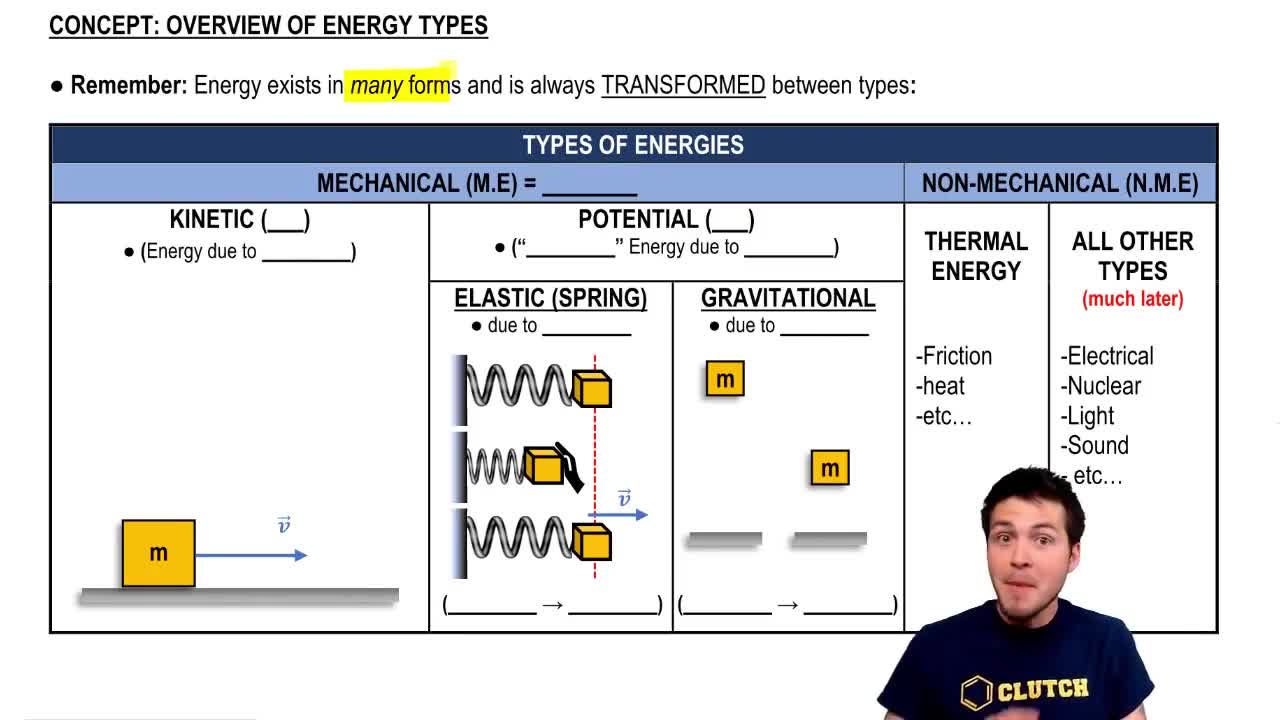
The two main forms of energy are mechanical energy and non-mechanical energy.
How many types of energy are described in the context of mechanical and non-mechanical energy, and what are they?
There are several types of energy described: mechanical energy (which includes kinetic and potential energy, with potential energy further divided into elastic and gravitational), and non-mechanical energy (which includes thermal energy and friction).
What is an example of thermal energy as described in the context of energy types?
An example of thermal energy is the heat generated by friction, such as when you rub your hands together.
What symbol is commonly used to represent kinetic energy in physics equations?
The symbol 'K' is commonly used to represent kinetic energy. It denotes the energy due to an object's motion.
How is elastic potential energy stored in a spring according to the video?
Elastic potential energy is stored in a spring when it is compressed or stretched. This energy is released when the spring returns to its original shape.
What happens to the energy when a box is released from a compressed spring?
When the box is released, the stored elastic potential energy in the spring is converted into kinetic energy of the box. This causes the box to move.
What causes gravitational potential energy to increase for an object?
Gravitational potential energy increases when an object's height above the ground increases. Lifting an object higher stores more energy due to gravity.
How does energy transformation occur when an object falls from a height?
As the object falls, its gravitational potential energy is converted into kinetic energy. The object loses height but gains speed during the fall.
What is a common feature shared by both elastic and gravitational potential energy?
Both elastic and gravitational potential energy involve storing energy due to an object's position. This stored energy can later be transformed into other forms.
What is the main focus of the lesson regarding types of energy?
The lesson mainly focuses on mechanical energies, specifically kinetic and potential energy. It also briefly mentions non-mechanical energies like thermal energy and friction.
Describe the sequence of energy transformations that occurs when gravitational potential energy is converted to kinetic energy and then to electrical current.
Gravitational potential energy, stored due to an object's height, can be transformed into kinetic energy as the object falls and gains speed. This kinetic energy can then be used to drive a generator, which converts the mechanical energy of motion into electrical current, demonstrating the transfer of energy between different forms.
Explain how energy is transformed from chemical energy to thermal energy and then to electrical current.
Chemical energy, stored in substances, can be released through a chemical reaction (such as combustion), producing thermal energy (heat). This thermal energy can be used to generate steam or drive turbines, which then convert the mechanical energy into electrical current, illustrating the transformation of energy from chemical to thermal to electrical forms.
 Back
Back


 03:26
03:26