Skip to main content
Physics with Calculus
My Course
Learn
Exam Prep
AI Tutor
Study Guides
Textbook Solutions
Flashcards
Explore
Try the app
My Course
Learn
Exam Prep
AI Tutor
Study Guides
Textbook Solutions
Flashcards
Explore
Try the app
Back
Intro to Energy & Kinetic Energy quiz #2
You can tap to flip the card.
How does kinetic energy differ from potential energy?
You can tap to flip the card.
👆
How does kinetic energy differ from potential energy?
Kinetic energy is the energy of motion, while potential energy is stored energy due to position.
Track progress
Control buttons has been changed to "navigation" mode.
1/40
Related flashcards
Related practice
Recommended videos
Intro to Energy & Kinetic Energy definitions
Intro to Energy & Kinetic Energy
15 Terms
Intro to Energy & Kinetic Energy quiz #1
Intro to Energy & Kinetic Energy
36 Terms
Intro to Energy & Kinetic Energy quiz #3
Intro to Energy & Kinetic Energy
40 Terms
Intro to Energy & Kinetic Energy
9. Work & Energy
7 problems
Topic
Patrick
Intro to Calculating Work
9. Work & Energy
6 problems
Topic
Patrick
9. Work & Energy - Part 1 of 2
3 topics
8 problems
Chapter
Patrick
9. Work & Energy - Part 2 of 2
5 topics
12 problems
Chapter
David-Paige
Guided course
04:10
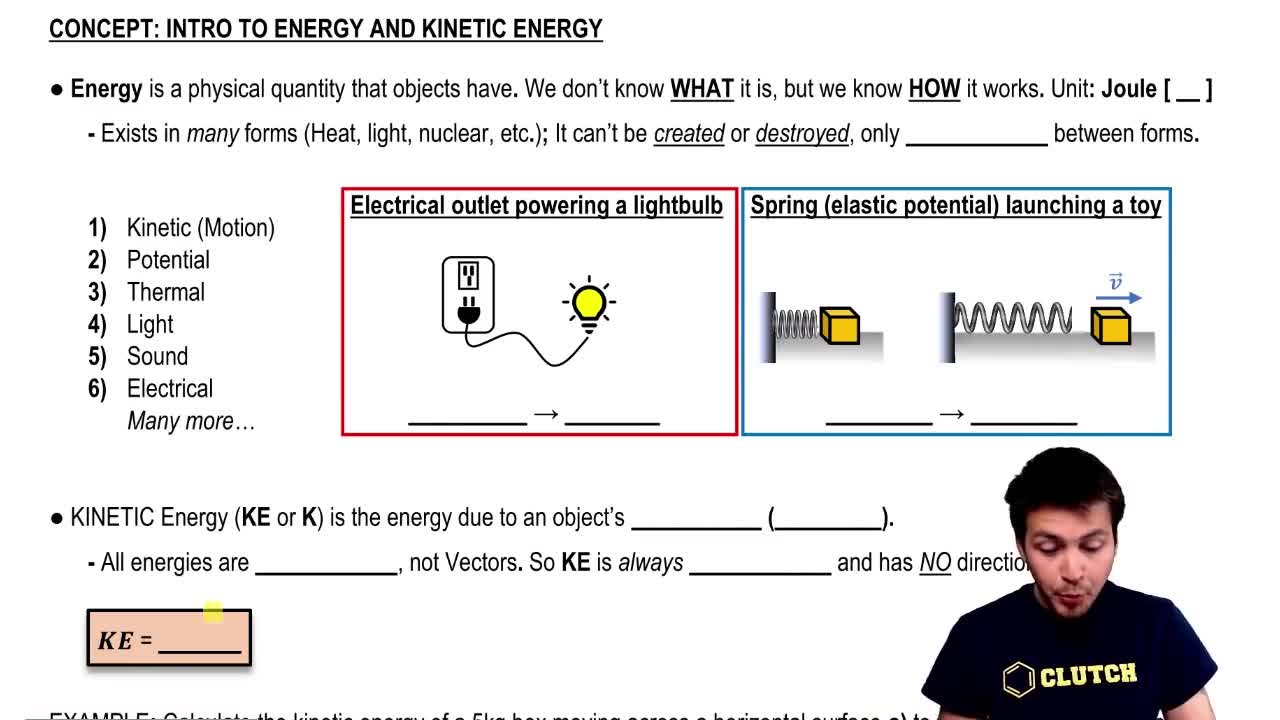
Intro to Energy & Types of Energy
23826
views
590
rank
Terms in this set (40)
Hide definitions
How does kinetic energy differ from potential energy?
Kinetic energy is the energy of motion, while potential energy is stored energy due to position.
What is happening in this photo in terms of kinetic energy and potential energy?
The question is incomplete. Please provide more context or details.
Why are energy carriers thought of as either “full” or “empty”?
Energy carriers like batteries are considered 'full' when charged and 'empty' when discharged.
What is the 10% rule? What is its significance? Why is energy lost?
The 10% rule states that only about 10% of energy is transferred to the next trophic level in an ecosystem, with the rest lost as heat.
Which option defines kinetic energy?
Kinetic energy is the energy an object possesses due to its motion, calculated as KE = 1/2 mv².
Which part of the Earth receives the most annual radiation from the Sun?
The equator receives the most annual solar radiation.
How is energy best described?
Energy is a physical quantity that can exist in various forms and cannot be created or destroyed, only transformed.
What kind of object does not expend energy?
An object at rest in a stable position does not expend energy.
Which best describes energy changes in a system?
Energy changes in a system involve transformations between different forms, such as potential to kinetic energy.
Which is the best example that something has kinetic energy?
A moving car is the best example of an object with kinetic energy.
What type of energy is stored for later use?
Potential energy is stored for later use.
What is an example of a form of kinetic energy?
The energy of a moving car is a form of kinetic energy.
What action requires an input of energy?
Lifting an object against gravity requires an input of energy.
What is kinetic energy? What is potential energy?
Kinetic energy is the energy of motion, while potential energy is stored energy due to position.
What type of energy includes both kinetic and potential energy?
Mechanical energy includes both kinetic and potential energy.
For your experiment in part b,
The question is incomplete. Please provide more context or details.
During which period did energy use increase exponentially?
Energy use increased exponentially during the Industrial Revolution.
Which of these features is true of both solar and wind power?
Both solar and wind power are renewable energy sources.
What type of energy can be stored until it is needed to do work?
Potential energy can be stored until it is needed to do work.
Why do some mountain ranges experience the rain shadow effect?
The rain shadow effect occurs when moist air rises over a mountain, cools, and loses moisture, leaving dry air on the leeward side.
What type of energy can be converted to kinetic energy when it is used to do work?
Potential energy can be converted to kinetic energy when it is used to do work.
What process in stars played a role in the formation of the universe?
Nuclear fusion in stars played a role in the formation of the universe.
When is an object's kinetic energy released?
An object's kinetic energy is released when it is in motion.
Which branch of physical science is most concerned with studying nonliving matter and energy?
Physics is the branch of physical science most concerned with studying nonliving matter and energy.
Is sound energy potential or kinetic?
Sound energy is a form of kinetic energy, as it involves the movement of particles in a medium.
What is the difference between stored energy and usable energy?
Stored energy, like potential energy, is held in readiness, while usable energy, like kinetic energy, is actively doing work.
What is the difference between potential energy and kinetic energy?
Potential energy is stored energy due to an object's position or interactions, while kinetic energy is the energy an object has due to its motion.
What is an example of kinetic energy?
An example of kinetic energy is a moving car.
Which type of object possesses kinetic energy?
Any object that is in motion possesses kinetic energy.
Which statement describes potential energy?
Potential energy is stored energy due to an object's position or the interactions between particles or objects.
How are potential and kinetic energy different?
Potential energy is stored due to position or configuration, while kinetic energy is due to motion.
What are some forms of kinetic energy?
Forms of kinetic energy include translational, rotational, and vibrational kinetic energy.
What is a type of potential energy?
Elastic potential energy, such as energy stored in a compressed spring, is a type of potential energy.
What is an example of kinetic energy?
A moving bicycle is an example of kinetic energy.
What is stored energy due to the interactions between particles or objects called?
Stored energy due to interactions is called potential energy.
What term describes the energy an object has because of its motion?
Kinetic energy describes the energy an object has due to its motion.
What variables determine the amount of kinetic energy an object has?
Kinetic energy depends on the object's mass and speed.
What two factors affect kinetic energy?
Kinetic energy is affected by mass and speed.
What is true regarding potential energy and kinetic energy?
Potential energy is stored due to position, while kinetic energy is due to motion; energy can transform between these forms.
What is the relationship between speed and kinetic energy?
Kinetic energy increases with the square of speed.
 BackBack

 04:10
04:10